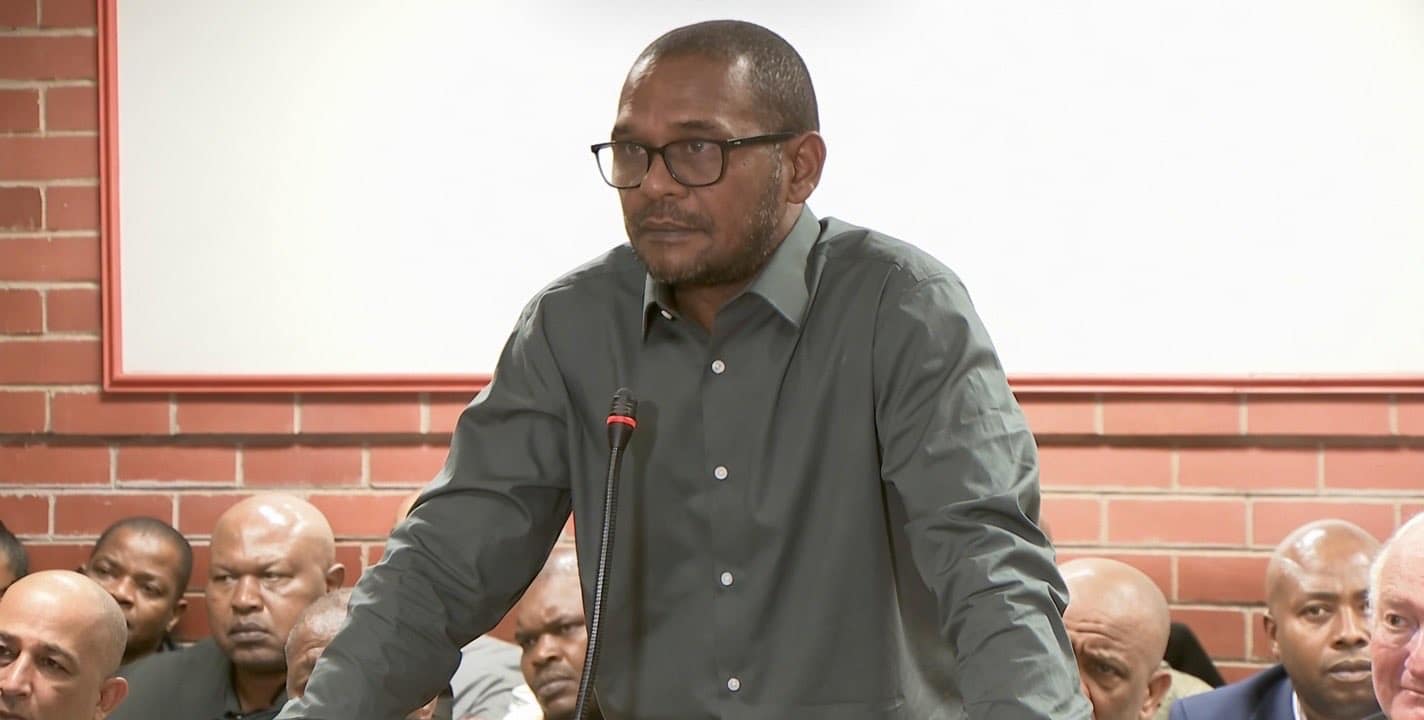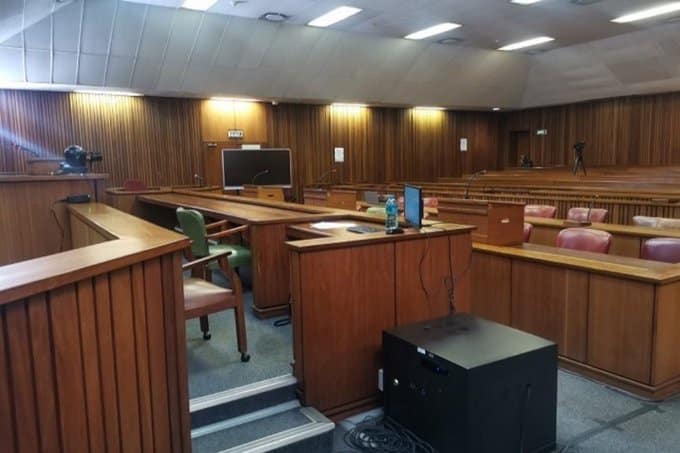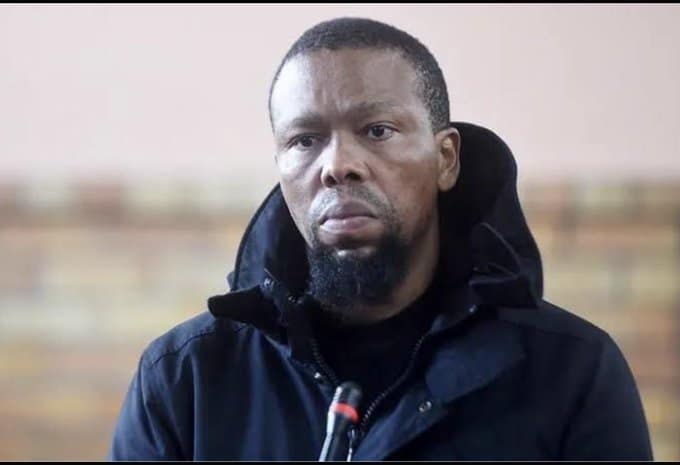
The heavy steel doors of the Brakpan Magistrate’s Court groaned open at exactly 9 AM. Inside, the public gallery was already packed—journalists, legal observers, family members, and activists who had followed the case since the first shots were fired. The air was thick with tension, the kind that precedes a verdict, though no verdict was expected today.
Today was about bail. Freedom. Whether a man who allegedly swore an oath to protect and serve would be allowed to walk the streets while awaiting trial for a crime that has shaken the foundations of South African law enforcement.
Alleged killer cop Matipandile Sotheni, a former detective with the South African Police Service (SAPS), was led into the dock in handcuffs. He wore a dark suit, no tie, and his face was impassive. He did not look at the public gallery. He did not look at the journalists. He stared straight ahead, at the magistrate, at the judge who would decide whether he would spend the coming months in a prison cell or in the comfort of his own home.
Sotheni is accused of the murder of Marius van der Merwe, a whistleblower known before the Madlanga Commission as Witness D. Van der Merwe was gunned down in a hail of bullets outside his home in Boksburg in January 2026, just days before he was scheduled to testify about alleged corruption within the SAPS leadership.
The killing sent shockwaves through the country. A witness killed. A cop accused. A conspiracy alleged. And at the centre of it all, a man who wore a badge and allegedly used it to commit the ultimate betrayal.
“The state will prove that the accused, a sworn officer of the law, conspired to murder a witness who was about to expose corruption at the highest levels of the SAPS,” said the lead prosecutor, Advocate Thabo Mkhabela, addressing the court. “This is not a case of a crime of passion. This is not a case of a robbery gone wrong. This is a case of premeditated murder, carried out by a man who knew exactly what he was doing and why.”
Sotheni’s legal team has denied the allegations, arguing that the state’s case is circumstantial and that their client is being made a scapegoat for a crime he did not commit. “The state has no direct evidence linking my client to the murder,” said defence attorney andries “Andre” van der Merwe (no relation to the victim). “They have no eyewitnesses. They have no forensic evidence. They have no confession. What they have is suspicion, innuendo, and a desperate desire to find someone—anyone—to blame. My client is innocent.”
The court will have to decide.
The Victim: Who Was Marius van der Merwe?
Marius van der Merwe, 54, was a former SAPS colonel who had served for 28 years. He was a decorated officer, with medals for bravery and long service. He was also a whistleblower.
In 2025, van der Merwe approached the Madlanga Commission—the judicial inquiry investigating corruption and maladministration within the SAPS—with explosive allegations. He claimed that senior police officials, including national and provincial commissioners, had been involved in a web of corrupt activities, including:
- The manipulation of tenders for police vehicles and equipment, with contracts awarded to companies owned by friends and relatives of senior officials.
- The protection of high-profile criminals in exchange for bribes, including cash, cars, and properties.
- The intimidation and silencing of whistleblowers who threatened to expose the rot.
- The “disappearance” of evidence in high-profile cases, including those involving politically connected individuals.
Van der Merwe agreed to testify before the commission. He was given the pseudonym “Witness D” to protect his identity. But someone found out who he was.
On the evening of 17 January 2026, van der Merwe was sitting in his car outside his home in Boksburg, waiting for his wife to finish a phone call before they drove to dinner. A car pulled up alongside him. A man got out. According to witnesses, the man approached the driver’s side window, raised a firearm, and fired multiple shots.
Van der Merwe was killed instantly. His wife, who witnessed the shooting from inside the house, collapsed from shock. She was hospitalised for three days.
The killer fled. The car was later found abandoned, burned out, in a nearby township. But the investigation did not end there.
“The murder of a state witness is an attack on the justice system itself,” said President Cyril Ramaphosa at the time. “We will leave no stone unturned in finding those responsible. They will face the full might of the law.”
The Accused: Who Is Matipandile Sotheni?
Matipandile Sotheni, 42, was a detective sergeant stationed at the Boksburg North police station. He had been with the SAPS for 18 years, joining as a constable in 2008 and working his way up through the ranks. He was known as a competent investigator, with a particular skill for tracking down fugitives.
But he was also known for something else: his close relationships with senior officials. According to sources within the SAPS, Sotheni was a “fixer,” someone who could be called upon to resolve “sensitive” matters quietly, without paperwork, without oversight.
“He was the guy you called when you needed something done off the books,” said a former colleague who spoke on condition of anonymity. “Not violent stuff, necessarily. Tracking someone down. Picking someone up. Having a conversation. But if you needed something done quietly, Mati was your man.”
It was this reputation, the state alleges, that led to Sotheni’s involvement in the van der Merwe murder.
The Arrest: How the Alleged Killer Was Caught
The investigation into van der Merwe’s murder was led by a team from the Hawks, the SAPS’s elite investigative unit. The team was led by Brigadier Naledi Mokoena, a veteran investigator with a reputation for integrity.
The break came three weeks after the murder, when a witness came forward. The witness, who cannot be identified for safety reasons, claimed to have seen Sotheni in the area on the night of the murder, driving a car matching the description of the getaway vehicle.
The witness provided cellphone records and photographs that placed Sotheni in the vicinity at the relevant time. The evidence was not conclusive, but it was enough for the Hawks to obtain a warrant for Sotheni’s arrest.
Sotheni was arrested at the Boksburg North police station on 12 February 2026. He was off-duty at the time, sitting in the canteen, drinking coffee. He did not resist. According to officers present, he appeared calm, almost resigned.
“He looked at us and said, ‘I know why you are here,'” said a Hawks officer. “He did not confess. He did not deny. He just said, ‘I know why you are here.'”
In the days following his arrest, the Hawks searched Sotheni’s home and vehicle. They found a pistol that matched the calibre of the weapon used in the murder, though ballistics tests have not yet been completed. They also found cash—R200,000 in an envelope hidden in a ceiling cavity—and a notebook containing the names of several senior police officials, including some who have since been suspended.
“The evidence is mounting,” said Advocate Mkhabela. “We believe that Mr. Sotheni did not act alone. We believe that he was part of a larger conspiracy. The investigation is ongoing.”
The Bail Application: The State’s Case for Denial
Sotheni has been in custody since his arrest in February. His bail application, which began last month, has been delayed by legal maneuvering and the sheer volume of evidence.
Today, the state will argue that bail should be denied on several grounds:
- Flight risk: Sotheni has access to significant cash (the R200,000 found in his ceiling) and has ties to foreign countries, including eSwatini and Mozambique, where he could flee to avoid prosecution.
- Interference with witnesses: Sotheni remains a serving police officer, with access to police databases and resources. He could use these to locate and intimidate witnesses, many of whom are already in fear for their lives.
- The seriousness of the charge: Murder carries a potential life sentence. The state argues that the gravity of the offence, combined with the strength of the evidence, makes Sotheni a prime candidate for remand.
- The public interest: The murder of a state witness strikes at the heart of the criminal justice system. Releasing Sotheni on bail would send a dangerous message that those who silence witnesses can do so with impunity.
“The state will vigorously oppose bail,” said Advocate Mkhabela. “The accused poses a significant risk to the community, to witnesses, and to the integrity of the judicial process. He must remain in custody.”
The Bail Application: The Defence’s Case for Release
Sotheni’s legal team will argue that the state’s case is weak and that their client is entitled to be released pending trial.
“Presumption of innocence is a fundamental right,” said defence attorney van der Merwe. “My client has not been convicted of anything. He is entitled to bail unless the state can prove that he will not stand trial or that he poses a danger to the community. The state cannot prove either.”
The defence will present several arguments:
- No direct evidence: The state has no eyewitnesses, no forensic evidence linking Sotheni to the murder, and no confession. The cellphone data and photographs are circumstantial and can be explained by innocent explanations.
- No flight risk: Sotheni has lived in South Africa his entire life. He has a wife and two children. He has a house. He has a job (suspended, but still employed). He has no incentive to flee.
- No interference with witnesses: Sotheni’s police access has been revoked. He is under 24-hour surveillance by the Hawks. He cannot access police databases or contact witnesses.
- Alternative conditions: Sotheni is willing to surrender his passport, report to the police station daily, and abide by any other conditions the court deems necessary.
“My client is not a monster,” said van der Merwe. “He is a husband, a father, a man who has served his country for 18 years. He deserves his day in court. He deserves to be with his family while he awaits that day.”
The Madlanga Commission Context: A Shadow Over the Case
The van der Merwe murder cannot be separated from the Madlanga Commission. The commission, chaired by retired Constitutional Court Justice Mbuyiseli Madlanga, was established in 2025 to investigate allegations of corruption and maladministration within the SAPS.
Van der Merwe was a key witness. He was scheduled to testify about the alleged involvement of senior officials in corrupt activities. He was killed days before his testimony.
“The murder was designed to silence a witness,” said a source close to the commission. “Whoever killed Marius van der Merwe did not just kill a man. They tried to kill the truth. They tried to derail the commission. They tried to protect themselves.”
The commission has since heard testimony from other witnesses, some of whom have corroborated van der Merwe’s allegations. Several senior officials have been suspended or placed on leave. The commission’s final report is due in December 2026.
Sotheni has not been linked directly to the commission or to any of the officials under investigation. But the state alleges that he was acting on behalf of someone—someone with a deep interest in ensuring that van der Merwe never testified.
“We are investigating that angle,” said Advocate Mkhabela. “We cannot comment further at this stage. But we are looking at everyone. No one is above suspicion.”
The Police Response: A Service in Crisis
The arrest of a serving detective for the murder of a state witness has plunged the SAPS into its deepest crisis in years. The service is already reeling from allegations of corruption, incompetence, and political interference. Now, it faces the prospect that one of its own is accused of the ultimate betrayal.
“We are horrified,” said a senior SAPS official who spoke on condition of anonymity. “Matipandile Sotheni was one of us. He wore the same uniform. He swore the same oath. If he is guilty, he has disgraced the entire service. We will cooperate fully with the investigation. We will root out the rotten apples. But we cannot pretend that this is not a devastating blow.”
The SAPS has suspended Sotheni pending the outcome of the trial. If convicted, he will be dismissed and will forfeit his pension.
The Democratic Alliance (DA) has called for a full-scale parliamentary inquiry into the SAPS’s vetting and oversight processes. “How does a man accused of murder remain a police officer for weeks after his arrest?” asked DA shadow police minister Andrew Whitfield. “How is it that a serving detective can be implicated in a conspiracy to kill a state witness? These are questions that demand answers.”
The ANC has defended the SAPS’s handling of the case, noting that the investigation was conducted by the Hawks, not by Sotheni’s colleagues. “The system worked,” said an ANC spokesperson. “A suspect was identified. A suspect was arrested. A suspect is in custody. That is how justice is supposed to work.”
The Public’s Reaction: Anger and Despair
Outside the Brakpan Magistrate’s Court, a small group of protesters gathered. They held placards reading “No Bail for Killer Cops” and “Justice for Marius.” They chanted slogans and demanded that Sotheni remain in custody.
“My brother was killed by a cop,” said a woman who identified herself only as Thandi. “Not this cop. Another cop. But it is all the same. They think they are above the law. They think they can do anything. We must show them that they cannot. We must show them that we are watching.”
A man who claimed to be a friend of van der Merwe expressed despair. “Marius was a good man,” he said. “He wanted to do the right thing. He wanted to expose the corruption. And they killed him for it. Now his killer is asking for bail. It is a sick joke. It is an insult to Marius’s memory.”
But not everyone was convinced of Sotheni’s guilt. “I know Mati,” said a woman who identified herself as a neighbour. “He is a good man. He is a family man. He would never kill anyone. This is a mistake. They have the wrong person.”
The Van der Merwe Family: Grief and Determination
Marius van der Merwe’s widow, Elsa, has been attending every court hearing. She sits in the front row of the public gallery, her eyes red from crying, her hands clasped in her lap. She does not speak to the media. She does not make statements. She just watches.
“She is a strong woman,” said a family friend. “She is determined to see justice done. She knows that the trial will be painful. She knows that she will have to relive the worst moment of her life. But she will not let that stop her. She will be there. Every day.”
The van der Merwe family has established a trust fund to support Elsa and her two children. Donations have poured in from across the country, from ordinary South Africans who were moved by Marius’s story.
“He died trying to make things better,” said a donor. “The least we can do is take care of his family.”
The Legal Road Ahead: What to Expect
The bail application is expected to last two days. The state will call witnesses, including the Hawks investigator who led the case. The defence will cross-examine. The magistrate will then decide.
If bail is granted, Sotheni will be released, likely with strict conditions. He will return to his family, but he will be under constant surveillance. He will be barred from leaving the country. He will have to report to the police station regularly.
If bail is denied, Sotheni will remain in custody at the Johannesburg Correctional Centre (Sun City), where he will await trial. The trial itself is not expected to begin until late 2026 or early 2027, given the complexity of the case and the volume of evidence.
Either way, the case is far from over.
The Broader Implications: A Test of the System
The Sotheni case is a test of the South African criminal justice system. Can a police officer be convicted of murdering a state witness? Can the system protect its own witnesses? Can justice prevail in the face of corruption and intimidation?
“This is not just about one man,” said Advocate Mkhabela. “This is about the rule of law. If we cannot protect witnesses, if we cannot hold our own accountable, then we have failed as a society. We must succeed. We will succeed.”
The eyes of the nation are on Brakpan. On the magistrate. On the prosecutor. On the defence. And on the man in the dock, the alleged killer cop, who once swore to protect and now stands accused of the ultimate betrayal.
The Final Word: Justice Delayed, Not Denied?
As the court adjourned for lunch, Sotheni was led back to the holding cells. He passed within a metre of Elsa van der Merwe. Their eyes did not meet. She stared straight ahead. He stared at the floor.
The bail application will resume at 2 PM. The magistrate is expected to deliver a ruling by Friday.
Outside, the sun broke through the clouds. The protesters chanted. The journalists filed their stories. The friends and families embraced.
And somewhere in Boksburg, an empty house stood silent, waiting for a man who would never return.
The badge is under blood. The question is whether justice will wash it clean.
The bail application of Matipandile Sotheni continues today at the Brakpan Magistrate’s Court. A ruling is expected on Friday, 25 April 2026. The Madlanga Commission continues its hearings in Pretoria. The van der Merwe family trust can be contacted through the Boksburg police station.
About The Author