It began as a whisper on a WhatsApp group. Then it became a forwarded voice note, crackling with urgency: “My cousin’s friend’s sister was at the border. They are letting Basotho through with just IDs now. No passport. No stamp. Just walk in.”
Within days, the whisper had become a roar. Social media platforms were flooded with memes, videos, and impassioned messages claiming that the South African government had quietly changed its border policies, allowing citizens of Lesotho to enter the country using only their national identity cards—bypassing the passport requirement that has been in place for decades.
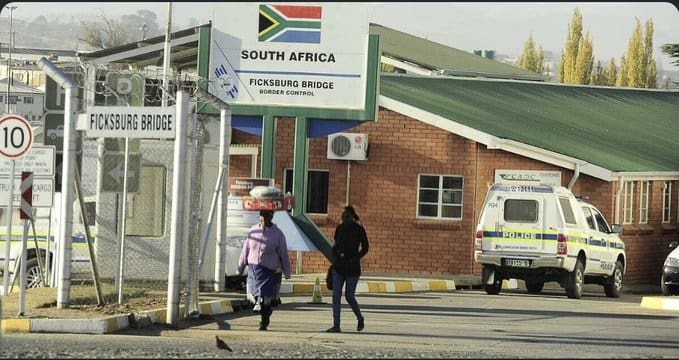
The news spread like wildfire across Lesotho’s mountainous highlands and South Africa’s sprawling townships. In Maseru, queues formed outside passport offices as Basotho citizens demanded refunds for applications they believed were now unnecessary. In Johannesburg, employers worried about verifying the legal status of their Lesotho-born workers. In border towns like Ficksburg and Caledonspoort, taxi drivers reported a surge in foot traffic as people tested the rumoured new rules.
But the news was false. Entirely, demonstrably, dangerously false.
On Wednesday, the South African government issued a firm and unequivocal rebuttal, labelling the claims “fake news” and urging the public to ignore “misleading and malicious” reports. The Department of Home Affairs, the Border Management Authority (BMA), and the Ministry of International Relations and Cooperation issued a joint statement clarifying that all Lesotho citizens entering South Africa must present valid passports—just as they always have.
“There has been no change in policy,” said Home Affairs Minister Dr. Aaron Motsoaledi in a briefing. “There is no special arrangement. There is no pilot project. Lesotho citizens require passports to enter South Africa. That is the law. It has not changed. It will not change without public announcement. Anyone telling you otherwise is spreading false information.”
But the damage had already been done. The rumour, once unleashed, proved difficult to contain. And the questions it raised—about how misinformation spreads, about the vulnerabilities of South Africa’s borders, and about the fragile relationship between two deeply intertwined nations—would not be silenced by a single press release.
The Rumor: Anatomy of a Fake News Firestorm
The false claim appears to have originated on a WhatsApp group in late March 2026. The original message, which has been traced to a user in Maseru, read: “Breaking news! South Africa and Lesotho have signed a new agreement. Basotho can now use IDs to cross into SA. No passport needed. Tell your families.”
The message included no source, no official link, no date, and no name. It was the digital equivalent of a note passed in class. But in the echo chamber of WhatsApp, where trust is often higher than on public platforms, the message was forwarded hundreds of times within hours. Within days, it had reached tens of thousands of recipients.
From WhatsApp, the rumour jumped to Facebook, where it was shared in Lesotho-focused groups with tens of thousands of members. Then to TikTok, where users created dramatic videos “confirming” the news with screenshots of—well, nothing. Then to X (formerly Twitter), where political commentators weighed in without verifying.
“Social media has become the primary source of information for millions of people in southern Africa,” said Dr. Phumzile Ndlovu, a media studies professor at the University of the Witwatersrand. “And the primary characteristic of social media is that speed trumps accuracy. By the time fact-checkers wake up, the rumour has already reached a million people. Correcting it is like trying to put smoke back into a bottle.”
The rumour was likely fueled by a combination of wishful thinking and genuine confusion. Lesotho and South Africa have a unique relationship. The two countries are bound by geography, economics, and culture. Lesotho is a landlocked enclave, entirely surrounded by South African territory. Hundreds of thousands of Basotho work in South Africa, many in the mining, agriculture, and domestic service sectors. The two countries are members of the same customs union (SACU) and the same monetary union (the CMA, which pegs the loti to the rand).
For years, there have been discussions about easing border restrictions between the two countries, including proposals for a “biometric corridor” that would allow frequent travellers to use simplified documentation. But those discussions have not yet resulted in any policy changes. The passport requirement remains firmly in place.
“People heard what they wanted to hear,” said a Home Affairs official who spoke on condition of anonymity. “They wanted cheaper, easier, faster border crossings. And they found a message that told them what they wanted. They did not stop to ask if it was true. That is how fake news works.”
The Government’s Response: A Firm Denial
The joint statement from Home Affairs, the BMA, and DIRCO was unusually forceful, reflecting the government’s frustration with the persistence of the rumour.
“The South African government wishes to categorically deny false and misleading reports circulating on social media platforms and elsewhere that citizens of the Kingdom of Lesotho may now enter South Africa using only their national identity cards,” the statement read. “This information is completely false. There has been no change to the immigration regulations governing entry into South Africa.”
The statement went on to list the valid documents for entry: a valid passport, a valid visa (if required), and in some cases, a passport-only exemption for certain categories of frequent travellers under bilateral agreements—none of which include ID cards.
“The only exception to the passport requirement is for holders of valid Lesotho passports who are also holders of certain permits or visas issued by South Africa,” the statement clarified. “Even in those cases, the passport remains the primary travel document. A national identity card is not a travel document. It cannot be used to cross an international border.”
The government also warned that anyone attempting to enter South Africa without a valid passport would be refused entry, detained, or deported.
“Border Management Authority officials have been instructed to enforce the law strictly,” the statement concluded. “There will be no exceptions. Anyone who has been misled by these false reports is advised to regularise their travel documents before attempting to cross the border.”
The Border Management Authority: On the Front Lines
The Border Management Authority (BMA), established in 2023 to consolidate border control functions previously scattered across multiple departments, has been on high alert since the rumour began circulating. BMA Commissioner Dr. Michael Masiapato confirmed that there had been a noticeable increase in the number of Lesotho citizens presenting ID cards at border posts, only to be turned away.
“In the past two weeks, we have seen a 40% increase in the number of people presenting invalid travel documents at the major border posts with Lesotho,” Masiapato said. “The vast majority are Basotho citizens who genuinely believed that their ID cards were sufficient. They were disappointed. Some were angry. Some accused our officers of lying to them. But the law is the law. We cannot bend it because of a WhatsApp rumour.”
Masiapato expressed concern that the false reports could lead to a humanitarian situation, with people arriving at the border with no other documentation and no means to return home.
“We have had cases where families arrived with children, expecting to cross, only to be told they cannot,” he said. “They had no money for accommodation. No way to contact relatives. We had to work with social services to assist them. That is not our job. Our job is border control. But we are not heartless. We try to help where we can.”
The BMA has since placed additional signage at all border posts with Lesotho, clarifying the documentation requirements. Officers have also been instructed to explain the law patiently, rather than simply rejecting travellers.
“We do not want to punish people who were misled,” Masiapato said. “We want to educate them. But we also need them to understand that ignorance of the law is not an excuse. A passport is required. That is not negotiable.”
The Political Sensitivities: A Delicate Relationship
The false ID rumour touched on a deeply sensitive issue in South Africa-Lesotho relations: immigration, sovereignty, and the perception of open borders.
South Africa is home to an estimated 500,000 to 1 million Lesotho nationals, including documented migrants, undocumented migrants, and dual citizens. The two countries share a 1,100-kilometer border that is largely unfenced and notoriously porous. Illegal crossings are common, particularly in remote mountainous areas where border posts are few and far between.
Some South Africans have expressed concern that Lesotho migrants are “taking jobs” or “straining public services,” though studies have shown that the economic contribution of Basotho workers—particularly in agriculture, mining, and domestic work—is substantial. Others have pointed to the irony of South Africa, a country with high unemployment, hosting hundreds of thousands of foreign workers while its own citizens struggle to find employment.
The false ID rumour played into these fears. Some South African social media users reacted with alarm, claiming that the government had secretly opened the borders to “uncontrolled migration.” Anti-immigrant groups shared the rumour as evidence of a conspiracy to “replace” South African workers with Basotho labour.
“The rumour was a gift to xenophobes,” said immigration lawyer Gary Eisenberg. “It confirmed their worst fears: that the government is secretly letting foreigners in without any controls. Never mind that it was false. Never mind that the government denied it. The damage was done. The narrative was set.”
In Lesotho, the rumour was met with a mix of hope and scepticism. Many Basotho viewed the prospect of ID-only travel as a long-overdue recognition of the special relationship between the two countries.
“We are not foreigners,” said a Lesotho national working in Bloemfontein, who asked not to be named for fear of retaliation. “We are neighbours. We are brothers. We have been coming here for generations. Why do we need a passport to visit our own families? It is insulting. It is expensive. It is a barrier that should not exist.”
Others were more pragmatic. “A passport is a passport,” said a taxi driver in Maseru. “If they say we need it, we need it. I am not going to risk being turned back because of a WhatsApp message. I will keep my passport. I will keep my papers. And I will ignore the rumours.”
The Lesotho Government’s Response: Caution and Clarification
The government of Lesotho has also sought to clarify the situation, warning its citizens not to rely on social media for official information.
“The Kingdom of Lesotho has not entered into any agreement with South Africa to allow ID-only travel,” said Lesotho’s Minister of Home Affairs, Lebohang Hlaele. “We urge our citizens to verify all information through official channels. The passport remains the only valid travel document for crossing into South Africa.”
Hlaele expressed concern that Basotho citizens who attempted to cross without passports could be blacklisted or face legal consequences.
“We do not want to see our people detained, deported, or barred from future entry,” he said. “That would be a tragedy. Please, do not take risks. Get a passport. Follow the law. Protect your future.”
The Lesotho government has also launched its own public awareness campaign, using radio, television, and social media to counter the false rumours. But in a country where internet penetration is low and WhatsApp is the primary means of communication, reaching everyone is a challenge.
“We are doing our best,” Hlaele said. “But the rumour spread faster than we can correct it. That is the nature of misinformation. It is faster than the truth. It always has been.”
The Broader Context: Border Management in Southern Africa
The false ID rumour comes at a time when border management in southern Africa is undergoing significant changes. The African Continental Free Trade Area (AfCFTA) envisions a future of easier movement of goods and people across the continent. The Southern African Development Community (SADC) has long promoted a “SADC passport” that would allow citizens to travel more freely within the region.
But progress has been slow. Only a handful of SADC countries have implemented the SADC passport, and none have fully embraced free movement of people. Concerns about security, migration, and economic competition have kept borders firmly controlled.
South Africa, in particular, has been cautious about easing restrictions. The country already hosts the largest number of migrants on the continent, and the government faces political pressure to tighten, not loosen, border controls.
“We are not ready for open borders,” said a senior official in the Department of Home Affairs. “We cannot even manage our current borders effectively. We have thousands of undocumented migrants. We have corruption at border posts. We have smuggling and human trafficking. Until we get those problems under control, we cannot talk about making it easier to enter. That would be irresponsible.”
The official acknowledged, however, that the current system is flawed. “The passport requirement is necessary, but it is also a burden. For many Basotho, getting a passport is expensive and time-consuming. They have to travel to Maseru. They have to pay fees. They have to wait weeks. That is not fair. But it is the law. And we cannot change the law unilaterally.”
The Human Cost: Stories from the Border
Behind the policy debates and the political posturing are real people, whose lives are disrupted by the false rumours.
Thabiso Mokoena, a 34-year-old construction worker from Maseru, traveled to the Caledonspoort border post last week after hearing the ID rumour from a friend. He brought his Lesotho ID card, a letter from his employer in South Africa, and a bus ticket to Johannesburg. He did not bring his passport, which had expired six months earlier.
“They told me I could not cross,” he said, standing on the Lesotho side of the border, his bag at his feet. “I showed them the message on my phone. They said it was fake. I did not believe them at first. I thought they were lying. But then the supervisor came. He showed me the official statement. He was very kind. But he could not let me through.”
Thabiso had quit his job in Lesotho to take a construction job in Johannesburg. Now, he is stuck. “I called my new boss. He said if I am not there by Monday, the job goes to someone else. I have no passport. I have no money to get a new one. I have nothing. All because of a message on WhatsApp.”
Refiloe Mofokeng, a 22-year-old student, had a different experience. She was planning to visit her sister in Bloemfontein during the university break. She heard the rumour but decided not to risk it. She paid R800 for an emergency passport and crossed without incident.
“I am lucky,” she said. “My mother told me not to believe everything I see on social media. She is old-fashioned. She trusts the government, not the internet. I am glad I listened to her. My friend did not. She is still in Maseru, trying to get her passport sorted.”
The Fight Against Misinformation: What Can Be Done?
The false ID rumour is not the first piece of misinformation to spread across southern Africa, and it will not be the last. Governments, civil society, and tech companies are all grappling with how to combat fake news in an era of instant, unverified communication.
Some have called for stricter regulation of social media, including penalties for spreading false information. Others argue that education and media literacy are the only long-term solutions.
“You cannot arrest your way out of misinformation,” said Dr. Ndlovu, the media studies professor. “You can pass laws, but people will still share false messages. The only real defence is a population that knows how to verify information. That means teaching critical thinking in schools. That means funding fact-checking organisations. That means social media platforms taking responsibility for the content they host. It is a multi-pronged approach. And we are not doing enough of any of it.”
The South African government has pledged to increase its efforts to combat misinformation, including working with WhatsApp and other platforms to label false content. But those efforts are still in their early stages.
“We are fighting an uphill battle,” said a government spokesperson. “But we are not giving up. Every time a rumour spreads, we push back. Every time someone shares false information, we correct it. It is exhausting. But it is necessary. Because the consequences of misinformation can be deadly. In this case, no one died. Next time, someone might.”
The Final Word: A Passport Is a Passport
As the sun set over the Caledonspoort border post on Wednesday evening, a line of travellers waited patiently at the immigration booths. Some held passports. Others held ID cards, hoping for mercy. The officers were firm but polite: “Passport only. No passport, no entry.”
One by one, those without passports turned away, shoulders slumped, phones in hand, scrolling through the same WhatsApp messages that had brought them there. Some cursed the rumour. Some cursed the government. Some cursed themselves for believing.
A young woman, no older than 20, sat on a concrete barrier, crying softly. She had traveled three hours from a village in the Lesotho highlands, convinced by a forwarded voice note that she could cross with her ID. She had no money for the return trip. No phone credit to call her mother. No plan.
A BMA officer approached her, speaking softly in Sesotho. He explained the law. He explained the rumour. He offered her a cup of tea and a seat in the welfare office. She nodded, wiping her eyes.
“I just wanted to see my sister,” she said. “She had a baby. I have not met the baby. I thought this would be easy. I thought they finally made it easy. But they did not. It is still hard. It will always be hard.”
The officer nodded. He had heard similar stories a hundred times. He had no easy answers. He could only enforce the law, explain the rules, and offer tea.
The woman finished her tea, thanked the officer, and walked back toward the Lesotho side of the border, her ID card tucked into her pocket, useless as a travel document, precious only as proof of who she was—and who she could not be, not today, not without a passport.
The rumour would continue to spread. The government would continue to deny it. And at border posts across the country, Basotho citizens would continue to arrive with ID cards in hand, hoping for a miracle that the law could not provide.
A passport is a passport. And a rumour is just a rumour. But when the two meet at a border, the rumour always loses. And the traveller pays the price.
About The Author