The whistle of a diesel locomotive drifted across the Transnet depot in Ladysmith, a sound usually swallowed by the rhythm of shunting engines and the clatter of coupling wagons. But on this particular Tuesday morning, the usual industrial symphony was muted, replaced by a heavy silence thick with unspoken tension. Ndzudzeni Ratshilumela’s keycard no longer worked at the security gate. His workstation sat empty, the clipboard untouched, his high-visibility vest still hanging on its hook.
The previous forty-eight hours had dismantled the life Ratshilumela had carefully constructed. To his colleagues, he was a competent technician who kept the locomotives running. To his 150,000 followers across TikTok and Instagram, he was something else entirely: a content creator with a sharp tongue and a relentless hunger for virality. And it was this second identity, wielded carelessly in the dark of his bedroom, that had now collided catastrophically with the first.
It had started, as these things often do, with a child. The video was only fifteen seconds long. Ratshilumela had filmed his television screen while watching a public awareness segment featuring a young boy with cerebral palsy. The child was attempting to tie his shoelaces, his small fingers struggling against the uncooperative strings. Instead of seeing perseverance, Ratshilumela saw content. He dubbed over the clip with a high-pitched, mocking voice, exaggerating the boy’s movements, turning a moment of determination into a punchline. The caption read: “When the homework is too hard.” It was his most-viewed video that week.
Emboldened by the likes and the comments—some supportive, some cruel, all engagement—he posted again. This time, the subject was a woman in her thirties, navigating a crowded taxi rank on crutches. She had a prosthetic leg and moved with the careful, practiced rhythm of someone who had long ago made peace with her body’s limitations. Ratshilumela zoomed in on her gait, slowed the footage, and set it to a comedic ska track. He captioned it: “Me trying to walk after leg day.” The woman was someone’s mother, someone’s sister, someone’s colleague. To Ratshilumela, she was just another vehicle for views.
The algorithm did its work. The videos spread beyond his usual audience, ripped from his page and shared across WhatsApp groups and community forums. They landed, as poison always does, in the hands of those they were meant to wound. A mother in Soweto watched the clip of the boy and recognized her own son’s struggle. A disability rights advocate in Durban saw the woman on crutches and felt the phantom weight of her own walking stick. The screenshots were taken. The emails were drafted.
By Monday morning, Transnet’s Corporate Communications office had received over two hundred complaints. The subject line was consistent: “Employee Mocks Disabled Persons – Urgent Action Required.” The attached videos carried the metadata linking them to Ratshilumela’s profiles, and a simple LinkedIn search confirmed his employment at the Ladysmith locomotive depot. The company, still recovering from its own recent reputational struggles, acted with uncommon speed.
Within hours, Ratshilumela was summoned from the workshop floor. He walked through the administrative block, past the posters promoting “Diversity and Inclusion: Everyone Counts,” past the framed values statement signed by the CEO. He was met by the depot manager and a representative from Human Capital. They did not ask him to sit down.
“Do you understand the gravity of this?” the manager asked, sliding a printed screenshot across the table. Ratshilumela looked at his own face, frozen mid-laugh, the child’s struggling fingers beside him. He opened his mouth to explain—it was just humor, just a joke, he didn’t mean any harm—but the words dissolved on his tongue.
Transnet’s official statement went live that afternoon. It was brief, clinical, and absolute. “Transnet is aware of the deeply offensive videos posted by an employee. Such behaviour has no place in our organisation. An investigation has been launched immediately.” The statement did not name him, but the internet is a small town. Within an hour, his full name, photograph, and job title were circulating on every platform that had hosted his videos.
The backlash was swift and without mercy. Comment sections became tribunals. “Fire him immediately.” “He should be held accountable, not just transferred.” “My daughter uses crutches. She watched this before school this morning.” Disability organizations issued joint statements condemning the ableism embedded in the content. Parents of children with disabilities shared their own stories, their words carrying the exhaustion of a lifetime spent defending their children’s dignity against a world that too often laughed at instead of with.
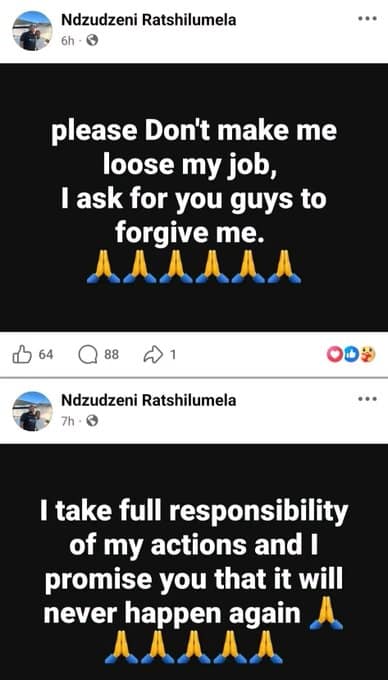
That night, Ratshilumela sat alone in his rented room near the depot. His phone was a hot brick in his hand, each notification another nail. He watched his follower count plummet. He watched old colleagues unfollow him. He watched his apology, hastily typed and trembling with self-preservation, land in a sea of skepticism.
“I sincerely apologize for my posts. I never intended to hurt anyone. I have learned my lesson. Please forgive me.”
The replies were merciless. “You didn’t learn. You got caught.” “The child you mocked is seven years old. He can read now.” “Forgiveness is not yours to demand.”
His apology was not accepted. It was dissected, found hollow, and discarded.
The investigation continues. Transnet has made no further public statement, but internally, the process is methodical. Interviews are being conducted. His employment history is being reviewed. The labour law experts have been consulted. His fate will be determined not by the mob, but by the policies his own actions violated—the same policies that hung framed and ignored outside the room where his career began to unravel.
But the real judgment has already been rendered, and it is not Ratshilumela’s to appeal. It lives in the memory of a mother who had to explain to her son why a stranger found his struggle entertaining. It lives in the woman on crutches, who deleted her social media accounts because she was tired of seeing herself reduced to a joke. It lives in every disabled person who watched the videos and recognized, with sickening familiarity, the shape of contempt disguised as comedy.
The depot in Ladysmith will run without him. The locomotives will shunt, the wagons will couple, the whistle will sound at dawn. But something has shifted in the spaces between the machinery. The silence where Ndzudzeni Ratshilumela once stood is not empty. It is occupied by a question no policy can fully answer: whether an apology made only in the shadow of consequence can ever be more than a transaction, and whether a man who laughed at a child’s struggle can learn, this late, what it truly means to see.
About The Author