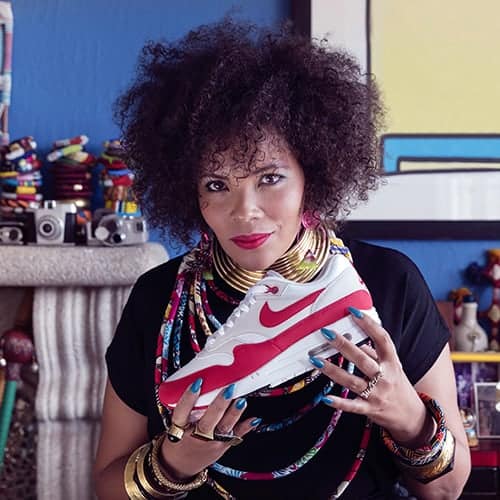
A profound silence has fallen over South Africa’s creative industries tonight following the sudden passing of renowned designer, publicist, and cultural force Maria McCloy, who died at the age of 50 after suffering heart failure at a Johannesburg hospital. The news, confirmed by family representatives earlier this evening, has sent shockwaves through the worlds of fashion, music, art, and entertainment—spheres McCloy helped shape, connect, and elevate for more than two decades.
McCloy, widely regarded as one of the most vibrant and influential figures in the post-apartheid creative renaissance, was admitted to a private hospital in the city earlier this week after complaining of shortness of breath and chest discomfort. Despite the efforts of medical staff, her condition deteriorated rapidly, and she was pronounced dead in the early evening, surrounded by close family members.
“Maria fought with the same grace and ferocity she brought to everything else in her life,” read a brief statement issued by her brother, Sean McCloy, on behalf of the family. “But some battles cannot be won. Our hearts are shattered. We ask for privacy as we grieve this unimaginable loss.”
The cause of death has been listed as heart failure, though family sources indicated that McCloy had been managing underlying health issues quietly for several years, rarely speaking publicly about them. “She didn’t want to be seen as fragile,” said a close friend who requested anonymity. “Maria wanted to be remembered for what she built, not what she fought against privately.”
A Multihyphenate Pioneer
Born in Durban in 1975 to a South African father and Irish mother, Maria McCloy’s life was a tapestry of contradictions she embraced rather than resolved. She studied graphic design at the Durban University of Technology before moving to Johannesburg in the late 1990s, where she quickly became a fixture in the city’s exploding post-isolation cultural scene.
Over the course of her career, McCloy wore—and redefined—numerous hats: fashion designer, publicist, event curator, brand strategist, mentor, and, as many called her, “the connector.” She founded the influential creative agency McCloy + Co. in 2005, which became a launchpad for emerging designers, musicians, and visual artists who would go on to define South African style for a generation.
Her fashion label, Maria McCloy Atelier, which she launched in 2008 and ran in parallel to her PR work, was celebrated for its bold use of African textiles reimagined through a contemporary, almost architectural lens. Her garments adorned the backs of celebrities, politicians, and musicians, including a memorable black-and-gold ensemble worn by Lira at the 2012 Metro FM Awards, widely hailed as one of the most iconic red carpet moments in South African history.
“I remember Maria draping that dress on Lira the night before the awards, no sleep, just pins and fabric and instinct,” recalled stylist and longtime collaborator Bee Diamondhead. “She didn’t sketch. She sculpted. With her hands, with her heart. That dress was not made of cloth. It was made of Maria’s belief in magic.”
A Publicist Who Became Family
Beyond her design work, McCloy’s reputation as a publicist was legendary—not for aggression or spin, but for fierce protection and genuine love. She represented a roster of South Africa’s most beloved musicians, actors, and cultural figures, including Thandiswa Mazwai, Simphiwe Dana, and the late musician and activist Madosini. Her approach was deeply unorthodox: she rarely signed formal contracts, preferring handshake agreements sealed with coffee and conversation.
“Maria didn’t handle your career. She held your hand through your career,” said musician and friend Msaki in an emotional Instagram tribute posted minutes after news of McCloy’s death broke. “She taught me that being an artist is not just about talent. It is about dignity. It is about knowing when to speak and when to listen. I would not be who I am without her wisdom and her warmth.”
Colleagues describe McCloy as both a shark and a soft place to land—fiercely negotiating deals behind closed doors while offering endless cups of rooibos tea and homemade rusks to distressed clients. Her office in Braamfontein, cluttered with fabric swatches, vinyl records, and mismatched vintage furniture, became an unofficial sanctuary for anyone navigating the chaotic waters of South Africa’s entertainment industry.
A Legacy of Lifting Others
McCloy’s sudden death has prompted an outpouring of grief across the creative sector, with tributes pouring in from the highest echelons of government and the smallest independent galleries.
Arts and Culture Minister Zizi Kodwa described her as “a guardian angel of South African creativity” and called for a moment of silence at all state arts events this week. “Maria McCloy understood something that many of us learn too late,” Kodwa said in a statement. “That culture is not an industry. It is a living, breathing, fragile thing. And she protected it with everything she had.”
Perhaps McCloy’s most enduring legacy, however, will be the hundreds of young creatives she mentored without fanfare or expectation of return. She founded an informal, unfunded program she called “The Table”—a weekly gathering at her home where emerging designers, publicists, and artists could pitch ideas, receive honest feedback, and, more often than not, eat a warm meal.
“I arrived at The Table in 2015 with nothing but a sketchbook and five rand in my pocket,” said fashion designer Rich Mnisi. “Maria looked at my drawings for ten minutes, then handed me a list of ten people to call—and told me to mention her name. That list changed my life. Every single person took my call. She had paved the road before I even knew I wanted to walk it. That was Maria. She built bridges and asked for no toll.”
The Shock of Absence
As news of her death spread across social media on Tuesday evening, the hashtags #RIPMariaMcCloy and #HeartOfSACreativity began trending nationally. Fans, fellow designers, musicians, and former clients shared photographs of McCloy in her element: laughing at an afterparty, pinning fabric onto a live model, dancing barefoot at a music festival, or simply sitting quietly with a cigarette and a knowing smile.
Her last public appearance was just three weeks ago, at a small exhibition opening in Maboneng, where she seemed in good spirits but told a friend she had been “feeling tired in a strange way.” That friend, speaking on condition of anonymity, said McCloy had joked about slowing down. “She said, ‘Maybe 50 is the year I finally learn to rest.’ She never got the chance.”
A memorial service is being planned for early next week in Johannesburg, with details to be announced by the family. A separate celebration of her life, described by insiders as “anything but somber,” will take place in Durban later in the month. In lieu of flowers, the family has requested donations to a fund being established in McCloy’s name to support young women entering creative fields—a cause she championed quietly and relentlessly.
The End of an Era
Maria McCloy leaves behind no spouse or children—something she often joked about with self-deprecating humor. “I am married to my work. And my work is a demanding, beautiful, impossible lover,” she said in a rare 2019 interview with Destiny Magazine.
But those who knew her best say she left behind something far larger than a family tree: she left behind a forest of careers she nurtured, a skyline of dreams she helped build, and a blueprint for how to move through the world with integrity, audacity, and tenderness.
“The lights are dimmer tonight,” wrote musician Thandiswa Mazwai in a lengthy tribute shared just after midnight. “Maria was not just a publicist or a designer. She was an energy. A gravity. A reason many of us believed we belonged in rooms that were not built for us. I am not ready to say goodbye. I will never be ready. But I am so grateful that she existed. That she chose us. That she loved us so loudly and so well.”
As the sun rises over Johannesburg on Wednesday morning, the city’s creative heart beats—but with a noticeable, painful irregularity. The world has lost Maria McCloy. And South Africa will feel that absence for years to come.
About The Author