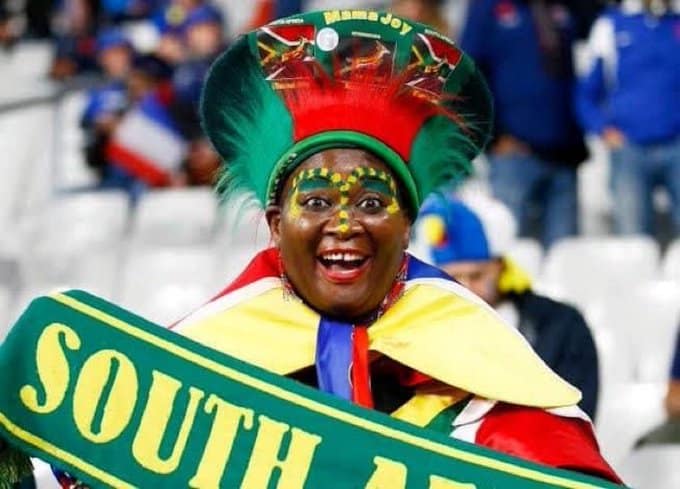
For nearly two decades, Joyce “Mama Joy” Chauke has been more than a spectator. Painted in green and gold, wrapped in the South African flag, and singing through 90 minutes of rain or roar, she has become the human heartbeat of Bafana Bafana. But this week, that heartbeat skipped a furious beat.
The beloved super fan has launched a blistering verbal counterattack against Sports Minister Gayton McKenzie after his department quietly announced it would no longer sponsor fans to attend major international tournaments. The decision, buried in a midweek briefing, has ignited a firestorm among the country’s most loyal supporters—and Mama Joy is leading the charge.
“I have spent my own money, my own tears, my own sweat following this team,” Chauke said in an emotional video posted to social media, her voice trembling then sharpening like a blade. “Now the minister wants to tell me that passion is not enough? That we must sit at home while our boys play for the nation? No, Mr. McKenzie. You are punishing the wrong people.”
The Department of Sport, Arts and Culture confirmed the policy shift earlier this week, citing budget constraints and a need to redirect funds toward grassroots development and athlete preparation. In a statement, McKenzie defended the move, saying, “Taxpayer money cannot be used to send flags and vuvuzelas to foreign stadiums while children in Mamelodi play with deflated balls.”
But for Mama Joy and a growing chorus of super fans—many of whom have become unofficial ambassadors for South African sport—the decision feels like a betrayal. Over the years, the department had covered travel, accommodation, and match tickets for a select group of “fan ambassadors” at events like the Africa Cup of Nations, World Cup qualifiers, and even the Olympics. In return, those fans painted the stands in a kaleidoscope of South African pride, often going viral for their energy and visibility.
“Do they know how many times I’ve been the only South African voice in a stadium of 60,000?” Mama Joy fired back during an interview. “When the team is losing, when morale is down, it is us—the fans—who lift them. You cannot measure that in rands. But you also cannot kill it with a memo.”
McKenzie, never one to shy away from a verbal scrap, responded swiftly. In a radio interview on Thursday morning, he pushed back: “I love Mama Joy. She’s a legend. But legends don’t run on government credit cards. The era of flying people to cheer is over. Let the private sector sponsor them if it’s so important.”
That remark only deepened the rift. Mama Joy, who has worked as a domestic worker and later a small-scale caterer to fund her travels, took the minister’s comment as a personal slight. “Does he think I’m asking for a luxury vacation?” she said. “I sleep in hostels. I eat bread and tea. I do this because I love my country. The minister should come sit next to me in the stands—not in a VIP box—and then tell me I don’t deserve a bus ticket.”
The backlash has been swift and split. Some South Africans applauded McKenzie’s austerity, arguing that the money should indeed go to neglected school sports programs and facilities. Others, however, see the fan sponsorship as a form of soft power—a relatively cheap way to project national pride on an international stage.
“Do you know how many tourists asked me about South Africa because they saw us dancing in the stands at the last Afcon?” asked Thabo “Vuvu King” Ndlovu, another prominent super fan. “That’s free marketing. That’s nation branding. And now they want to kill it for a few million rand? Shortsighted.”
Mama Joy has vowed to continue traveling to support Bafana Bafana—with or without government help. But she’s also calling on corporate South Africa to step in. “Let MTN sponsor us. Let Castle Lager. Let anyone who believes in the spirit of this nation. Because if we wait for the minister, we will be cheering from our living rooms forever.”
As of now, the Department of Sport has not reversed its decision. McKenzie, however, has hinted at a possible compromise: a reduced, merit-based system where only the most impactful fan ambassadors receive partial support. But for Mama Joy, trust has already been fractured.
“You don’t cut the drums out of the march,” she said, adjusting her signature green-and-gold headwrap. “The team needs us. And we need a minister who understands that a nation’s roar doesn’t come from a spreadsheet.”
For now, the battle lines are drawn: one side holding a balance sheet, the other a flag. And in the middle stands Mama Joy—arms crossed, voice loud, and not going anywhere.
About The Author