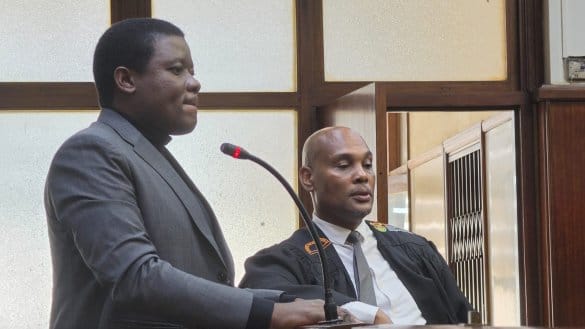
For nearly three years, the legal fraternity in South Africa has watched and waited. The case against Eastern Cape Judge President Selby Mbenenge — one of the most senior judges in the country — has wound its way through tribunals, appeals, and legal technicalities. But on Thursday, the axe finally fell.
The Judicial Service Commission (JSC) has reportedly overturned an earlier tribunal finding of misconduct, upgrading it to gross misconduct in connection with a high-profile sexual harassment complaint brought by his former secretary, Andiswa Mengo. The ruling, which has not yet been formally published but was confirmed by multiple sources familiar with the proceedings, clears the path for Parliament to begin impeachment proceedings against Mbenenge — a process that could see him removed from the bench permanently.
If impeachment proceeds and succeeds, Mbenenge would become one of the most senior judges ever removed from South Africa’s judiciary since the advent of democracy in 1994. The case has become a lightning rod for broader debates about sexual harassment in the legal profession, the accountability of senior judicial officers, and the adequacy of the mechanisms designed to police judicial conduct.
“This is a watershed moment,” said legal activist and women’s rights advocate Thuli Madonsela, the former Public Protector, speaking to reporters outside the JSC’s Johannesburg offices. “For too long, complaints of sexual harassment by judges have been swept under the carpet. The JSC has now sent a clear message: no one is above the law. Not even a Judge President.”
The allegations: A pattern of unwanted advances
The complaint at the heart of the case was filed by Andiswa Mengo, who served as Mbenenge’s secretary at the Makhanda High Court between 2018 and 2021. In her sworn testimony before the Judicial Conduct Tribunal, Mengo alleged that Mbenenge subjected her to a sustained campaign of sexual harassment, including unwanted physical advances, sexually explicit text messages, and requests for sexual favors in exchange for career advancement.
According to Mengo’s testimony, the harassment began shortly after she was assigned to Mbenenge’s office and continued for nearly two years. She alleged that Mbenenge would call her into his chambers after hours, make inappropriate comments about her appearance, and send her WhatsApp messages of a sexual nature. On at least one occasion, she testified, Mbenenge attempted to kiss her and touched her inappropriately.
“I felt trapped,” Mengo said during her testimony, according to transcripts leaked to the media. “He was my boss. He was the Judge President. He controlled my career, my salary, my future. Who could I report him to? Who would believe me against a man of his power?”
Mbenenge has consistently denied all allegations. Through his legal team, he has maintained that his interactions with Mengo were professional and that any messages of a personal nature were taken out of context or fabricated. He has not publicly commented on the JSC’s latest ruling, but his lawyers have indicated that they are considering a legal challenge.
“This is a man of impeccable character who has served the judiciary with distinction for decades,” his lead counsel, advocate Muzi Sikhakhane, said in a statement last year. “These allegations are baseless and are being weaponized to destroy a career. We will fight them at every level.”
The tribunal’s original finding: Misconduct, not gross misconduct
The case first came before a Judicial Conduct Tribunal in 2024. After hearing weeks of testimony from Mengo, Mbenenge, and a series of character witnesses, the tribunal — composed of a retired judge, a legal academic, and a member of the public — issued a finding that Mbenenge had committed misconduct, but not gross misconduct.
The distinction is critical. Misconduct can result in sanctions such as a fine, a reprimand, or a temporary suspension. Gross misconduct, by contrast, is grounds for impeachment — the permanent removal of a judge from office by Parliament, requiring a two-thirds majority vote in the National Assembly.
The tribunal’s original finding was met with outrage from women’s rights groups and legal activists. “How can a Judge President sending sexually explicit messages to his secretary not be gross misconduct?” asked Bontle Mafora, coordinator of the #NotInMyCourt campaign, which has tracked judicial sexual harassment complaints. “The tribunal seemed to be bending over backward to protect a powerful man.”
The JSC, which oversees the conduct of judges, had the authority to accept the tribunal’s finding, reject it, or refer it back. After months of deliberation and closed-door meetings, the JSC has now reportedly exercised its power to overturn the tribunal’s finding, upgrading the conduct to gross misconduct.
“The JSC is not bound by the tribunal’s findings,” explained legal analyst Professor Pierre de Vos of the University of Cape Town. “The commission has its own powers of evaluation and can reach a different conclusion based on the same evidence. In this case, the JSC appears to have concluded that the tribunal underestimated the severity of Mbenenge’s conduct. Sexual harassment by a senior judge against a subordinate employee is, by its very nature, gross misconduct. It goes to the heart of judicial integrity.”
Impeachment: What comes next
The JSC’s ruling is not the final word. Under Section 177 of the Constitution, a judge may be removed from office only if the JSC finds evidence of gross misconduct, incompetence, or incapacity, and if the National Assembly adopts a resolution calling for removal by a two-thirds majority.
The process now moves to Parliament. The JSC will formally submit its finding to the Speaker of the National Assembly, who will refer it to the Portfolio Committee on Justice and Correctional Services. That committee will hold its own hearings, during which Mbenenge will have an opportunity to make representations. The committee will then recommend whether the National Assembly should proceed with an impeachment vote.
If a two-thirds majority of the National Assembly votes in favor of removal, President Cyril Ramaphosa will formally remove Mbenenge from office. He would lose all judicial privileges, including his pension and other benefits.
“This is a high bar, deliberately so,” said legal expert and former parliamentary legal adviser Richard Calland. “The Constitution protects judicial independence by making removal difficult. But it is not impossible. If the evidence is as strong as the JSC believes, Parliament will act. The political will, however, is another question. Mbenenge has powerful allies in the ANC. This will test the party’s commitment to accountability.”
Mbenenge’s defense: A legal fight on multiple fronts
Mbenenge is not without options. His legal team has already signaled that they will challenge the JSC’s ruling on procedural grounds, arguing that the commission overstepped its authority in overturning the tribunal’s finding. A court application is expected within weeks.
“The JSC cannot simply disregard the tribunal’s factual findings unless they are manifestly unreasonable,” Sikhakhane said in a brief statement on Thursday evening. “Our client maintains his innocence. We will be seeking judicial review of this decision.”
If the courts side with Mbenenge, the impeachment process could be delayed for months or even years. If they side with the JSC, the path to Parliament clears.
Mbenenge has also faced separate legal challenges. In 2024, a group of Eastern Cape lawyers filed a complaint with the JSC alleging that Mbenenge had improperly interfered with judicial appointments in the province. That complaint is still under investigation and is not directly related to the Mengo case, but it has added to the pressure on the Judge President.
The Mengo family: ‘Finally, some justice’
For Andiswa Mengo, the JSC’s ruling is the culmination of a four-year ordeal that cost her her job, her mental health, and her sense of safety. She left the Makhanda High Court in 2021 and has not worked in the legal sector since. According to friends, she has struggled with depression and anxiety, and has undergone therapy to process the trauma of the alleged harassment.
Speaking through her lawyer, Mengo said she was “grateful but exhausted.”
“The JSC has done the right thing,” her statement read. “But this was never about revenge. It was about accountability. Judge President Mbenenge abused his power over me for years. He thought he was untouchable. Today, we learned that no one is untouchable. Not even a Judge President. I hope this ruling sends a message to every woman in the legal profession: you do not have to suffer in silence. There is a system. It can work. It worked for me.”
Outside the JSC’s offices, a small group of supporters gathered with placards reading “Believe Survivors” and “Bench Not a Bedroom.” One woman, who identified herself as a magistrate but declined to give her name for fear of reprisal, wiped away tears.
“I know what it is like to be harassed by a senior judge,” she said softly. “I never came forward because I was afraid. Watching this case, I wondered: would anyone believe me? Today, the JSC told me: yes. Yes, we would believe you. That changes everything.”
The broader context: Judicial accountability in South Africa
The Mbenenge case is the highest-profile judicial sexual harassment complaint since the 2021 case of Western Cape Judge President John Hlophe, who faced impeachment proceedings after the JSC found him guilty of gross misconduct for attempting to influence Constitutional Court justices in matters involving former President Jacob Zuma. Hlophe’s impeachment process was delayed for years by legal challenges and political maneuvering. He remains on the bench, though he is currently suspended.
Women’s rights advocates have long argued that the judiciary has a culture of silence around sexual harassment, with victims fearing retaliation and a system that protects its own. A 2022 survey by the South African Women in Law organization found that 43% of female lawyers and court staff had experienced sexual harassment in the workplace, but fewer than 10% had reported it.
“The Mbenenge case is a test,” said Fatima Hassan, director of the Women’s Legal Centre. “If he is impeached, it will signal that the judiciary is finally taking sexual harassment seriously. If he is not — if political interests or legal technicalities save him — it will tell women that nothing has changed. The eyes of the nation are on Parliament now.”
The legacy of Selby Mbenenge
Selby Mbenenge, 61, has had a long and distinguished legal career. He was appointed as a judge in 2008 and became Judge President of the Eastern Cape in 2016 — the first black man to hold that position in a province with deep historical significance in South Africa’s liberation struggle. He has presided over several high-profile cases, including constitutional matters and commercial disputes, and was widely respected among his peers before the allegations emerged.
His supporters describe him as a “gentleman and a scholar” and argue that the sexual harassment allegations are a “smear campaign” orchestrated by enemies within the legal establishment.
“He has given his life to the law,” one colleague, who spoke on condition of anonymity, told a local newspaper. “To see him destroyed like this, over allegations that are disputed and unproven in a criminal court — it is tragic. Whatever happened, does it really warrant the end of a career?”
Critics counter that the standard for judicial misconduct is not criminal conviction but conduct that undermines the integrity of the bench. “We do not need a criminal conviction to know that a Judge President should not be sending sexually explicit texts to his secretary,” said De Vos. “That is common sense. That is the bare minimum we expect from a judge.”
What happens now
The immediate future is uncertain. Mbenenge is expected to challenge the JSC’s ruling in court, potentially delaying any parliamentary action for months. If the courts uphold the JSC’s finding, the Portfolio Committee on Justice will likely hold hearings in late 2026, with a possible impeachment vote in early 2027.
In the meantime, Mbenenge remains the Eastern Cape Judge President, though he has been on voluntary leave since the tribunal’s initial finding in 2024. The Eastern Cape High Court has been operating under an acting Judge President, and legal sources say the uncertainty has taken a toll on morale in the province.
“We need closure,” said an Eastern Cape advocate who regularly appears before the Makhanda High Court. “Either he is guilty, and he should go. Or he is innocent, and he should return. This limbo is good for no one. The JSC has made its decision. Now let the courts and Parliament do their work.”
A message to the judiciary
For all the legal complexity, the Mbenenge case carries a simple, powerful message: sexual harassment by judges will no longer be tolerated. That message has been a long time coming. Whether it will be backed by action — impeachment, removal, accountability — remains to be seen.
But for Andiswa Mengo, sitting in her small flat in Makhanda, watching the news on a crackling television, the JSC’s ruling was already enough.
“I told the truth,” she said in her final statement to the tribunal. “The truth is all I had. It was enough then. It is enough now. Whatever happens next, I am free. He is not. That is justice.”
The Selby Mbenenge case is far from over. But a line has been crossed. A Judge President has been found guilty of gross misconduct for sexual harassment. And for the first time in South Africa’s democratic history, impeachment is not just a theoretical possibility — it is a real and imminent threat.
The bench has been put on notice. The question now is whether Parliament will act.
About The Author