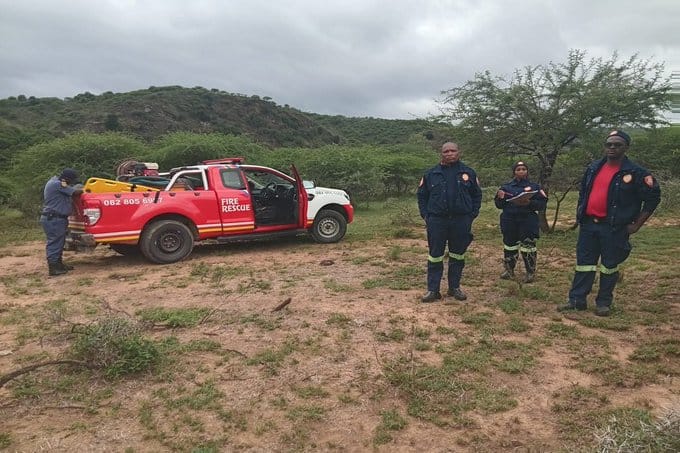
Msinga, KwaZulu-Natal – The rolling hills and valleys of Msinga, a region more accustomed to the harsh dryness of the Thornveld, have been transformed into a landscape of grief and relentless toil. As the sun beats down on the muddy banks of the Tugela River, a somber team of search and rescue divers, police officers, and community volunteers continues its painstaking quest, holding onto a fragile thread of hope that they will recover the body of the last person still missing after the catastrophic floods that ripped through this community on Thursday night.
What began as a heavy downpour, a common occurrence in a summer rainfall region, quickly escalated into a full-blown disaster. A vehicle, attempting to navigate one of the area’s infamous low-lying bridges, was caught in a sudden, ferocious flash flood. The torrent of brown, churning water, swollen by the deluge upstream, swept the car off the crossing as if it were a toy, plunging it into the darkness.
The incident has shattered the close-knit community, leaving families enveloped in a “deep sorrow,” according to local authorities. While several bodies have been recovered in the days since the tragedy, one person remains unaccounted for, their fate a torturous unknown for their loved ones.
“We are hopeful that we will find the last person. Our teams are doing everything they can,” said a spokesperson for the KwaZulu-Natal Department of Cooperative Governance and Traditional Affairs (CoGTA), who is on-site coordinating the response. “The conditions are difficult. The water level, while lower than Thursday night, is still unpredictable, and the mud is thick, but we will not stop until we have brought closure to this family.”
A Community on Edge
The search operation has become the focal point of a community in mourning. On Friday and over the weekend, rescue personnel combed the riverbanks downstream from the bridge, using everything from sophisticated sonar equipment to long poles to probe the murky depths. Local fishermen, who know the river’s temperamental moods better than anyone, have joined the official teams, navigating the treacherous currents in their small boats, driven by a sense of communal duty.
The tragedy has also ignited a painful and familiar debate about the safety of low-lying bridges in rural KwaZulu-Natal. These crossings, essential for connecting remote villages to towns and services, become death traps during heavy rains. Residents have voiced their frustration, recounting numerous near-misses and previous incidents that, they say, were ignored.
“They know this river. They know when it rains upstream, this bridge becomes a monster,” said a grieving relative of one of the victims, speaking on condition of anonymity. “Why is there no barrier? Why are there no warnings? Our people are dying because they have no other way to get home.”
The provincial government has acknowledged these concerns, pledging to conduct a full investigation into the incident and to review the safety protocols at river crossings across the district municipality.
Beyond the Bridge: A Region in Recovery
The search for the final victim is just one part of a much larger recovery picture in Msinga. The heavy rains have caused widespread damage, washing away roads, cutting off access to villages, and damaging homes. Disaster management teams are working to assess the full extent of the infrastructure damage and are providing aid to displaced families.
As the hours tick by, the initial hope of finding a survivor has long since faded, replaced by the grim but necessary task of recovery. For the rescue workers, each day in the mud and sun is a race against time and the elements. For the waiting family, it is an agonizing purgatory.
Authorities have pledged to maintain the search operation until the last missing person is found. Until then, the people of Msinga remain in a state of suspended grief, their hearts with the searchers on the river, hoping for an end to the uncertainty, even if it brings the most heartbreaking of news.
About The Author