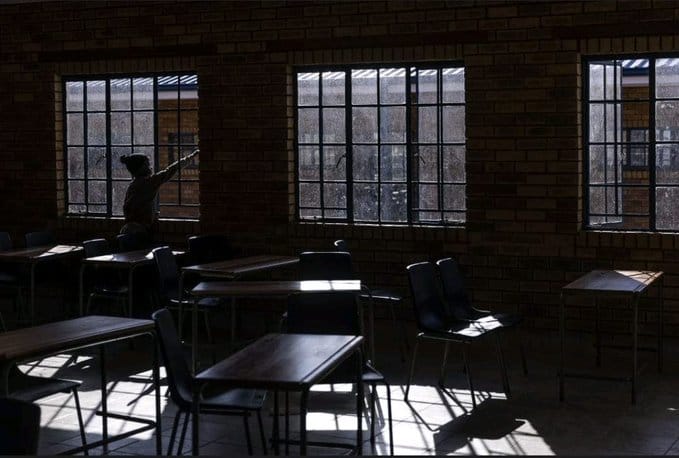
Carletonville – A quiet Wednesday morning at Badirile Secondary School, located in the informal settlement of Khutsong outside Carletonville, descended into chaos and horror when a 17-year-old Grade 10 learner allegedly stabbed a 15-year-old Grade 9 pupil to death, leaving a community shattered and reigniting urgent debates about the crisis of violence in South African schools.
The incident, which occurred during school hours, has resulted in the arrest of the teenage suspect, who is now in police custody facing a charge of murder. The Grade 9 victim, whose name has been withheld pending family notification, was pronounced dead on the scene after sustaining fatal stab wounds.
According to initial reports from the Gauteng Department of Education and police sources, the altercation between the two learners escalated rapidly. While the exact trigger for the dispute remains under investigation, witnesses suggest it may have stemmed from a personal disagreement that spiraled tragically out of control.
A Scene of Panic and Grief
The atmosphere at Badirile Secondary in the hours following the stabbing was one of profound shock and grief. Learners were seen streaming out of the school gates, many in tears, as emergency services and police vehicles descended on the premises. The school, which serves the community of Khutsong, was immediately closed for the day as authorities secured the scene and began their investigation.
“It was chaos. We just heard screaming, and then everyone was running,” recounted one visibly distressed pupil who witnessed the aftermath. “We didn’t know what was happening, only that someone was hurt. Then we saw the blood. We are all scared. This is supposed to be a safe place.”
The Gauteng Department of Education has dispatched a team of psychologists and social workers to the school to provide trauma counseling to learners and staff who witnessed the horrific event. MEC for Education, Matome Chiloane, expressed his deep sorrow and condemned the violence, emphasizing that schools must be sanctuaries of learning, not arenas of conflict.
“This is a devastating blow to the entire school community,” MEC Chiloane said in a statement. “We extend our deepest condolences to the family of the young victim. No parent should ever have to receive the news that their child will not be coming home from school. We are providing all necessary psycho-social support and will cooperate fully with the police investigation.”
The Suspect: A Child in the Eyes of the Law
The alleged perpetrator, a 17-year-old boy, is himself a minor and was taken into custody shortly after the incident. He is expected to appear before the Carletonville Magistrate’s Court soon, where he will face a charge of murder. Due to his age, the proceedings will be handled in a juvenile court, and his identity is protected under child justice laws.
The case throws a harsh spotlight on the intersection of youth, violence, and the criminal justice system. While the state will pursue accountability for the alleged crime, questions are already being asked about what could drive a teenager to such extreme violence within the walls of an educational institution.
A National Crisis of School Violence
The tragedy at Badirile Secondary is not an isolated incident but rather a grim addition to a growing national statistic. South African schools have increasingly become flashpoints for violence, ranging from bullying and assault to the use of weapons and, in the most extreme cases, murder.
Data from the South African Police Service and the Department of Basic Education indicates that incidents of violence, including the carrying of dangerous weapons, are alarmingly common. Factors contributing to this crisis are complex and deeply rooted in broader societal ills:
- Gang Culture: In many communities, including informal settlements like Khutsong, gang influence permeates daily life, and its values of territoriality and violent conflict resolution can seep into the school environment.
- Socio-Economic Stress: High levels of poverty, unemployment, and family instability create stressful home environments. Children often bring this trauma and frustration into the classroom, where it can manifest as aggression.
- Lack of Resources and Support: Many schools, particularly in under-resourced areas, lack adequate security measures, such as metal detectors or security personnel. More critically, there is a severe shortage of school psychologists, social workers, and counselors who can identify at-risk children and intervene before conflicts escalate.
- Weapons in Schools: The easy availability of knives and other weapons in communities makes it all too simple for a heated argument to turn fatal.
Community Outrage and Mourning
In Khutsong, the mood is one of collective grief and simmering anger. Parents are questioning the safety of sending their children to school. Community leaders have called for an urgent meeting with school officials and education authorities to demand concrete action.
“We are burying our children,” said a community activist who spoke on condition of anonymity. “The government talks, but we see no change. Our schools have become dangerous places. We need security, we need searches, we need programs that teach our children to solve problems without a knife.”
As the family of the deceased 15-year-old prepares to lay their child to rest, the broader community is left to grapple with uncomfortable truths. The tragedy at Badirile Secondary is a stark reminder that for many South African children, the journey to school is not just a path to opportunity, but a journey into a space where their very lives may be at risk. The arrest of a 17-year-old boy for murder is a legal conclusion to a human tragedy, but the causes—and the solutions—lie far deeper than any courtroom can reach.
About The Author