In a significant escalation of labour unrest, South Africa’s most powerful trade union federations have forged a rare and formidable alliance, unveiling a sweeping united programme of action to combat the relentless rise in the cost of living. The announcement, made on Friday in Johannesburg, signals a new, aggressive phase of worker militancy, with the country’s largest labour movements vowing to move beyond isolated protests and toward coordinated, disruptive action to force the government’s hand.
For years, South African households have been battered by a perfect storm of economic pressures: record-high fuel prices that spike with global volatility, relentless electricity tariff hikes from the struggling state utility Eskom, soaring food costs that put basic nutrition out of reach for millions, and stubbornly high interest rates that have pushed home loan and credit repayments to breaking points. However, what makes this moment distinct is the unprecedented unity on display.
Leaders from the Congress of South African Trade Unions (COSATU), the South African Federation of Trade Unions (SAFTU), and the Federation of Unions of South Africa (FEDUSA) stood shoulder-to-shoulder at a press conference in Braamfontein, a historic hub of labour activism, to declare that the time for piecemeal negotiations is over.
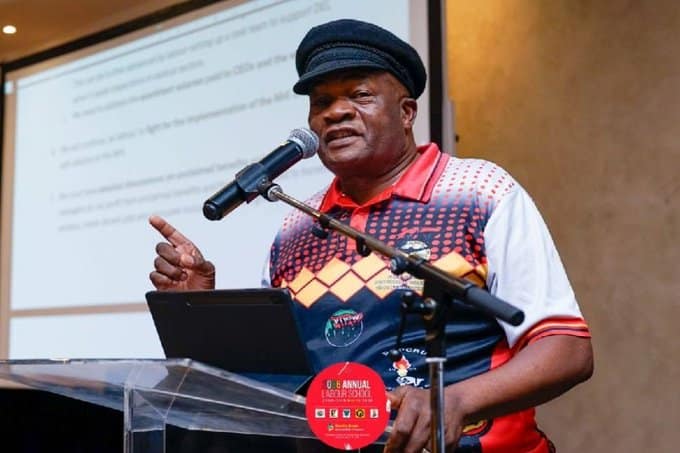
“For too long, workers have been told to wait—wait for the next inflation report, wait for the next interest rate decision, wait for the next election,” said COSATU First Deputy President Mike Shingange, his voice echoing through the packed hall. “While they wait, families are choosing between paying for electricity or putting food on the table. We are done waiting. We are done with the fragmentation of our struggle. Today, we unite to fight for the survival of the working class.”
The newly forged alliance, tentatively dubbed the “United Front for Economic Relief,” has laid out a three-phased programme of action designed to ratchet up pressure on the government of national unity.
Phase One: National Mobilisation and Information Drives
The unions plan to immediately launch a nationwide campaign to educate workers on their rights and organize community-based structures. This phase will involve mass door-to-door campaigns in townships and informal settlements, as well as “teach-ins” at factories, mines, and universities. The goal, according to SAFTU General Secretary Zwelinzima Vavi, is to build a grassroots movement that transcends traditional union membership. “This is not just about union members,” Vavi stated. “This is about the unemployed youth, the informal trader, the pensioner whose grant no longer covers the basics. We are building a mass movement of all those crushed by this economy.”
Phase Two: Coordinated Sectoral Strikes and Provincial Shutdowns
Should their demands not be met, the unions will escalate to a series of rolling, coordinated strikes targeting key economic sectors. Rather than isolated work stoppages, the plan involves a synchronized shutdown of strategic industries—including mining, transport, and municipal services—in a staggered fashion to maximize economic impact while sustaining the movement’s momentum. This phase will also include provincial “shutdowns” in regions like Gauteng, KwaZulu-Natal, and the Western Cape, where workers and community members will march on premier’s offices and key municipal centers.
Phase Three: A Nationwide General Strike
The ultimate threat, held in reserve, is a full-blown national general strike. Union leaders emphasized that this is a last resort but one they are fully prepared to execute if the government fails to deliver on their core demands. Such an action would effectively grind the nation’s economy to a halt, reminiscent of the mass protests that have periodically shaken the country’s political landscape.
The Core Demands
The coalition has distilled its grievances into a concrete list of demands addressed to President Cyril Ramaphosa and his cabinet:
- Immediate Price Controls or Subsidies: The unions are demanding the immediate reintroduction of a basic food basket price cap or, alternatively, a massive expansion of food vouchers for low-income households. They also demand a review of the fuel price formula to remove layers of levies and provide immediate relief at the pump.
- A Moratorium on Electricity Tariff Hikes: With Eskom’s application for another double-digit tariff increase pending before the National Energy Regulator of South Africa (NERSA), the unions are calling for an immediate moratorium on all electricity tariff increases, labeling them a “regressive tax on the poor.”
- A Significant Below-Inflation Interest Rate: The coalition is demanding that the South African Reserve Bank (SARB) lower the repo rate aggressively. While the SARB is constitutionally mandated to focus on inflation targeting, the unions argue that the bank’s primary focus must shift to promoting economic growth and protecting employment.
- An Increase in Social Grants: The alliance is calling for a substantial increase in the Child Support Grant and the Older Persons Grant, arguing that social welfare is a critical buffer against poverty that must keep pace with the cost of living, not lag behind it.
Government and Business Response
The announcement was met with immediate concern from government and business circles. The Ministry of Finance released a brief statement acknowledging the “legitimate hardships” faced by South Africans but warning that the unions’ demands, particularly regarding price controls and interest rates, could have unintended consequences, potentially spooking investors and further destabilizing a fragile economy.
“We understand the frustration, but the solution to high inflation is not to introduce measures that historically have led to shortages or capital flight,” the statement read. “We call on social partners to return to the negotiating table at the National Economic Development and Labour Council (NEDLAC).”
The South African Reserve Bank declined to comment directly on the unions’ demands but reiterated its commitment to its inflation-targeting mandate, which currently aims to steer inflation toward the 3-6% target range.
Meanwhile, business lobby groups, such as Business Unity South Africa (BUSA), expressed alarm at the threat of a general strike, warning that it would further damage an already ailing economy, exacerbate job losses, and undermine the fragile post-election stability.
A Political Tinderbox
The coordinated action presents a major political challenge for President Ramaphosa and the Government of National Unity. While COSATU is a key alliance partner of the ruling African National Congress (ANC), the federation has shown increasing impatience with the party’s neoliberal economic policies. This new alliance with the more militant SAFTU, which broke away from COSATU years ago, signals that COSATU is willing to look outside the Tripartite Alliance to achieve its goals.
Political analyst Professor Susan Booysen noted, “This is a high-stakes game for the ANC. They are facing a labour movement that is not just angry, but united. If the government fails to respond meaningfully, they risk not only a massive economic disruption but also the collapse of their traditional voter base ahead of the next election cycle. The question is whether the state has the fiscal capacity to meet these demands without triggering a fiscal crisis.”
As the sun set over Johannesburg, the message from the labour federations was clear: patience has worn thin. With winter approaching, bringing with it the coldest months and the peak of the festive season planning, the clock is ticking for government to avert what is shaping up to be the most significant wave of industrial action South Africa has seen in a decade. The United Front for Economic Relief has promised that the coming weeks will see the country’s streets filled with the sound of workers demanding not just a living wage, but a liveable life.
About The Author