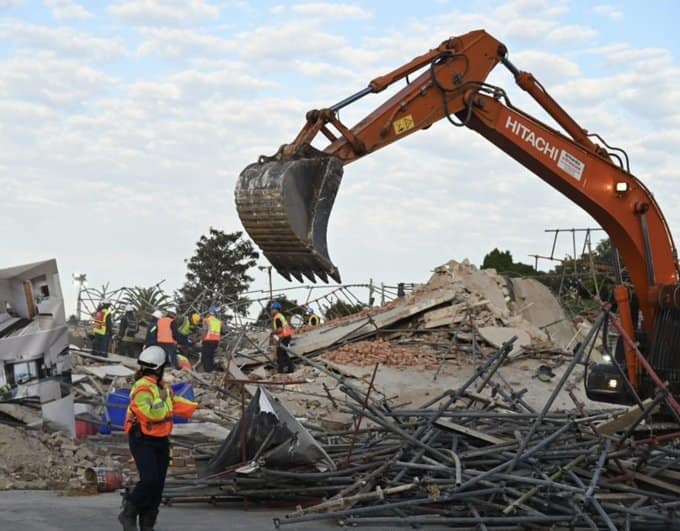
ORMONDE, Johannesburg – As the pale winter sun crept over the horizon on Tuesday morning, painting the smoke-grey sky in hues of amber, the silence of the Johannesburg south suburb was broken by a sound that has become all too familiar in disaster zones: the metallic grind of earthmoving equipment, the urgent bark of commands, and the desperate hope that somewhere beneath the twisted concrete, someone is still alive.
Rescue teams returned to the scene at first light in Ormonde, where a catastrophic building collapse yesterday claimed the lives of six people and left a gaping wound in the earth where a structure once stood. As the second day of the search operation gets underway, the mission has shifted from pure recovery to a desperate race against time to find at least two people still trapped under tons of heavy rubble.
Officials from the City of Johannesburg Emergency Management Services (EMS) confirmed that while the initial rescue efforts yesterday pulled several survivors from the debris, the situation beneath the wreckage remains perilously unclear. At least three other individuals are still unaccounted for, and feared buried in the most inaccessible parts of the collapse.
“We are moving into a critical phase,” said EMS spokesperson Robert Mulaudzi, his voice hoarse from a night of coordination. “We are hoping and praying that those still trapped have found pockets of air. We are working with specialist search and rescue dogs and cutting equipment to try and reach them.”
‘A Sound of Hope’
Throughout the night, rescue workers employed a grim but necessary tactic: total silence. Heavy machinery was paused periodically so that firefighters and urban search and rescue specialists could kneel on the concrete and listen for any sound from below.
It was during one of these eerie silences, just after 4 a.m., that a team near the epicenter of the collapse heard a faint sound that reignited the operation.
“We heard tapping,” said one rescue worker on the scene, his face smeared with dust and sweat. “It’s faint, and we are trying to triangulate where it’s coming from. It could be one of the missing, trying to signal us. It gives us hope that there are still people alive down there.”
The tapping, if confirmed, would suggest that despite spending a cold night entombed in concrete and steel, at least one of the victims has survived. However, the fragility of the debris pile makes the rescue excruciatingly slow. Every piece of concrete removed could destabilize another, potentially crushing the very people they are trying to save.
A Community in Mourning
The area surrounding the collapse site has been transformed into a makeshift command center. Residents of Ormonde have gathered in small, somber clusters, wrapped in blankets against the morning chill, their eyes fixed on the mountain of debris. Some are looking for family members; others have come simply to bear witness.
Yesterday’s initial death toll of six has cast a long shadow over the neighborhood. The victims, believed to be workers who were on site when the structure gave way, have not yet been formally identified, but grief is already palpable among the community.
“These are our neighbors, our brothers,” said a local resident who gave his name only as Thabo. “We stand here helpless. We can only wait and pray that the rescue teams are blessed with a miracle this morning.”
The Mechanism of the Rescue
The operation underway is a delicate ballet of heavy machinery and human precision. Large excavators are being used to remove the biggest slabs of concrete from the periphery, clearing a path for the “swarm” phase of the rescue. Once a potential location of a survivor is identified, the heavy machinery stops, and the hand teams move in.
These teams, often comprising firefighters and paramedics, use small hand tools—jackhammers, concrete saws, and even their bare hands—to carefully chip away at the debris. They are accompanied by sniffer dogs, whose sensitive noses can detect human scent deep within the pile.
City authorities have also deployed structural engineers to the scene. Their job is to assess the stability of the remaining wreckage and the adjacent structures to ensure that the rescue effort does not trigger a secondary collapse.
A Long Road Ahead
As the sun rises higher over Johannesburg, the mood is a tense mix of urgency and caution. The “golden hours” for survival in a structural collapse are finite. While people have been known to survive for days trapped in voids, exposure, dehydration, and crush injuries are relentless enemies.
For the families of the missing, the wait is agonizing. For the rescue teams, the tapping in the early morning dark was a much-needed boost. It served as a reminder that beneath the wreckage of yesterday’s tragedy, the faint pulse of life may still be fighting to survive.
“We will not stop until we have accounted for everyone,” Mulaudzi vowed. “As long as there is a chance, we will be here.”
About The Author