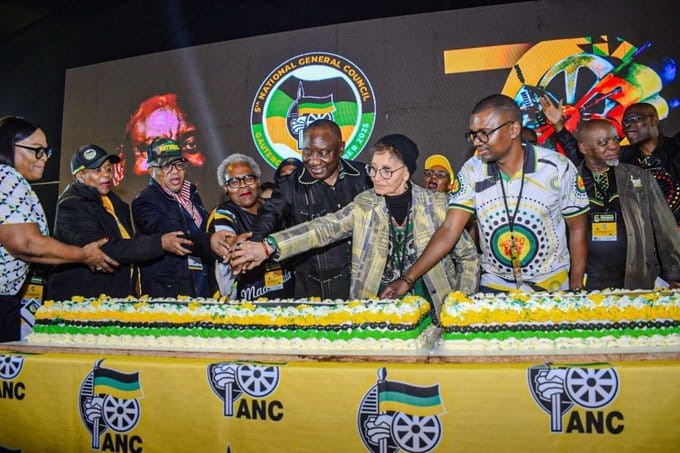
Against a backdrop of escalating global conflicts and intense domestic pressure for political renewal, African National Congress (ANC) President Cyril Ramaphosa reaffirmed South Africa’s foundational diplomatic principle, declaring, “We respect the rights and sovereignty of all nations.” The statement was delivered during a solemn and symbolically charged special gathering at the Birchwood Hotel and OR Tambo Conference Centre on Tuesday, commemorating the 70th anniversary of the Freedom Charter, the seminal 1955 document that served as the moral and ideological blueprint for South Africa’s democracy.
The event, attended by veterans of the liberation struggle, current ANC leadership, diplomats, and civil society representatives, was less a festive celebration and more a reflective convocation aimed at re-anchoring the ruling party to its core values. Ramaphosa’s emphasis on sovereignty and non-interference, repeated throughout his address, was a clear articulation of South Africa’s often-controversial foreign policy stance, which has sought to maintain neutrality in major power conflicts and champion multilateralism. “The Freedom Charter proclaimed that ‘there shall be peace and friendship,'” Ramaphosa stated. “This foundational principle compels us to uphold the United Nations Charter and to respect the right of all peoples to self-determination, to peace, and to development within their own borders.”
The President’s speech meticulously wove together the Charter’s historic domestic promises—”The People Shall Govern,” “All National Groups Shall have Equal Rights,” “The Doors of Learning and Culture Shall be Opened”—with contemporary governance challenges. He framed the current national struggles against corruption, inequality, and unemployment as the ongoing work of fulfilling the Charter’s “visionary clauses,” acknowledging that the journey remained incomplete. “The Charter was not a destination, but a compass,” he told the assembled crowd. “It guides our commitment to redress, to social justice, and to building a South Africa that truly belongs to all who live in it.”
However, the commemorative event also served as an implicit response to growing calls for the ANC’s internal renewal. By returning to the Charter, Ramaphosa sought to reclaim the party’s moral high ground and present a unifying ideological core beyond factional politics. Analysts noted the strategic timing. “Invoking the Freedom Charter is the ANC’s ultimate nostalgia play and its most potent tool for legitimacy,” said political scholar Professor Susan Booysen. “In a period of severe electoral pressure and internal discord, Ramaphosa is reminding both the party and the public of the ANC’s historic raison d’être, attempting to transcend current crises by linking them to a heroic, collective past.”
The ceremony concluded with a ceremonial reading of the Freedom Charter by a multi-generational group, underscoring its enduring relevance. Yet, the subtext of the day was unmistakable: 70 years on, the ANC is engaged in a dual battle—to honour the Charter’s profound legacy in a complex global arena while confronting the urgent task of applying its egalitarian principles to a nation still yearning for their full realisation. The event was a potent reminder that the document, born in the struggle against apartheid, now faces its ultimate test in the struggle for accountable governance and equitable development.
About The Author