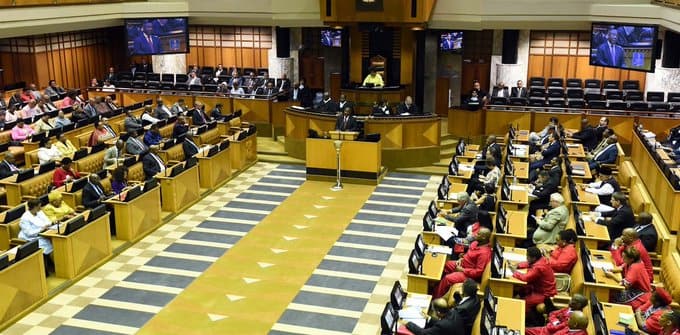
In a sobering and at times tense parliamentary briefing that laid bare the fractures in South Africa’s economic foundations, lawmakers were presented with alarming evidence of rapid deindustrialisation, systemic policy failures, and a looming social crisis driven by vanishing factories and jobs.
The Portfolio Committee on Trade, Industry and Competition heard detailed testimony from economists, industry representatives, and research institutions depicting an economy where grand ambitions are consistently undermined by implementation failures, energy instability, logistical decay, and global competitive pressures.
A Picture of Systemic Decline
The briefing, which stretched for over four hours, moved beyond abstract economic indicators to deliver a human and industrial autopsy. Central to the testimony was data showing a persistent decline in manufacturing’s share of GDP—now hovering around 12%, a multi-decade low—and the steady closure of production lines, particularly in labour-intensive sectors.
“We are not just seeing a cyclical downturn; we are witnessing the unraveling of our industrial base,” stated Dr. Lulama Ntshoe, a senior economist from the Manufacturing Circle. “Facilities that took decades to build are going silent. Each closure creates a ripple effect—from the direct job losses to the small suppliers and service providers who depended on that factory’s ecosystem.”
The Automotive Sector: A Case Study in Precipitous Risk
A significant portion of the alarm focused on the automotive sector, long hailed as a jewel of South Africa’s advanced manufacturing. Committee members were shown maps plotting the locations of component manufacturers that have ceased operations in the past 18 months, primarily in the Eastern Cape and Gauteng.
“The auto masterplan targets are now in serious jeopardy,” warned Justin Barnes, an analyst from Benchmarking and Manufacturing Analysts. “Original Equipment Manufacturers (OEMs) are under global instruction to localise production near key markets. Our persistent load-shedding, port delays, and infrastructure challenges make us a high-risk, high-cost producer. We are losing the race to Eastern Europe, North Africa, and Southeast Asia not on skill, but on reliability.”
Where Policy Has “Stalled and Stumbled”
Perhaps the most pointed criticism was reserved for the gap between policy design and execution. Experts cited the Steel Master Plan, the Poultry Master Plan, and the Green Hydrogen ambitions as examples of well-intentioned frameworks that are failing to translate into ground-level investment and job creation at the required scale.
“The plans are on paper, but the enabling conditions are absent,” said Priya Dhevar, a policy researcher. “Local procurement directives are ignored by state entities. Critical reforms to unlock private investment in energy are bogged down in bureaucracy. We have a ‘paradox of planning’—more strategies, less tangible output.”
Committee members, across party lines, expressed frustration. ANC MP Sifiso Mbatha questioned whether there was “coordination or cacophony” within government, while DA representative Dean Macpherson stated, “We are expertly diagnosing the patient’s illness while the patient is walking out the door.”
A Call for Urgency and Coherent Action
The briefing concluded not just with warnings, but with a set of urgent, if daunting, recommendations:
- An immediate, cross-departmental crisis response coordinating Trade and Industry, Electricity, Transport, and National Treasury to address energy, rail, and port dysfunction as an existential threat.
- A ruthless review of existing masterplans, moving from broad targets to specific, accountable interventions with clear timelines.
- Leveraging the African Continental Free Trade Area (AfCFTA) more aggressively to secure regional market demand for South African manufactured goods.
- A targeted support fund to prevent the closure of strategically important, medium-sized firms that form the backbone of industrial supply chains.
In his closing remarks, the committee chairperson, Mr. Duma Nkosi, acknowledged the gravity of the testimony. “The voices we have heard today are not crying wolf. They are sounding a national alarm,” he said. “We will be compiling these findings into a report with urgent recommendations for the Minister. The cost of inaction is measured in closed factories, destitute families, and a diminished future. The time for tinkering at the edges is over.”
The session ended with a palpable sense that the committee had been handed not just a report, but a responsibility—to turn stark warnings into a catalyst for actionable change, before South Africa’s industrial heartbeat grows dangerously faint.
About The Author