The phone calls always come at night. A mother in Lagos is asking if her son is still breathing. A wife in Benin City is pleading for her husband to stay indoors. A cousin in Abuja is forwarding yet another WhatsApp video of a shop being looted, a foreign-owned spaza shop reduced to splinters and ash. For the more than 130 Nigerian nationals who have now formally asked their government to fly them home, the decision was not reached in a boardroom or an embassy briefing room. It was reached in the dark, behind locked gates, with suitcases half-packed and children asking when the burning will stop.
As anti-immigrant protests sweep through South Africa’s major cities—Johannesburg, Pretoria, Durban, and parts of the Cape—a quiet exodus has begun. The 130-plus applicants are the first cohort under a new voluntary repatriation programme launched by the Nigerian government, designed to offer a dignified escape for its citizens who no longer feel safe in a country many once called their second home. Nigerian Foreign Minister Bianca Odumegwu-Ojukwu confirmed the figure during a press briefing in Abuja on Wednesday, adding that the number is expected to grow “significantly” in the coming days as more Nigerians register their intent to leave.
“We cannot ignore the fear in the voices of our people,” Odumegwu-Ojukwu said, her tone measured but firm. “The South African government has a duty to protect all residents, regardless of nationality. But while we engage diplomatically, we must also provide an escape route for those who no longer wish to wait for safety that may never come.”
The Protests and the Panic
The current wave of anti-foreigner sentiment did not emerge from a vacuum. For weeks, social media has been flooded with incendiary rhetoric blaming immigrants—particularly Nigerians, Zimbabweans, and Pakistanis—for South Africa’s stubbornly high unemployment rate, the proliferation of counterfeit goods, and, most recently, a spate of food poisoning incidents linked to unregulated spaza shops. Despite repeated statements from police and health authorities that no evidence points to a coordinated foreign conspiracy, the allegations have taken on a life of their own.
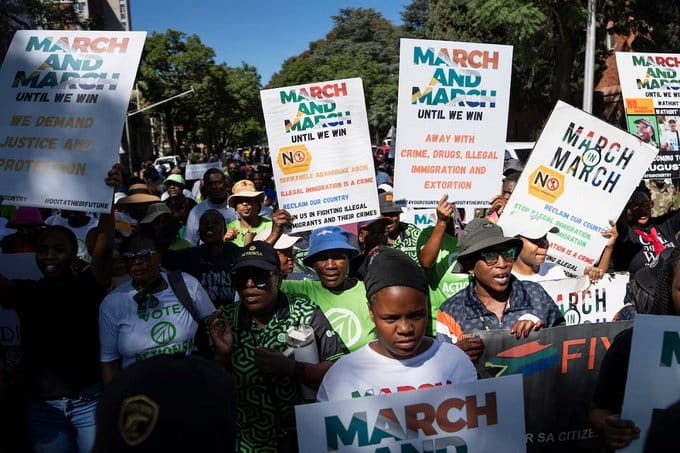
Operation Dudula, the controversial anti-immigrant movement, has led marches through the streets of Soweto and Alexandra, carrying placards reading “We Are Dying in Our Own Land” and “Foreign Criminals Go Home.” While most protests have remained peaceful, isolated incidents of looting and property damage have been reported, and at least three Nigerian-owned shops in the Johannesburg CBD were firebombed in the past fortnight. No deaths have been recorded this cycle, but the memory of the 2019 xenophobic attacks—which left over a dozen people dead, including two Nigerians—hangs like a specter over every conversation.
For the Nigerian community, estimated to number between 30,000 and 50,000 across South Africa, the psychological toll has been crushing. Many are successful small business owners, academics, or skilled professionals who have lived in the country for over a decade. Some hold valid work permits and permanent residency. But to the angry crowds circling their neighborhoods, they remain outsiders.
One Man’s Story
Chidi Okonkwo, a 42-year-old electronics trader who has lived in Johannesburg since 2008, was among the first to apply for repatriation. He spoke to this reporter from a locked storage unit in the city’s outer suburbs, where he has been sleeping for four nights after his shop in Jeppestown was ransacked.
“They came on a Tuesday afternoon. About 30 men, young, with their faces covered. They didn’t shout slogans. They just smashed and took,” Okonkwo said, his voice cracking. “I called the police. They came three hours later. By then, everything was gone. Three years of work. Rent I owe. My son’s school fees for next term. All gone.”
Okonkwo said he never imagined leaving South Africa. He arrived as a young man chasing a dream of independence. He learned to speak Zulu. He employed three South Africans. He paid his taxes. But after the attack, he lay awake in the storage unit and made a calculation: rebuild again, as he did after 2019, or go home before his luck runs out.
“My mother is 70. She prays for me every night. I cannot make her bury me in a country that does not want me,” he said. “The Nigerian government is offering a way out. I am taking it.”
Diplomatic Strains and a Strained Relationship
The repatriation request lands at a delicate moment in Nigeria-South Africa relations. The two nations are Africa’s largest economies, often jostling for continental leadership. While their governments maintain official ties—cooperating on trade, peacekeeping, and African Union matters—public sentiment on both sides has soured in recent years. Nigerian musicians and actors are wildly popular in South Africa, and vice versa, but the political rhetoric has grown sharper.
President Cyril Ramaphosa’s administration has condemned the anti-immigrant protests, with Police Minister Bheki Cele promising “visible policing” in hotspots. However, critics argue that the government has been slow to prosecute perpetrators of xenophobic violence, and that statements of condemnation are not translating into protection on the ground.
The Nigerian High Commission in Pretoria has been overwhelmed with calls from distressed citizens. A source inside the commission, speaking anonymously due to lack of authorization, told reporters that the repatriation list grew from 50 names to 130 in just 48 hours after videos of burning shops began circulating on Nigerian WhatsApp groups.
“We are organizing flights, but it is a logistical challenge,” the source said. “Some of these people have entire families here. Children born in South Africa who have never seen Nigeria. Spouses who are South African. Leaving is not simple. But staying feels impossible.”
What Comes Next?
The voluntary repatriation programme is exactly that—voluntary. The Nigerian government has made clear it does not intend to force an evacuation, nor does it wish to sever economic or cultural ties with South Africa. But the very existence of the programme is a diplomatic rebuke. It signals that Abuja believes the situation is serious enough to warrant state-sponsored flights, a measure typically reserved for war zones or natural disasters.
For those who stay, the calculus is different. The Nigerian Community Association in South Africa has urged calm and cautioned against mass departure, arguing that leaving hands a propaganda victory to xenophobic elements. “We have fought for our place here,” said association secretary Emmanuel Uche. “If we all run, we tell them they were right. We belong.”
But on the streets of the Johannesburg CBD, where foreign-owned shops have pulled down their metal shutters during daylight hours for the first time since the pandemic, the argument for resilience grows thinner by the day.
As dusk fell over the city, another name was added to the repatriation list: a 29-year-old hairdresser from Enugu, robbed at knifepoint three days ago. She wrote her name in shaky handwriting on a form at the Nigerian High Commission. Then she sat down on the curb and cried, not from relief, but from the weight of starting over—again.
The flight home has not yet been scheduled. But for 130 Nigerians, and counting, the journey has already begun.
About The Author