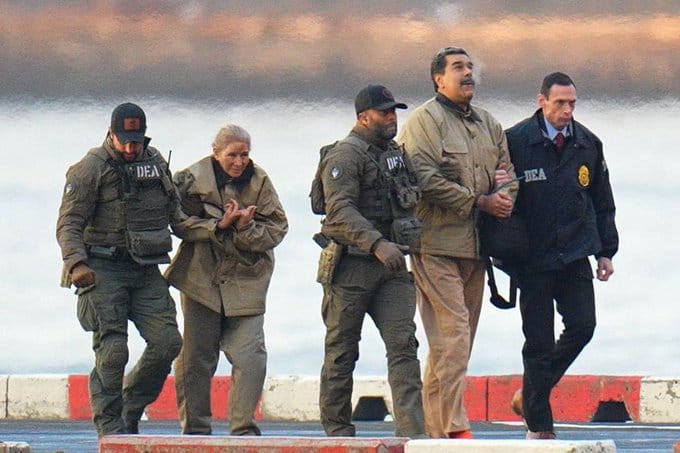
For just over one hour on Thursday, the weight of the United States justice system pressed down on the former first couple of Venezuela in a hushed federal courtroom in Manhattan. Nicolás Maduro, the embattled former president, and his wife, Cilia Flores, once the most powerful political duo in Caracas, sat side by side at the defense table as a federal judge delivered a decisive blow to their legal strategy: the sweeping drug trafficking and narco-terrorism charges against them would stand.
The brief but consequential hearing at the Daniel Patrick Moynihan Federal Courthouse marked the second pre-trial appearance for the couple since their dramatic extradition to the United States last year. And while the proceedings lasted barely sixty minutes, the implications rippled far beyond the mahogany-paneled courtroom, sending a stark message that the long arm of American justice intended to hold the former leaders accountable for crimes the prosecution alleges destabilized a continent and poisoned American communities.
As the couple was led into the courtroom by federal marshals, the atmosphere was electric with the kind of tension reserved for proceedings that carry the weight of history. Maduro, dressed in a standard-issue beige prison jumpsuit, appeared composed but weary, his eyes scanning the gallery where journalists and a handful of diplomatic observers sat in silent observation. Flores, wearing a matching jumpsuit, sat ramrod straight beside her husband, her expression unreadable. The couple, who ruled Venezuela with an iron grip for over a decade, now found themselves subject to the rhythms and rules of a system they had long vilified as imperialist.
The Motion to Dismiss: A Failed Gambit
The core of Thursday’s hearing was the defense’s sweeping motion to dismiss the indictment. Maduro’s legal team, led by high-profile New York defense attorney Marcos Jiménez, had argued that the charges—which include narco-terrorism, money laundering, and conspiracy to distribute cocaine—were politically motivated, lacked jurisdictional basis, and violated the principles of sovereign immunity.
In a tightly worded ruling delivered from the bench, Judge Alvin K. Hellerstein, a veteran jurist known for handling complex international cases, rejected each argument in turn.
“The Court finds that the indictment alleges with sufficient specificity a conspiracy that directly targeted the United States,” Judge Hellerstein said, his voice carrying across the silent courtroom. “The defendants are charged with utilizing the apparatus of the Venezuelan state to flood American streets with cocaine, knowing full well the devastation such activity would cause. These are not political questions. These are criminal allegations of the most serious order.”
The judge also dismissed the sovereign immunity argument, noting that the charges against Maduro and Flores pertain to conduct that falls outside the scope of official state functions under both U.S. and international law. “There is no sovereign immunity for narco-terrorism,” Hellerstein stated flatly.
For the prosecution, led by Assistant U.S. Attorney Matthew Laroche of the Southern District of New York’s elite narcotics unit, the ruling was a vindication of a case that had been years in the making.
“The evidence will show that Nicolás Maduro and Cilia Flores transformed Venezuela into a narco-state,” Laroche told reporters briefly outside the courthouse after the hearing. “They presided over a conspiracy that trafficked tons of cocaine, armed terrorist organizations, and enriched themselves while the Venezuelan people suffered. Today, the court affirmed that they will face justice for those crimes.”
The Charges: A Narco-State Unveiled
The indictment against Maduro and Flores, first unsealed in 2020 when the U.S. State Department offered a $15 million reward for information leading to Maduro’s arrest, reads like a geopolitical thriller. According to prosecutors, Maduro, Flores, and a cadre of high-ranking Venezuelan military and political officials orchestrated a sprawling drug trafficking conspiracy that leveraged the country’s state institutions to facilitate the shipment of hundreds of tons of cocaine from Colombia and Venezuela to the United States and Europe.
The so-called “Cartel of the Suns”—a reference to the stars worn by high-ranking Venezuelan military officials—allegedly controlled drug routes, provided protection for shipments, and laundered billions of dollars through a web of shell companies and front businesses. Prosecutors allege that Flores, who served in various high-level political roles during her husband’s presidency, played a key role in managing the financial architecture of the conspiracy.
“This was not a rogue operation,” the indictment states. “It was state policy. The defendants used the full power of the Venezuelan government—its military, its intelligence services, its ports, and its diplomatic missions—to build and protect a drug trafficking empire.”
For years, the charges existed largely in the realm of diplomatic rhetoric, with the Trump and Biden administrations using them to justify sanctions and political pressure against the Maduro regime. But the extradition of the former leaders last year, following a negotiated surrender after Maduro’s ouster in the wake of Venezuela’s political collapse, transformed the indictment from a symbolic statement into a living legal proceeding.
The Defense: A Political Prosecution
Maduro’s legal team has consistently maintained that the charges are a politically motivated attempt to criminalize what they characterize as the legitimate governance of a sovereign nation. In their motion to dismiss, they argued that Maduro and Flores were being targeted not for criminal conduct but for their political opposition to U.S. foreign policy in Latin America.
Speaking to reporters after Thursday’s hearing, Jiménez struck a defiant tone, vowing to continue fighting the charges at trial.
“President Maduro and First Lady Flores maintain their complete innocence,” Jiménez said, standing on the courthouse steps. “What we are witnessing here is the continued criminalization of politics. The United States government, unable to achieve its political objectives in Venezuela through diplomacy, has resorted to using its criminal justice system as a weapon. We intend to expose that in front of a jury.”
Jiménez also signaled that the defense would challenge the admissibility of key evidence, including testimony from cooperating witnesses who were themselves members of the alleged conspiracy. “The government’s case rests on the word of confessed drug traffickers, individuals who have every incentive to lie in exchange for leniency,” he said.
A Tense Hour in the Courtroom
During the hour-long proceeding, the interaction between the bench and the defense was terse but professional. Maduro’s legal team made one final oral plea for reconsideration, arguing that the geopolitical fallout of a trial could destabilize an already fragile region.
“Your Honor, this case has implications far beyond these four walls,” Jiménez argued. “A trial of this nature will inflame tensions, complicate humanitarian efforts in Venezuela, and set a dangerous precedent for the prosecution of foreign leaders.”
Judge Hellerstein was unmoved. “The Court’s role is not to weigh geopolitical implications,” he responded. “It is to apply the law to the facts as they are presented. The defendants are entitled to a fair trial. They will receive one. But they are not entitled to immunity from prosecution for crimes of this magnitude.”
As the hearing concluded and marshals prepared to escort the defendants back to the Metropolitan Detention Center in Brooklyn, Maduro turned briefly to the gallery, offering a slight nod. Flores, who had remained silent throughout, fixed her gaze forward, her posture unbroken. In a matter of minutes, they were gone, swallowed back into the machinery of a justice system that now held their fate.
What Comes Next: The Road to Trial
With the motion to dismiss denied, the case now moves into the pre-trial phase, with both sides preparing for what promises to be a protracted and high-stakes legal battle. Judge Hellerstein set a schedule for discovery and pre-trial motions, with a tentative trial date set for early 2027.
The government’s witness list is expected to include a parade of former Maduro associates who have agreed to cooperate with U.S. prosecutors, including several high-ranking military officials and members of the alleged Cartel of the Suns. The defense is expected to mount an aggressive cross-examination, seeking to portray these witnesses as unreliable and motivated by self-interest.
Legal analysts note that the case presents unique challenges for both sides. For the prosecution, the sheer scale of the alleged conspiracy requires marshaling an enormous volume of evidence—financial records, wiretap transcripts, testimony from witnesses scattered across multiple countries. For the defense, the challenge is political as much as legal: convincing a New York jury that the former leader of a hostile foreign state is a victim of political persecution rather than a drug lord.
“This is going to be one of the most watched trials in the world,” said Rebecca Mermelstein, a former federal prosecutor now in private practice. “The Southern District of New York has a well-deserved reputation for prosecuting complex international cases, but this one is in a league of its own. The stakes—for the defendants, for U.S. foreign policy, for the rule of law—could not be higher.”
Broader Implications: A Precedent for Prosecuting Former Leaders
The Maduro case marks a significant escalation in the U.S. government’s use of criminal prosecution as a tool for addressing alleged abuses by foreign leaders. While the U.S. has previously prosecuted foreign officials for drug trafficking—most notably Manuel Noriega of Panama—the Maduro case is unprecedented in its scope and in the seniority of the defendants.
Human rights advocates have watched the case with a mixture of interest and unease. Some argue that prosecution in U.S. courts offers a vital mechanism for accountability when domestic justice systems fail. Others worry that the case could be perceived as a form of judicial imperialism, undermining efforts to build independent, credible justice systems in countries emerging from authoritarian rule.
“There is no question that the Maduro regime was responsible for immense suffering,” said José Miguel Vivanco, a human rights lawyer who has worked extensively in Latin America. “But the question of whether U.S. courts are the appropriate forum for accountability is a complex one. Whatever the outcome, this case will shape the debate about international criminal justice for years to come.”
A Regime’s Reckoning
For Nicolás Maduro and Cilia Flores, the journey from the Miraflores Palace to a federal courtroom in Manhattan has been a long and humbling one. Once the undisputed masters of Venezuela, they now face the prospect of spending the rest of their lives in an American prison if convicted.
The charges carry sentences ranging from 10 years to life. And while the defense has vowed to fight every step of the way, Thursday’s ruling made clear that the legal road ahead will be steep.
As the couple’s defense team packed up their files and the gallery emptied out, the reality of the moment settled over the courthouse. For one hour, the world’s attention had focused on Room 706 of the Daniel Patrick Moynihan Courthouse. But for the two defendants now back in their cells, the wait for a trial that could determine the final chapter of their political story has only just begun.
Outside, the city hummed with its usual indifference. Taxis honked. Pedestrians rushed past. But inside the courthouse, a small piece of history had been made—a reminder that even the most powerful leaders can, eventually, be called to answer for their actions. Whether that call will result in conviction or acquittal is now a question for a jury, a judge, and the slow, deliberate machinery of American justice.
The next hearing in the case is scheduled for June, when the court will take up pre-trial evidentiary motions. In the meantime, Nicolás Maduro and Cilia Flores wait—as they have waited before, but never quite like this—for a reckoning that, after Thursday’s ruling, seems increasingly inevitable.
About The Author