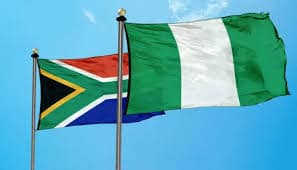
The battle lines were drawn not on a field of combat, but in the comment sections of social media platforms. It began with a simple, provocative question from a South African user named Makhanya, and it quickly escalated into a full-blown digital war between two of Africa’s most powerful and prideful nations. The topic: identity fraud, national pride, and the age-old question of who wants to be who.
“Why do Nigerians pretend to be South Africans when they travel abroad?” Makhanya posted, attaching a meme that suggested Nigerians were ashamed of their own nationality when seeking visas or crossing borders.
The question, loaded with implication, landed like a grenade in the bustling online space where Nigerians and South Africans coexist in a state of perpetual, often humorous, sometimes hostile, rivalry. Within hours, the replies poured in, transforming a simple query into a complex referendum on the state of two nations, their self-images, and their troubled relationship.
The Nigerian Response: “We Brag About Being Naija”
Nigerian social media users, known for their fierce patriotism and digital fluency, did not take the bait quietly. They pounced. The consensus was swift and scornful: Nigerians do not pretend to be South African; in fact, they do the opposite.
“Pretend to be South African?” scoffed one Lagos-based user. “My brother, Nigerians are the ones teaching the world how to be great. We don’t pretend to be anyone. We go everywhere with our heads held high, and we tell everyone where we are from. Naija to the world!”
The response tapped into a deep well of national pride. Nigerians are famous for their diaspora success stories, their dominance in Afrobeats, Nollywood, and their reputation as some of the most entrepreneurial and educated immigrants in the world. To suggest that a Nigerian would deny their heritage to pass as a South African was, to them, not just inaccurate, but deeply insulting.
And then came the counter-attack. Why, Nigerians asked, would anyone want to pretend to be South African? They pointed to the very real crises plaguing South Africa: an unemployment rate hovering around 35%, some of the highest crime statistics in the world, rolling blackouts (load shedding) that cripple the economy, and a crumbling public infrastructure.
“You want us to pretend to be South African?” another user mocked. “To do what? Come and stand in a queue for a job that doesn’t exist? Come and be robbed at gunpoint in Johannesburg? Come and sit in the dark when Eskom switches off the lights? No thank you. We are Nigerians. We are survivors. We don’t need to be you.”
The South African Defense: Denials and Evidence
The South African side, stung by the economic and social critiques, fired back. They denied that any South African would ever pretend to be Nigerian. On the contrary, they argued, it is Nigerians who are desperate to escape their own country’s problems and seek a better life elsewhere.
“Why would a South African pretend to be Nigerian?” asked a user from Soweto. “To claim a country with corruption so deep you can’t drink the water? To claim a country where Boko Haram blows up schools? No, we are proud South Africans. We have our problems, but we are not running from them.”
To bolster their argument, South African users began sharing videos and news articles. They posted clips allegedly showing Nigerian nationals in various parts of the world denying their origin. In one widely shared video, a man stopped at an airport overseas is asked where he is from. He repeatedly insists he is South African, despite evidence in his passport suggesting otherwise.
The most potent piece of evidence, however, was the recent case of the Oyekanmi family in Ireland. The family, originally from Nigeria, was facing deportation after Irish authorities allegedly discovered they had obtained and used fraudulent South African passports to enter and reside in the country. The case was a gift to the South African side.
“Look at this!” they exclaimed. “A whole family pretending to be South African! Using our passports! And you tell us you are proud? If you are so proud, why are you trying to be us?”
The Oyekanmi Case: A Flashpoint
The Oyekanmi family saga became the central exhibit in the online trial. The details, as reported in Irish media, were damning: a Nigerian family, facing deportation from Ireland, was found to have used South African passports to facilitate their travel and stay. The implication was clear: they had adopted a South African identity to access the benefits of a “better” passport.
For South Africans, this was proof positive of their original claim. It was not about Nigerians being “ashamed” in some abstract sense; it was about concrete action: obtaining fraudulent documents to assume a South African identity. It was a tangible example of the very behavior Makhanya’s original post had alleged.
Nigerian respondents, however, dismissed the case as an isolated incident of criminality, not a reflection of national character. “Criminals exist in every country,” they argued. “You cannot judge 200 million people by the actions of one family. And besides, if South African passports are so easy to fake, maybe you should ask your own government why your documents are not secure.”
The Deeper Context: Xenophobia and History
The online clash, for all its memes and humor, is rooted in a painful and violent history. The relationship between Nigerians and South Africans has long been fraught with tension, much of it playing out on South African soil. Nigeria was a staunch supporter of the anti-apartheid struggle, providing funds, diplomatic support, and a home in exile for many liberation movements. There was an expectation of gratitude and brotherhood after 1994.
Instead, many Nigerians who migrated to South Africa in search of opportunity found hostility. They were often stereotyped as drug dealers, fraudsters, and criminals. This prejudice boiled over into horrific waves of xenophobic violence in 2008, 2015, and 2019, where foreign nationals, including many Nigerians, were attacked, their shops looted, and in some cases, they were killed.
For Nigerians, the memory of those attacks is fresh. It adds a layer of deep bitterness to the online exchanges. When a South African makes a joke about Nigerians, many Nigerians hear the echo of a mob shouting “kwerekwere” (a derogatory term for foreign nationals) before burning a shop.
For South Africans, the frustration is rooted in a sense of being overwhelmed. With a struggling economy and sky-high unemployment, the presence of a large, successful, and visible foreign population, particularly Nigerians who dominate certain street-level trades, can feel like a threat. The resentment is real, even if its expression is often ugly.
The Humor and the Hurt
Throughout the online battle, humor was a constant companion. Memes flew back and forth. Nigerians mocked the South African accent. South Africans mocked Nigerian “419” scams (advance-fee fraud). There were jokes about food, music, and football. In many ways, it was classic African banter, the kind that happens between friends who are comfortable enough to insult each other.
But beneath the laughter, the hurt was real. The exchange touched on deep insecurities. For South Africans, it was the pain of having their country’s problems laid bare for the world to mock. For Nigerians, it was the frustration of being stereotyped and scapegoated, of having their identity reduced to fraud and crime.
As the sun set on another day of digital warfare, the argument remained unresolved. Nigerians insisted they are the continent’s proudest people. South Africans insisted their documents are being fraudulently used. Both sides posted screenshots, videos, and news articles as evidence. Neither side conceded.
The only certainty is that this will not be the last clash. The rivalry between Africa’s two giants is too deep, the stakes too high, and the proximity too close for peace to ever truly break out. For now, the war continues, one post, one meme, one angry reply at a time.
About The Author