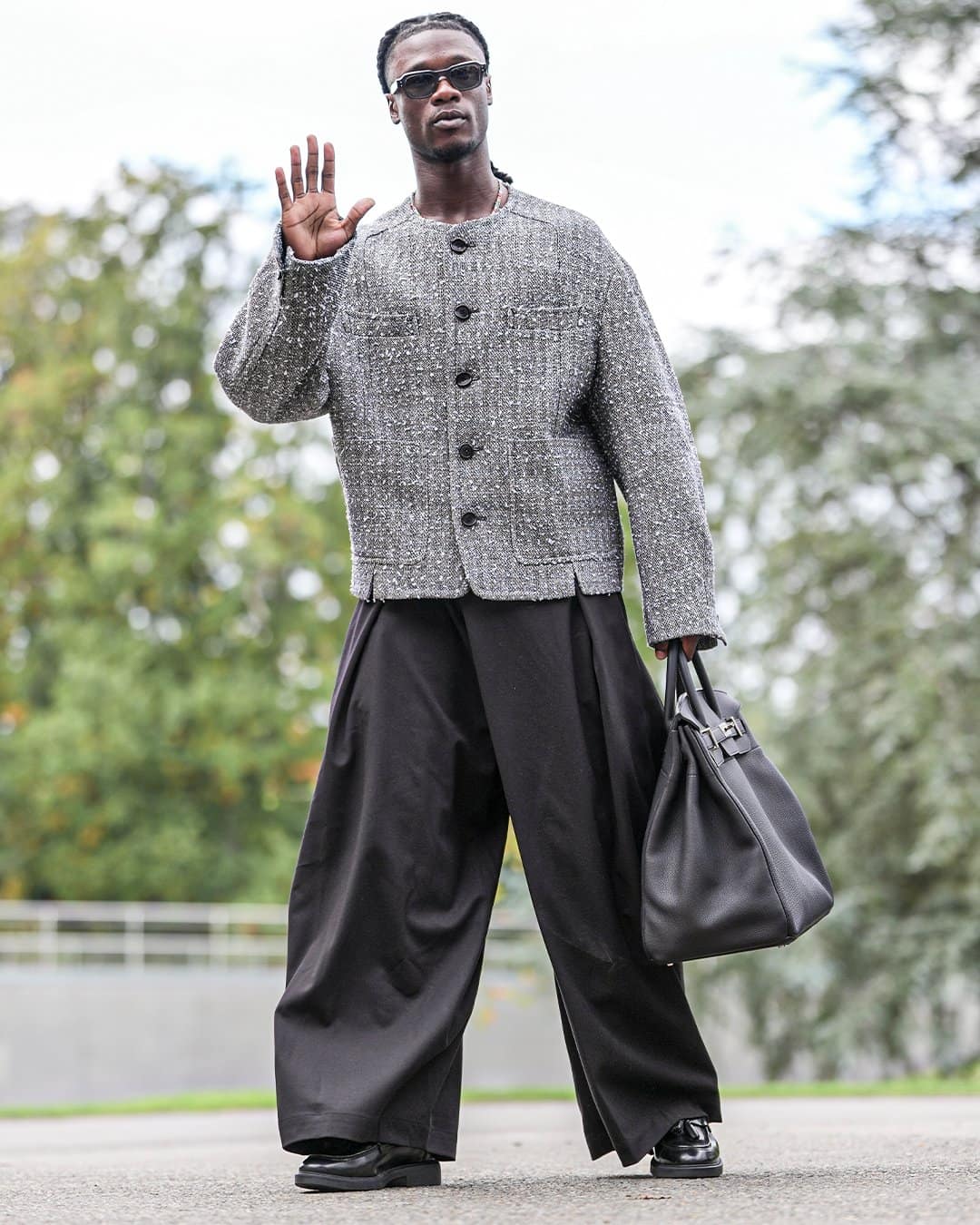
The hallowed gates of the French Football Federation’s Clairefontaine training center, a place traditionally synonymous with athletic discipline and national team preparation, received a jolt of high fashion on October 6th. Eduardo Camavinga, the dynamic 22-year-old Real Madrid midfielder, arrived for the World Cup qualifiers against Azerbaijan and Iceland not just as a footballer, but as a style icon, turning the team’s entrance into an impromptu runway and sparking a firestorm of social media debate.
Camavinga’s ensemble was a masterclass in contemporary, avant-garde aesthetics, directly channeling the dominant trends of the 2025 Balenciaga playbook. He eschewed the standard athlete’s travel uniform of hoodies and joggers for a meticulously curated look: a textured, oversized grey jacket that draped effortlessly over his frame, paired with wide-leg black pants that pooled slightly over his sneakers. The pièce de résistance was a large, structured handbag, an accessory that firmly placed the outfit in the realm of high fashion rather than sportswear. This was not a casual choice; it was a deliberate sartorial declaration.
The reaction across platforms like X and Instagram was instant and polarized, reflecting the divide that often accompanies bold fashion moves. His supporters and fashion commentators were quick to applaud his confidence and vision. They praised him for “breaking the mold” of the athlete archetype, championing his individuality and his embrace of fashion as a form of self-expression. For them, Camavinga represented a new generation of athletes, cosmopolitan, culturally aware, and unafraid to challenge conventions.
On the other side of the divide, critics were equally vocal. They derided the outfit as “clownish,” “baggy,” and impractical, with the oversized proportions becoming a particular target for ridicule. The discourse was sharply framed by comparison, as photographers captured the arrivals of his teammates. Captain Kylian Mbappé, for instance, embodied a more traditional, sleek athleisure look, while Jules Koundé opted for a classic and understated style. This visual contrast highlighted Camavinga’s choice as a deliberate departure from the norm, amplifying both the praise and the criticism.
Beyond the mere fashion debate, Camavinga’s sartorial moment carries deeper significance. It underscores the evolving role of the modern athlete, who is now a global influencer with interests and a personal brand that extends far beyond the pitch. His choice to wear such a distinctive outfit while reporting for national duty, a period often associated with unity and conformity-speaks volumes about his confidence in blending his professional obligations with his personal identity.
Furthermore, the moment provided a compelling subtext to the team’s preparations. As Camavinga steps onto the training ground, having recently recovered from an ankle injury, his fashion statement serves as a reminder of the multifaceted personalities that comprise a national squad. He is not just a player recovering fitness; he is a young man with a distinct identity, using his platform to make a statement that has, for a moment, rivaled the upcoming matches for public attention. In doing so, Eduardo Camavinga has proven that at the highest level, influence isn’t just about scoring goals; it’s about setting trends.
About The Author