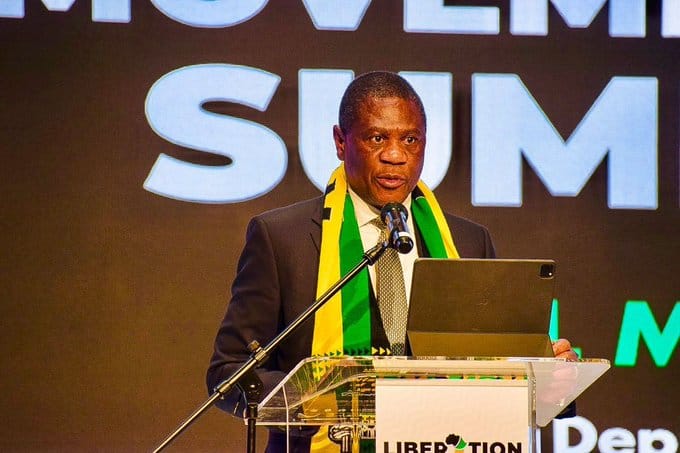
Johannesburg – In what his office is calling a “defining moment” for South Africa’s troubled logistics sector, Deputy President Paul Mashatile has unveiled a sweeping, multi-billion-rand plan to rescue the country’s crumbling rail network from years of decay and dysfunction. Addressing a gathering of industry leaders, government officials, and international investors, Mashatile laid out a comprehensive roadmap backed by a staggering R500 billion in infrastructure investment over the next three years, with R120 billion ring-fenced specifically for the transport sector.
The announcement signals the government’s most aggressive intervention yet to reverse the precipitous decline of Transnet, the state-owned freight logistics giant, whose rail and port inefficiencies have cost the economy billions in lost export revenue and hampered growth. The plan, Mashatile emphasized, is not just about fixing old tracks, but about reimagining the very architecture of how goods move across the country.
“We stand at a crossroads,” Mashatile told the audience. “For too long, our rail network has been a story of missed opportunities, aging infrastructure, and declining market share. Today, we begin the work of writing a new chapter. A chapter of recovery, of modernization, and of partnership.”
The Numbers: A Commitment Beyond Rhetoric
The financial scale of the commitment is unprecedented in recent years. The R500 billion infrastructure investment, spread over the next three fiscal years, is intended to catalyze projects across energy, water, and sanitation, but the transport sector emerges as a clear priority.
The R120 billion ring-fenced for transport will be channeled into:
- Rehabilitating Critical Corridors: Urgent repairs to the coal, iron ore, and chrome export lines, which have seen volumes plummet due to cable theft, vandalism, and poor maintenance.
- Rolling Stock Renewal: Procuring new locomotives and wagons, and refurbishing existing fleets to increase capacity and reliability.
- Security and Technology: Deploying advanced surveillance technology, including drones and fiber-optic sensing, to combat the rampant theft and vandalism that has crippled operations.
- Port Interface: Upgrading the rail link to South Africa’s key ports—Durban, Ngqura, and Richards Bay—to ensure seamless movement of goods from mine to ship.
Opening the Gates: Private Sector Joins the Fight
A cornerstone of the new strategy is the aggressive opening of the rail network to private sector participation, a policy shift long advocated by economists and business leaders. Mashatile confirmed that under the National Rail Policy of 2022, and fast-tracked by the government’s delivery unit Operation Vulindlela, the network is being formally opened to third-party operators.
Crucially, he announced that eleven private freight companies have already been enlisted to begin operating on the network. This marks a historic break from Transnet’s historic near-monopoly and introduces competition that, the government hopes, will drive efficiency, lower costs, and restore shippers’ confidence in rail.
“Operation Vulindlela has been working tirelessly to remove the regulatory barriers that have kept private operators off our tracks for decades,” Mashatile explained. “We are not just talking about reform; we are implementing it. These 11 companies are the pioneers. They will bring investment, innovation, and a customer-centric focus that will benefit every South African.”
The involvement of private operators is expected to target specific routes and commodities, with an initial focus on the container corridor between Gauteng and Durban, as well as the manganese and coal lines. The private sector is expected to bring its own locomotives, invest in terminal upgrades, and sign long-term access agreements with Transnet, which will retain ownership of the core infrastructure.
A ‘Whole-of-Society’ Approach
The Deputy President was careful to frame the recovery not just as an economic imperative, but as a social one. A functioning rail network, he argued, is essential for reducing the cost of living, creating jobs, and revitalizing local economies.
“When rail works, everyone benefits. Manufacturers can get their goods to market cheaper. Miners can compete globally. And ordinary South Africans can see trucks taken off our deadly roads, making our highways safer for everyone,” he said. “This is a whole-of-society effort. It requires labor to work with management, communities to protect infrastructure, and government to provide stable policy.”
Mashatile directly addressed the scourge of infrastructure crime, which has bled Transnet dry. He announced a strengthened security partnership between the South African Police Service (SAPS), the private security industry, and communities living along rail corridors, promising that those who steal copper cable and vandalize infrastructure will face the full might of the law.
The Road Ahead: Challenges Remain
While the announcement was met with cautious optimism from business groups, analysts were quick to point out the immense challenges ahead. Transnet’s balance sheet is strained, its operational credibility damaged by years of underperformance. Implementing such a massive investment program will require world-class project management, procurement integrity, and labor stability—all areas where the parastatal has struggled.
Furthermore, the integration of private operators onto a network still managed by Transnet poses significant logistical and regulatory hurdles. Questions of fair access, tariff setting, and dispute resolution will need to be carefully managed.
However, Mashatile expressed confidence that the plan was not just aspirational but executable. “We have done the diagnostics. We have secured the funding. We have passed the legislation. Now, it is time for delivery,” he said. “We will measure our success not by the speeches we give, but by the tons of goods moved, the kilometers of track repaired, and the jobs created.”
About The Author