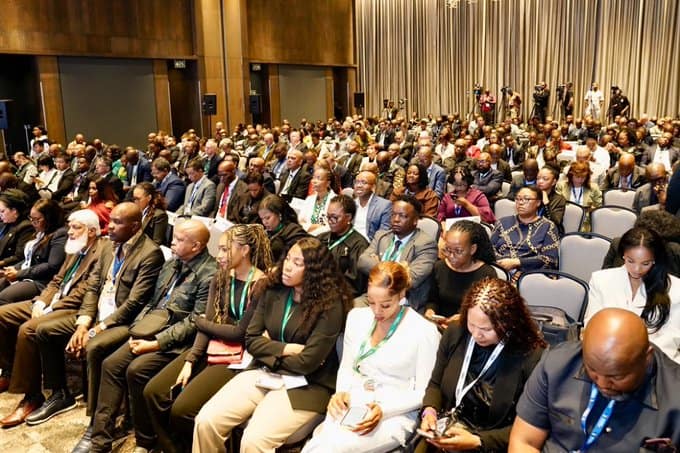
In the soaring atrium of the Sandton Convention Centre, where the city’s business elite mingled with international investors over canapés and coffee, there was a palpable sense of something shifting. Not just the usual buzz of a conference—the business cards exchanged, the hands shaken, the promises made—but something rarer: the feeling that the promises might actually be kept.
On Thursday, the Gauteng Provincial Government announced that it had secured R205.6 billion in fresh investment commitments from local and international investors at the second annual Gauteng Investment Conference, comfortably surpassing the ambitious R180 billion target set for the two-day event. The result, delivered by MEC for Economic Development, Agriculture and Rural Development Vuyiswa Ramokgopa to a packed media briefing, represents a powerful vote of confidence in South Africa’s economic heartland—and builds directly on the momentum of the inaugural conference in 2025.
“Last year, we asked investors to believe in Gauteng again. This year, they have answered with their wallets,” Ramokgopa said, her voice carrying a mixture of pride and urgency. “R205.6 billion is not a number on a spreadsheet. It is factories being built. It is roads being repaired. It is young people being trained. It is businesses expanding and hiring. This is what delivery looks like.”
Beating the Target: A Closer Look at the Numbers
The R205.6 billion figure surpasses the conference’s official target by more than R25 billion—a significant overperformance in an economic environment where many competitors are struggling to attract capital. The commitments break down as follows:
- Domestic investment (South African companies): R89.3 billion (43.4%)
- Foreign direct investment (non-African): R72.1 billion (35.1%)
- Pan-African investment (other African nations): R44.2 billion (21.5%)
The foreign component is particularly notable. Investors from China, Germany, the United Arab Emirates, and the United Kingdom led the pack, with significant new commitments also emerging from Japan, Saudi Arabia, and for the first time, India. The pan-African figure, nearly double what was achieved in 2025, suggests that Gauteng is successfully positioning itself as a gateway for African companies seeking to expand into Southern Africa’s most sophisticated economy.
“We are seeing a shift in investor psychology,” said Dr. Thabo Mnguni, chief economist at the Johannesburg-based Centre for Risk Analysis, who attended the conference but was not involved in its organization. “For years, the narrative about Gauteng was about decay—load-shedding, crime, policy uncertainty. This conference, and the numbers coming out of it, suggest that narrative is being challenged. Investors are still cautious, but they are no longer running. They are engaging.”
Building on 2025: From Promises to Progress
The 2025 inaugural conference, which attracted over 1,800 participants from 34 countries, generated R312.5 billion in investment pledges—a staggering figure that was met with some skepticism at the time. Critics pointed out that investment conferences often produce “photo opportunity pledges” that never translate into actual capital deployment.
But at Thursday’s briefing, Ramokgopa was at pains to demonstrate that the 2025 pledges are being converted into real economic activity. According to the Gauteng Department of Economic Development’s tracking dashboard, 67% of the R312.5 billion pledged in 2025 has either been fully disbursed (41%) or is in the process of being disbursed (26%). The remaining 33% is either pending regulatory approvals or has been abandoned after due diligence.
“We said last year that we would move from promises to delivery,” Ramokgopa said. “We have not been perfect. Some pledges have fallen through. That is the nature of investment. But two-thirds of the money promised is now in the economy. That is not theater. That is transformation.”
Notable 2025 pledges that have reached implementation include:
- A R45 billion logistics hub at OR Tambo International Airport, led by a consortium of Chinese and South African companies, which broke ground in March 2026 and is expected to create 12,000 construction jobs.
- A R22 billion solar manufacturing plant in the Vaal Triangle, announced by a German renewable energy firm, which began production in January 2026 and now employs 850 people.
- A R9 billion affordable housing development in Tembisa, backed by a South African pension fund, which has already completed its first phase of 1,200 units.
These tangible outcomes gave this year’s pledges a credibility that the 2025 event lacked. Investors who attended the 2025 conference and saw their peers follow through were more willing to commit their own capital this time around.
“The proof is in the concrete,” said Maria van der Merwe, CEO of a mid-sized construction firm that announced a R1.2 billion expansion pledge at this year’s conference. “Last year, I watched. This year, I signed. Not because the speeches were better—they were fine—but because I saw my competitors actually building things. That changed my risk calculation.”
Sectoral Breakdown: Where the Money Is Going
The R205.6 billion in new pledges is distributed across several key sectors, reflecting both Gauteng’s traditional strengths and emerging opportunities:
Energy and Infrastructure: R78.4 billion (38.1%)
The largest single sector, driven by the ongoing energy crisis and the provincial government’s aggressive push for private-sector participation in power generation. Major pledges include a R30 billion commitment from a consortium of solar and battery storage developers to build 1.2 gigawatts of embedded generation capacity across Gauteng’s industrial corridors, and a R15 billion pledge from a Chinese state-owned enterprise to upgrade the province’s electricity transmission network.
Logistics and Transport: R42.1 billion (20.5%)
Gauteng’s position as a logistics hub for Southern Africa continues to attract investment. New pledges include a R18 billion expansion of the City Deep container terminal, a R12 billion road upgrade program focused on the N3 and N12 corridors, and a R6 billion investment in last-mile delivery infrastructure for e-commerce.
Technology and Innovation: R31.2 billion (15.2%)
The tech sector, long a bright spot in Gauteng’s economy, saw robust pledges including a R10 billion data center campus in Midrand (backed by an American cloud computing giant), a R7 billion artificial intelligence research hub linked to the University of the Witwatersrand, and multiple smaller commitments to fintech, edtech, and healthtech startups.
Manufacturing and Agro-processing: R28.9 billion (14.1%)
A sector that has struggled in recent years showed signs of revival, with pledges including a R9 billion automotive components plant in Rosslyn, a R6 billion pharmaceutical manufacturing facility in Springs, and a R5 billion food processing hub in Soweto.
Residential and Commercial Property: R25 billion (12.2%)
The property sector, battered by high interest rates and the shift to remote work, saw selective but significant commitments focused on affordable housing and mixed-use developments in underserved areas.
A Word on Implementation: The Delivery Dashboard
One of the most closely watched announcements at Thursday’s briefing was the launch of the Gauteng Investment Delivery Dashboard, a public-facing digital tool that will track every pledge made at both the 2025 and 2026 conferences. The dashboard, accessible via the provincial government’s website, allows users to search by company, sector, or municipal district and see:
- The amount pledged
- The date of the pledge
- The current status (pledged, due diligence, regulatory approval, capital deployed, completed, or abandoned)
- The number of jobs created (if any) to date
- Any delays or obstacles reported by the investor
“We are not afraid of transparency because we have nothing to hide,” Ramokgopa said. “Some pledges will fail. That is business. But when a pledge fails, we want to know why. Was it regulatory? Was it infrastructure? Was it crime? The dashboard will tell us the patterns. And the patterns will tell us what to fix.”
The dashboard has been praised by transparency advocates, though some have noted that it relies on self-reporting by investors, with limited independent verification. “It is a step in the right direction, but it is not yet a reliable accountability mechanism,” said Pumeza Mthethwa of the anti-corruption watchdog Outa. “The real test will be whether the provincial government publishes data that makes it look bad. If the dashboard only shows successes, it is propaganda. If it shows failures too, it is useful.”
The Human Element: Jobs and Livelihoods
Behind the billions and the dashboards and the sectoral breakdowns are real people whose lives are affected—or not—by whether these pledges translate into economic activity. Ramokgopa was careful to ground the numbers in human terms.
“R205.6 billion is a number. But 45,000 is also a number,” she said, referring to the projected job creation from the 2026 pledges over the next three years. “Forty-five thousand people who might be able to pay school fees. Forty-five thousand families who might be able to put food on the table. Forty-five thousand young people who might not have to leave Gauteng to find work. That is what this is about. Not headlines. Livelihoods.”
The job projections are based on input-output models that estimate direct, indirect, and induced employment. Direct jobs are those created at the investment sites themselves (construction workers, factory employees, technicians). Indirect jobs are those created in supply chains (transporters, suppliers, maintenance contractors). Induced jobs are those created by the spending of newly employed workers (retail, hospitality, services).
For the 2026 pledges, the projected breakdown is: 18,000 direct jobs, 15,000 indirect jobs, and 12,000 induced jobs. Critics have noted that these are projections, not guarantees, and that South Africa’s track record of translating investment pledges into jobs has been mixed.
“We have seen this movie before,” said labour economist Professor John Monyaki. “The government announces billions, promises thousands of jobs, and then two years later we discover that many of the jobs are temporary or that the investment did not materialize as planned. I hope this time is different. But hope is not a strategy. The dashboard will tell us. We should check it every quarter.”
The Political Context: An ANC Stronghold Fighting for Credibility
The investment conference’s success cannot be separated from the political context in which it occurs. Gauteng, South Africa’s richest province, has long been an African National Congress (ANC) stronghold, but the party’s dominance has eroded in recent years. In the 2024 national elections, the ANC’s share of the vote in Gauteng fell to 39%, its lowest ever, requiring the party to form a Government of Provincial Unity with the Democratic Alliance (DA) and other parties.
The investment conference is widely seen as a flagship initiative of the coalition government, with Ramokgopa (ANC) working alongside DA officials who hold key economic portfolios in various municipalities. The R205.6 billion result is a political victory for the coalition, demonstrating that investors are willing to engage despite the province’s political fragmentation.
“Investors do not care about party colors. They care about stability, predictability, and competence,” said political analyst Susan Booysen. “The Gauteng coalition has been messy at times, but on investment promotion, they have shown surprising coherence. That coherence is paying off.”
Challenges Ahead: Load-Shedding, Crime, and Red Tape
Despite the positive headlines, no one at the conference pretended that Gauteng’s investment climate is without serious challenges. In private conversations and panel discussions, investors repeatedly raised three concerns:
Load-shedding: While Eskom has reported fewer stage 6 blackouts in 2026 compared to previous years, the grid remains fragile. Many of the energy pledges announced at the conference are explicitly designed to help businesses bypass the national grid through embedded generation—a workaround, not a solution.
Crime and security: Logistics and manufacturing investors in particular cited cargo theft, hijackings, and extortion as significant operational risks. Several pledges include line items for private security, a cost that investors say should be borne by the state.
Regulatory delays: Despite the provincial government’s efforts to streamline permitting, investors reported that national-level approvals (environmental authorizations, import permits, visa processing for skilled workers) remain slow and unpredictable.
Ramokgopa acknowledged these challenges without defensiveness. “We are not asking investors to pretend the problems do not exist. They exist. We live with them every day,” she said. “What we are asking is that investors see these problems as opportunities. Where there is no grid, there is a market for solar. Where there is crime, there is a market for secure logistics. Where there is red tape, there is a market for compliance consulting. The entrepreneurs who solve Gauteng’s problems will become Gauteng’s richest people. That is the bet we are making.”
What Comes Next: From Pledges to Payrolls
With the conference over and the media cameras packed away, the real work begins. The Gauteng Department of Economic Development has established a dedicated “Investment Concierge Unit” to help each pledge move through the implementation pipeline. The unit, staffed by 35 people including project managers, legal advisors, and regulatory specialists, will be responsible for:
- Facilitating permit and license applications
- Connecting investors with municipalities for land use approvals
- Coordinating with Eskom and municipalities on electricity connections
- Tracking progress on the delivery dashboard
- Escalating obstacles to the MEC’s office for intervention
The unit’s budget for the 2026/27 financial year is R85 million—a fraction of the investment it is tasked with shepherding. Ramokgopa has promised to increase the unit’s funding if needed.
“We are not naive. We know that not all of this R205.6 billion will become real,” she said. “But if we can convert 70% of it—if we can get R140 billion into the real economy, building things, employing people, generating taxes—that will be a transformation. And we will do it again next year. And the year after. Until Gauteng is no longer a place that promises. Until it is a place that delivers.”
The Last Word
As the sun set over the Sandton skyline on Thursday evening, the conference delegates dispersed to airports and hotels, carrying conference bags stuffed with brochures and business cards. The R205.6 billion figure will dominate headlines for a day or two, then fade, replaced by other news, other numbers.
But for the thousands of Gauteng residents who are not investors or economists, the only number that will ultimately matter is the number on their payslip. Will the pledges of 2026 become jobs in 2027? Will the factories be built? Will the solar panels be installed? Will the roads be repaired?
Those answers are not in the headlines. They are in the delivery dashboard, updated quarterly, scrutinized by skeptics, and defended by optimists. For now, Gauteng has done what it set out to do: it has convinced the world to write a check. Now comes the harder part—convincing the world that the check will not bounce.
Ramokgopa, gathering her papers after the briefing, offered a final thought to a journalist who asked whether she was worried about underdelivering.
“I worry every day,” she said. “But I would rather worry about delivering than apologize for not trying. Gauteng has spent too long apologizing. We are done with apologies. We are now in the business of results. Watch us.”
About The Author