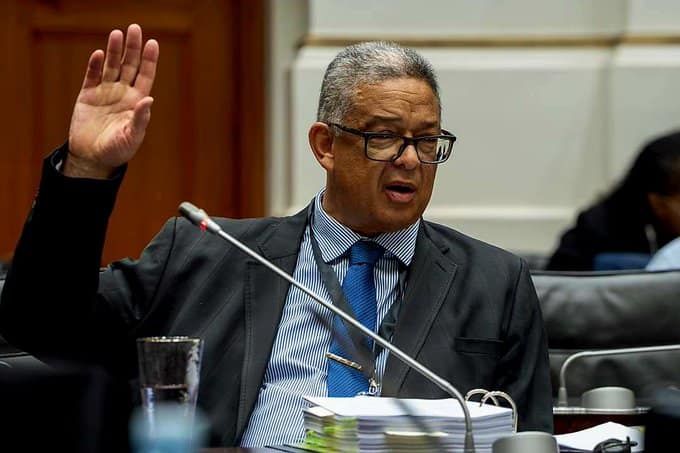
In a tense and electrifying session of Parliament’s Portfolio Committee on Police this week, former executive director of the Independent Police Investigative Directorate (IPID), Robert McBride, delivered a damning testimony, alleging a calculated campaign of political interference designed to cripple the watchdog’s most sensitive investigations. His primary target: former Minister of Police, Nkosinathi Nhleko.
McBride, whose own tenure at IPID was marked by legal battles and suspension, painted a picture of an office under siege from the very political authority meant to oversee it. His testimony went beyond broad accusations, providing a detailed chronology of alleged obstruction that, if proven, suggests a deep and deliberate sabotage of South Africa’s mechanisms for police accountability.
The Core Allegations: A Pattern of “Hands-On” Obstruction
McBride’s allegations centered on what he termed “operational interference” aimed at protecting specific individuals and derailing probes into high-stakes cases. Key accusations include:
- The “Illegal” Suspension and the Spy Tapes: McBride detailed how, shortly after he took office in 2014, IPID began investigating high-profile cases involving high-ranking SAPS officials, including the so-called “Cato Manor death squad” allegations and the kidnapping and assault of Detective Lieutenant Colonel Vishnu Naidoo. He alleged that Minister Nhleko, acting on what McBride called “fabricated” disciplinary charges, suspended him in 2015 to halt these investigations. Crucially, McBride claimed this decision was influenced by covert “spy tapes”—audio recordings of conversations—provided to Nhleko, the origin and authenticity of which were never properly scrutinized.
- Direct Meddling in the “Police HQ” Shooting Probe: One of the most startling claims involved IPID’s investigation into a 2016 shooting at the Police Headquarters in Pretoria. McBride testified that Nhleko directly contacted investigating officers, demanding detailed briefings and attempting to influence the trajectory of the probe, which involved senior police figures. “The Minister was acting not as an executive overseer, but as a case officer for the suspects,” McBride told the committee.
- Starving the Beast: Financial and Administrative Strangulation: Beyond direct meddling, McBride outlined a strategy of bureaucratic suffocation. He alleged that the Ministry, through the Department of Police, systematically underfunded IPID and delayed critical appointments, leaving it without the resources to pursue complex investigations. Requests for forensic audit capacity, additional investigators, and legal support were routinely blocked or delayed, creating what he called a “deliberate incapacity.”
- The “Withdrawal” of the Kebble Murder Docket: In a revelation that sent murmurs through the committee, McBride mentioned the sensitive investigation into the 2005 murder of mining magnate Brett Kebble. He alleged that pressure was applied from “the highest levels” to have the docket withdrawn from IPID’s purview, implying a desire to control the findings of a case with potential far-reaching political and business connections.
Nhleko’s Silence and the ANC’s Unease
Former Minister Nhleko, who was present in the parliamentary gallery, declined to comment immediately after the testimony, stating he would respond “through the appropriate channels.” His allies have previously dismissed McBride’s claims as the grievances of a disgruntled former official with his own history of controversy.
Within the ANC, the testimony has caused visible discomfort. Committee members from the ruling party questioned McBride aggressively, focusing on his own suspensions and the legitimacy of his claims, while opposition members, notably from the DA and EFF, seized on the allegations as evidence of “state capture” within the security services.
Analysts: A Testament to a Broken System
Governance experts say McBride’s testimony, regardless of the eventual findings, reveals systemic flaws.
“McBride’s account is a textbook case of the vulnerability of independent institutions in a polarized political environment,” said legal analyst advocate Nombulelo Nyathi. “The law grants IPID operational independence, but in practice, it is hostage to the Ministry for its budget, its leadership appointments, and its administrative support. This creates endless avenues for indirect interference, even without a single illegal order being given.”
She pointed out that the allegations, if true, would represent a fundamental breach of the constitutional principle of policing impartiality and the separation between executive power and independent investigation.
The Fallout and Future of IPID
The current IPID leadership, under director Jennifer Ntlatseng, has stated it is “studying the testimony” and remains committed to its mandate. The Portfolio Committee has resolved to formally request a response from Nhleko and to review all documentation related to the cases McBride cited.
Civil society groups, including the Social Justice Coalition and Freedom Under Law, have called for a full-scale independent judicial inquiry into the decade-long relationship between the Ministry and IPID. “What McBride has described is not mere policy disagreement,” said a coalition statement. “It is an alleged criminal conspiracy to obstruct justice and protect powerful individuals within the state. This cannot be swept under the rug by parliamentary protocol.”
As the dust settles in the committee room, the implications are vast. McBride’s testimony has not just accused a former minister; it has thrown a high-intensity spotlight on the fragile plumbing of South Africa’s justice system. It raises unsettling questions about how many other investigations were derailed, how many allegations against powerful police officials were quietly buried, and whether IPID can ever truly be independent while reporting to a politician with a vested interest in its findings. The battle for the soul of police accountability, it seems, has just entered a new and explosive phase.
About The Author