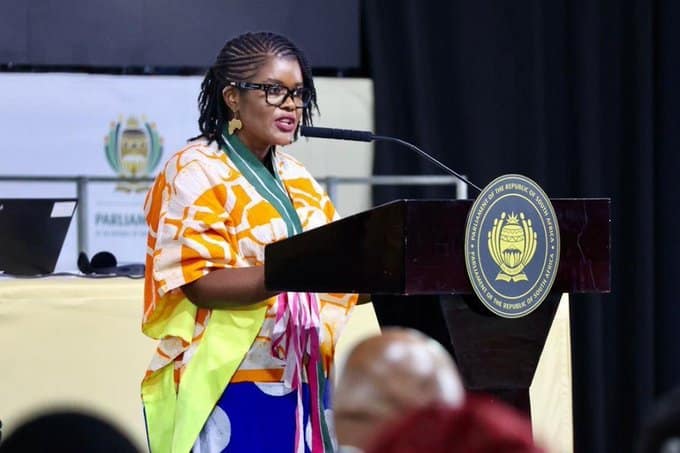
Parliament’s Joint Committee on Ethics and Members’ Interests has delivered a damning finding against Dr Nobuhle Nkabane, the African National Congress’s (ANC) newly appointed Deputy Chief Whip and a former Minister of Higher Education and Training, ruling that she violated the Code of Ethical Conduct and Disclosure of Members’ Interests in connection with controversial appointments to sector education and training authority (SETA) boards.
The ruling, which was quietly released after months of deliberation, represents a significant blow to a senior ANC parliamentarian who has occupied some of the party’s most sensitive positions. It also reignites questions about the enforcement of ethical standards within Parliament and the consequences faced by high-ranking officials found to have breached the rules designed to prevent conflicts of interest and uphold the integrity of public office.
While the committee’s findings have been made public, the specific sanctions imposed on Nkabane—if any—remain a subject of speculation, with sources close to the committee indicating that the matter has been referred for further consideration. For a Deputy Chief Whip tasked with enforcing party discipline and ensuring parliamentary attendance and voting cohesion, the finding of an ethical breach places her in an acutely uncomfortable position.
The Allegations
The complaint against Dr Nkabane centered on her conduct during her tenure as Minister of Higher Education and Training, a portfolio she held until a cabinet reshuffle in mid-2024. During her time in that ministry, Nkabane wielded significant influence over appointments to the boards of SETAs—statutory bodies responsible for skills development and training across key economic sectors.
According to evidence presented to the Ethics Committee, Nkabane was alleged to have facilitated or influenced appointments to SETA boards in a manner that favored individuals with whom she had personal or political connections, without properly declaring her interests or recusing herself from decision-making processes where conflicts existed. The complaint further alleged that she failed to disclose certain interests in her parliamentary register as required by the ethics code.
While the specifics of the appointments and the identities of the individuals involved have not been publicly detailed by the committee, sources familiar with the investigation indicated that the breaches related to a pattern of conduct rather than a single isolated incident. The Ethics Committee’s finding suggests that the committee was persuaded that Nkabane’s actions fell short of the standards expected of a cabinet minister and a member of Parliament.
The SETA system has long been a flashpoint for concerns about governance, with previous investigations revealing instances of mismanagement, irregular expenditure, and politically connected appointments. The scrutiny of Nkabane’s conduct thus fits into a broader pattern of concern about how appointments to these powerful bodies are made and the potential for undue influence by political principals.
The Ethics Committee’s Process
The Joint Committee on Ethics and Members’ Interests is a statutory body composed of members of both the National Assembly and the National Council of Provinces. It is tasked with receiving complaints, conducting investigations, and adjudicating alleged breaches of the Code of Ethical Conduct. The committee has the power to impose a range of sanctions, from reprimands and fines to recommending more severe penalties to the relevant house of Parliament.
The investigation into Nkabane’s conduct was initiated following a complaint lodged by a member of the public or an organization—a process that typically remains confidential until findings are finalized. The committee heard evidence from both the complainant and Nkabane, who was given the opportunity to respond to the allegations and present her defense.
After months of deliberation, the committee concluded that Nkabane had indeed breached the code. In its finding, the committee noted that members of Parliament, particularly those serving in the executive, are held to a higher standard of transparency and accountability, and that the failure to declare interests and avoid conflicts of interest undermines public trust in the integrity of government institutions.
The committee’s ruling did not detail the specific nature of the breaches beyond confirming that they related to SETA board appointments and disclosure obligations. However, the finding itself is a formal determination that Nkabane’s conduct was incompatible with the ethical standards expected of a parliamentarian.
Political Ramifications
For Dr Nkabane, the Ethics Committee’s finding arrives at a particularly sensitive moment. She was appointed as Deputy Chief Whip of the ANC in Parliament in late 2025, a position of considerable responsibility within the party’s parliamentary machinery. The Deputy Chief Whip plays a key role in maintaining party discipline, managing parliamentary business, and ensuring that ANC members are present and voting according to the party line.
Holding a senior leadership position while simultaneously being found to have breached parliamentary ethics codes creates an undeniable tension. Opposition parties have already begun to call for Nkabane to step aside from her leadership role pending further action, arguing that it is untenable for someone entrusted with enforcing discipline to have been found wanting in their own ethical compliance.
“You cannot have someone who has been found guilty of breaching the ethics code serving in a position that requires the highest standards of integrity,” said one opposition MP, speaking on condition of anonymity. “The Deputy Chief Whip is supposed to be a guardian of parliamentary process. How can they fulfill that role when they themselves have been found to have violated the rules?”
Within the ANC, reactions have been more muted. Party spokespersons have emphasized that the Ethics Committee’s process is ongoing and that Nkabane is entitled to exhaust all available remedies before any conclusions are drawn about her fitness to serve. Supporters have pointed to her record of public service and argued that the finding relates to technical administrative matters rather than allegations of personal enrichment.
Nevertheless, the finding is an unwelcome distraction for the ANC leadership at a time when the party is seeking to project an image of renewal and accountability. The party has previously committed to strengthening ethical standards and rooting out misconduct among its public representatives, and the handling of Nkabane’s case will be seen as a test of that commitment.
A Pattern of Scrutiny
Dr Nkabane’s tenure as Minister of Higher Education and Training was marked by significant challenges, including ongoing crises around student funding, university governance, and the stability of the post-school education and training system. Her appointment to the portfolio came during a period of transition following the departure of her predecessor, and she faced steep learning curve in a complex and politically sensitive department.
The SETA system, over which she exercised oversight, has been the subject of multiple investigations by the Auditor-General and parliamentary committees. Concerns have been raised for years about governance failures, irregular expenditure, and the politicization of appointments. The Ethics Committee’s finding against Nkabane suggests that the scrutiny of decision-making within the ministry has yielded concrete evidence of breaches of ethical standards.
The case also adds to a growing list of instances in which senior ANC figures have been found to have violated parliamentary ethics rules. While some have faced sanctions such as fines or reprimands, critics have argued that the consequences for breaches are often insufficient to deter misconduct or to signal that ethical violations carry meaningful consequences.
What Happens Next
With the Ethics Committee having made its finding, the matter now proceeds to the next stage of the process. The committee is expected to determine an appropriate sanction, which could include a formal reprimand, a fine, or a recommendation to the National Assembly for further action. In cases where the committee finds that a member has committed a serious breach, it may recommend suspension from the house or other penalties.
Dr Nkabane retains the right to respond to the committee’s finding and to make representations before any sanction is imposed. She may also seek to challenge the finding through parliamentary mechanisms or, potentially, through legal action, though such avenues would likely be pursued only if she believes the process was procedurally flawed.
In the meantime, the political fallout continues to unfold. Opposition parties have signaled their intention to raise the matter in the National Assembly, seeking to hold the ANC accountable for the conduct of its leadership. Civil society organizations that focus on governance and accountability are also likely to weigh in, calling for transparency about the nature of the breaches and the sanctions imposed.
Broader Implications
Beyond the immediate fate of Dr Nkabane, the case raises important questions about the effectiveness of Parliament’s ethics regime. The Joint Committee on Ethics has often been criticized for its lack of transparency, its slow pace, and what some perceive as a reluctance to impose meaningful sanctions on senior members. The Nkabane case will be scrutinized not only for its outcome but also for the process by which that outcome was reached.
For ordinary South Africans, cases like these matter because they speak to the integrity of the institutions that govern them. When parliamentarians are found to have breached ethical rules, the public’s faith in the system erodes. Conversely, when breaches are properly investigated and sanctions applied, it can strengthen confidence that no one is above the rules.
As one governance expert noted: “The Ethics Committee exists precisely for situations like this. Its credibility depends on its willingness to treat all members equally, regardless of their seniority or party affiliation. If the committee applies the rules consistently and transparently, it serves an important function. If it does not, then the system fails.”
Conclusion
For Dr Nobuhle Nkabane, the Ethics Committee’s finding represents a significant stain on a political career that has seen her rise rapidly through the ranks of the ANC. Once a cabinet minister and now a member of the party’s parliamentary leadership, she finds herself in the difficult position of having been found to have breached the very ethical standards she is now expected to help enforce.
As the committee deliberates on an appropriate sanction, the eyes of Parliament and the public will remain fixed on the outcome. Whether this case becomes a turning point for parliamentary accountability or merely another instance of a finding without meaningful consequence will depend on the actions taken in the coming weeks.
For now, Dr Nkabane continues to serve as Deputy Chief Whip, attending to her duties while navigating the fallout from the Ethics Committee’s ruling. But the political cost of the finding—both for her personally and for the ANC’s broader narrative of accountability—has only begun to be calculated.
The Ethics Committee has not yet announced a timeline for the imposition of sanctions, but with Parliament sitting regularly, the matter is expected to be concluded in the coming months.
About The Author