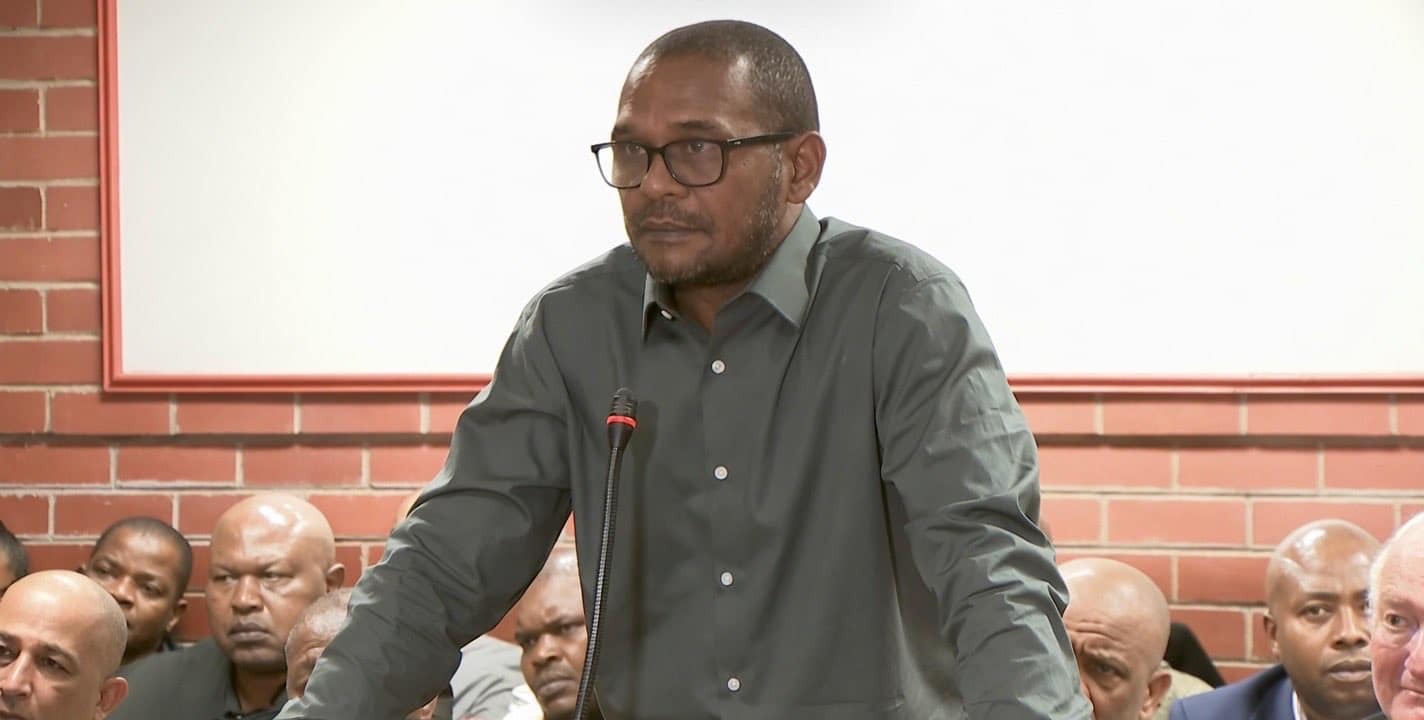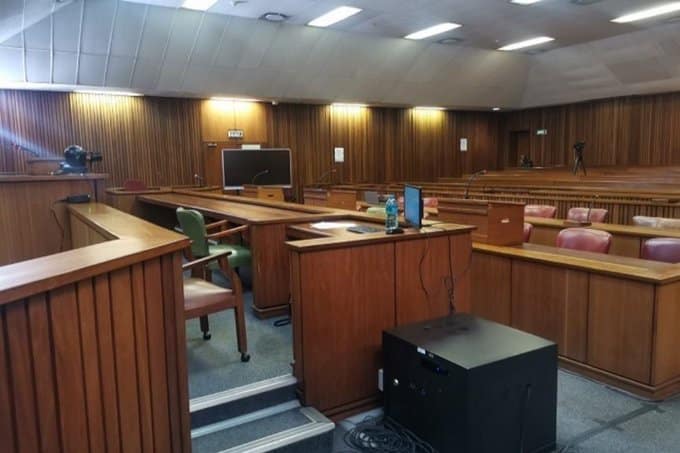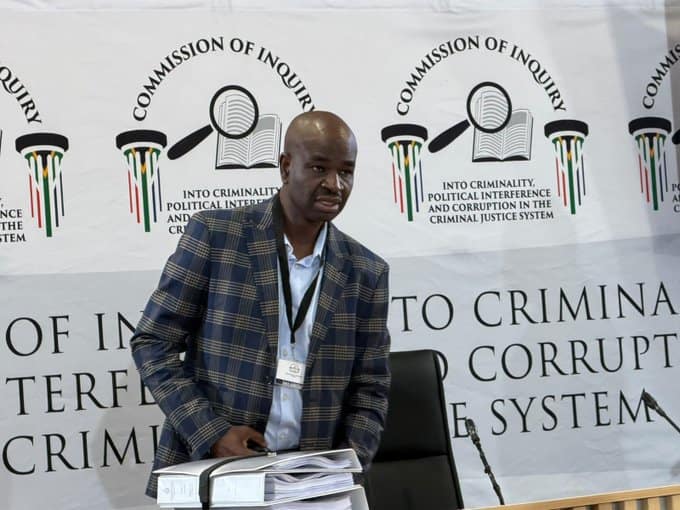
The witness chair at the Madlanga Commission of Inquiry has a way of shrinking even the most powerful figures. It is a hard wooden seat, angled slightly toward the commissioner, with a microphone that picks up every hesitation, every sigh, every swallowed word. For the past several days, that chair has been occupied by a man who arrived in it as one of Tshwane’s most senior law enforcement officials—and who may leave it as something far less.
Suspended Tshwane Metropolitan Police Department (TMPD) Deputy Chief Umashi Dhlamini has concluded his testimony after days of grueling, sometimes combative, questioning. But his involvement with the commission is far from over.
On Wednesday, as Dhlamini stepped down from the stand, presiding commissioner retired Judge President Mogoeng Madlanga issued a terse but significant order: Dhlamini must submit a supplementary affidavit by 4 May 2026, addressing specific issues raised during his cross-examination. The commission will then adjourn briefly, resuming on Thursday, 7 May, to consider the affidavit and determine next steps.
The order suggests that Commissioner Madlanga is not yet satisfied that the full truth has emerged. And for Dhlamini—a man whose career hangs in the balance—the coming days will be a race against the clock to shape his narrative before the commission moves on.
“This is not the end of Dhlamini’s involvement,” said legal analyst Professor Mpho Mthembu. “It is a tactical pause. The commissioner wants more. The question is: more of what? More detail? More candor? More accountability? Dhlamini must now decide how much to give.”
The Witness: Who Is Umashi Dhlamini?
Umashi Dhlamini is not a household name outside of Tshwane’s law enforcement circles. But within those circles, he is a figure of considerable weight—and considerable controversy.
A 28-year veteran of the TMPD, Dhlamini rose through the ranks from a junior officer to deputy chief, the second-highest position in the city’s police service. He was known as a “street cop” who never lost touch with the beat, a man who could command both respect and fear from those under his command.
But his career has also been shadowed by allegations. Over the years, whistleblowers have accused Dhlamini of:
- Tender manipulation in the awarding of vehicle impound and towing contracts.
- Favoritism in promotions and assignments, rewarding loyalists and sidelining critics.
- Interference in disciplinary proceedings against officers accused of misconduct.
- Unexplained wealth—including properties and vehicles that seemed beyond his official salary.
The Madlanga Commission, established to investigate corruption and maladministration in Gauteng’s metropolitan municipalities, summoned Dhlamini to testify after his name surfaced repeatedly in the testimony of other witnesses. Some of those witnesses placed Dhlamini at the center of a network of patronage and kickbacks that, they alleged, reached into the highest levels of Tshwane’s city government.
Dhlamini has denied all allegations. Through his legal team, he has described the commission’s inquiry as a “smear campaign” driven by political rivals.
“I have served this city with honor and integrity,” Dhlamini said in a brief statement before his testimony began. “I have nothing to hide. I welcome the opportunity to clear my name.”
But after days of questioning, it is far from clear that his name has been cleared.
The Testimony: Days Under the Microscope
Dhlamini’s testimony spanned four days—Monday through Wednesday of this week—with several breaks for legal argument and witness fatigue. The questioning was led by chief evidence leader Advocate Matthew Chaskalson SC, whose reputation for relentless cross-examination preceded him.
Day One: Opening Statement and Denials
Dhlamini began with a lengthy opening statement—unusual for a witness but permitted by the commissioner. In it, he painted himself as a dedicated public servant, a victim of “malicious gossip,” and a scapegoat for broader failures within the TMPD.
“I am not a corrupt person,” he said, reading from prepared remarks. “I have never taken a bribe. I have never rigged a tender. I have never abused my position. The allegations against me are false. They are invented by people who want to destroy me because I stood in their way.”
Commissioner Madlanga listened impassively, then turned the floor to Advocate Chaskalson.
Day Two: Tender Allegations
The second day focused on the impound and towing contracts—a lucrative area of TMPD operations that has long been a magnet for corruption. Witnesses had previously testified that certain towing companies paid “commissions” to senior officials in exchange for being placed on the city’s rotation list.
Chaskalson confronted Dhlamini with documents showing that his signature appeared on approvals for two companies that had been flagged by internal audit as “high risk.”
Dhlamini defended himself: “I signed many approvals. I did not personally investigate each company. I relied on my subordinates. If mistakes were made, they were not mine.”
Chaskalson pressed: “But you were the deputy chief. The buck stopped with you. Are you saying you approved contracts without reading the recommendations?”
Dhlamini: “I am saying I trusted my team. Perhaps that was a mistake. But it was not corruption.”
Day Three: Conflict of Interest
The third day brought allegations of conflicts of interest. A whistleblower had testified that Dhlamini’s brother owned a company that won a TMPD contract for vehicle maintenance—and that Dhlamini had not declared the relationship.
Dhlamini acknowledged that his brother owned the company but denied any involvement in the award. “I recused myself from the procurement process,” he said. “I was not present for the evaluation. I did not vote. The contract was awarded on merit.”
Chaskalson produced minutes from a bid adjudication committee meeting showing Dhlamini’s signature as the chair.
“Are these minutes forged?” Chaskalson asked.
Dhlamini: “I do not recall that meeting. It was years ago. But if my signature is there, I must have been present. I do not remember.”
The exchange was widely seen as a low point for Dhlamini. Legal observers noted that “I don’t recall” is a phrase that witnesses turn to when they have no good answer.
Day Four: Unexplained Wealth
The final day of testimony focused on Dhlamini’s personal finances. Documents obtained by the commission showed that Dhlamini owns three properties (two of which are rented out), a luxury SUV, and a holiday home in Mpumalanga—assets that seem difficult to explain on a deputy chief’s salary of approximately R1.2 million per year.
Dhlamini responded that the properties were bought with a combination of savings, a bond, and an inheritance from his late mother. He produced bank statements and a will. But the timeline was murky, and the documents did not fully account for the timing of the purchases.
Chaskalson: “You inherited money in 2019. You bought the holiday home in 2020. That makes sense. But the SUV was purchased in 2017. Where did that money come from?”
Dhlamini: “Savings.”
Chaskalson: “Your bank statements show average balances of R30,000 in 2016. The SUV cost R800,000. Did you save R800,000 over two years on a salary of R80,000 per month?”
Dhlamini: “I had other income. My wife works.”
Chaskalson: “Your wife’s salary is R25,000 per month. That does not bridge the gap.”
Dhlamini: “I do not have to account for every rand. I am not a criminal.”
The exchange ended inconclusively. Commissioner Madlanga intervened, instructing Chaskalson to move on. But the damage was done. The impression left with many observers was that Dhlamini’s finances did not add up—and that he knew it.
The Affidavit: A Second Chance or a Trap?
Commissioner Madlanga’s order for a supplementary affidavit is unusual at this stage of proceedings. Typically, witnesses are questioned, they step down, and the commission moves on. If there are gaps in the testimony, they remain gaps—to be addressed in the commissioner’s final report.
But Madlanga has chosen a different path. By ordering Dhlamini to submit an affidavit by 4 May, he is giving the witness an opportunity to fill those gaps—or to dig himself deeper.
“The commissioner is signaling that he is not satisfied,” said legal analyst Rebecca Masemola. “He wants more detail. He wants more documents. He wants more accountability. Dhlamini now has a choice: be forthcoming, or be evasive. The commissioner will judge accordingly.”
The supplementary affidavit is expected to address:
- Specific financial transactions during the period 2015–2020, including the source of funds for the SUV and the holiday home.
- The bid adjudication committee meeting of 2018 where Dhlamini allegedly approved his brother’s contract without recusing himself.
- Communications between Dhlamini and the towing companies that received favorable treatment.
- Disciplinary actions that Dhlamini allegedly overruled against officers accused of misconduct.
Dhlamini’s legal team has indicated that he will comply with the order. Whether he will comply fully—providing all requested documents and answering all questions—remains to be seen.
“We will cooperate,” said his attorney, who declined to be named. “But we will also protect Mr Dhlamini’s rights. He is not required to incriminate himself. The affidavit will be truthful, but it will also be careful.”
That carefulness may be the rub. If the affidavit is seen as evasive, Commissioner Madlanga could draw adverse inferences—concluding that Dhlamini has something to hide.
The Commissioner’s Approach: Madlanga’s Method
Retired Judge President Mogoeng Madlanga has presided over the commission with a steady hand, allowing witnesses to speak at length but intervening when necessary to maintain focus and decorum. His order for a supplementary affidavit is consistent with his reputation for thoroughness.
“Judge Madlanga is not a headline-seeker,” said Professor Mthembu. “He is a details person. He wants every i dotted and every t crossed. If he thinks there is more to know, he will find a way to know it.”
That approach has earned him praise from legal purists but frustration from those who want faster results. The commission has been sitting for nearly 18 months. Several witnesses have testified. But no one has been criminally charged yet—though the commission can only make recommendations; it cannot prosecute.
“Patience is wearing thin,” said community activist Tshepo Moloi. “People want arrests. People want their money back. Instead, we get another affidavit. Another delay. Another chance for the guilty to hide.”
Madlanga would likely respond that thoroughness is not delay—it is due process. A flawed report that leads to failed prosecutions is worse than a delayed report that leads to convictions.
The Tshwane Context: A City in Crisis
The Dhlamini testimony is not happening in isolation. It is part of a broader investigation into the Tshwane Metropolitan Municipality, which has been plagued by political instability, financial mismanagement, and allegations of corruption.
Tshwane, which includes Pretoria and surrounding areas, has had six mayors since 2016. Coalition governments have collapsed and reformed. Service delivery has suffered. And the TMPD, once a source of pride, has been implicated in a series of scandals ranging from tender fraud to brutality.
Dhlamini’s suspension—ordered by Tshwane Mayor Nasiphi Moya following the commission’s summons—has been deeply controversial. Some praised it as a necessary step to restore integrity. Others condemned it as a politically motivated witch hunt.
“The mayor is using the commission to settle scores,” said a TMPD officer who spoke on condition of anonymity. “Dhlamini is being made an example. But he is not the only one. There are many others who should be sitting in that chair. Why are they not there?”
That question may be answered in the coming weeks. The commission has indicated that additional TMPD officials will be summoned once Dhlamini’s testimony is fully processed.
The Political Fallout: Who Is Watching?
The Madlanga Commission operates under the authority of the Gauteng provincial government, but its findings will have national implications. Corruption in municipalities is a national crisis, and the African National Congress (ANC) has been under sustained pressure from opposition parties and civil society to clean house.
The Democratic Alliance (DA), which leads a fragile coalition in Tshwane, has been careful not to comment on Dhlamini’s testimony, citing the sub judice rule. But privately, DA officials have expressed satisfaction that the commission is continuing its work.
“We have always said that no one is above the law,” said a DA source. “If Dhlamini has done wrong, he must face consequences. The same goes for anyone else. That is what the commission is for.”
The Economic Freedom Fighters (EFF), which has been critical of the commission’s pace, called for Dhlamini’s immediate arrest—a demand that has no legal basis, as the commission cannot arrest anyone.
“You cannot arrest based on testimony alone,” said legal commentator Rebecca Masemola. “The commission must complete its work, issue a report, and then the NPA must decide whether to prosecute. That is how the system works. The EFF knows this. They are scoring political points.”
The Media Coverage: A Tale of Two Headlines
South Africa’s media has covered Dhlamini’s testimony extensively, but with varying angles.
- City Press focused on the financial discrepancies: “Dhlamini’s Luxury Lifestyle Doesn’t Add Up.”
- The Sowetan highlighted the brother’s contract: “Dhlamini Approved Tender for Family Member, Records Show.”
- News24 took a broader view: “TMPD Deputy Chief Denies All as Commission Digs Deeper.”
- The Citizen was more sympathetic: “Dhlamini: ‘I Am Being Persecuted.’
Social media has been less nuanced. Memes mocking Dhlamini’s “I don’t recall” responses have gone viral. Hashtags like #DhlaminiMustFall and #WhereDidTheMoneyComeFrom have trended. The court of public opinion has largely convicted him—though the legal court has not.
“The public is tired of corruption,” said social media analyst Naledi Mkhize. “They see a senior official with a fancy car and a holiday home, and they assume the worst. Whether that assumption is fair is irrelevant. The perception is the reality.”
What Happens Next: The Road from 4 May
The commission’s schedule for the coming days is as follows:
- 4 May 2026: Dhlamini’s supplementary affidavit is due. It must be submitted to the commission secretary by 4:00 PM. Late submissions will not be accepted.
- 5–6 May: Commissioner Madlanga and his legal team will review the affidavit, compare it to the testimony, and identify any remaining gaps or inconsistencies.
- 7 May: The commission resumes. Dhlamini may be recalled for further questioning if the affidavit raises new issues or fails to address old ones. Alternatively, the commission may move on to other witnesses.
- May–June: Additional TMPD officials are expected to be summoned. Their names have not yet been released.
- Late 2026: The commission aims to complete its hearings and begin drafting its final report, though delays are possible.
For Dhlamini, the immediate future is uncertain. He remains suspended from the TMPD, drawing a reduced salary. His legal bills are mounting. His reputation, once sterling, has been tarnished.
“I have done nothing wrong,” he repeated as he left the commission on Wednesday. “I will prove it. Just wait.”
Those who have followed the commission are waiting. But patience, as they say, is not infinite.
Epilogue: The Weight of the Chair
As Dhlamini walked out of the hearing room, the commission staff began preparing for the next witness. Files were reshuffled. Seats were reset. The hard wooden chair in the witness box was wiped clean—not physically, but symbolically. Ready for the next person who would sit in it, sweat under the lights, and answer questions they would rather not answer.
Dhlamini paused at the door. He turned back, looked at the chair, and seemed to shudder. Then he left.
He will return—not necessarily to the chair, but to the process. By 4 May, his words will be on paper, sworn under oath, delivered to the commissioner. Those words may save him. They may damn him. They may simply leave him in the same grey zone of suspicion where he now resides.
The commission moves on. The truth, elusive as ever, waits to be uncovered.
About The Author