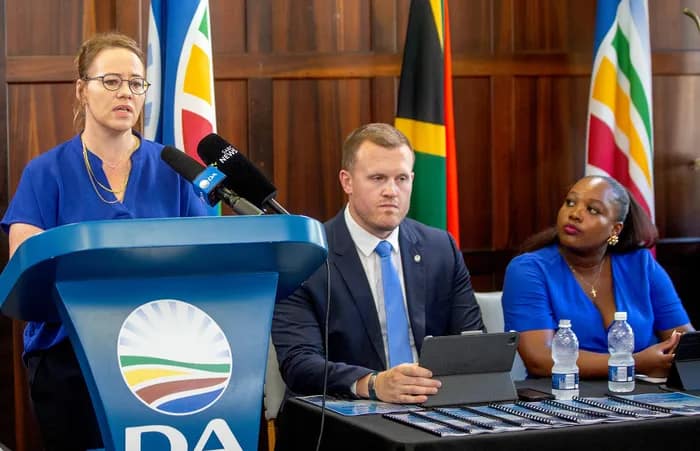
Cape Town – In a move that has sent shockwaves through Parliament’s most sensitive investigation, the Democratic Alliance (DA) has abruptly withdrawn its Member of Parliament, Lisa Schickerling, from the high-stakes Ad Hoc Committee probing deep-seated corruption within South Africa’s criminal justice system. The decision, confirmed in a terse statement from the party on Tuesday, follows the emergence of a serious, undisclosed conflict of interest that threatens to compromise the integrity of the entire inquiry.
The Ad Hoc Committee, established amid national outrage over the findings of the Madlanga Commission, is tasked with translating the Commission’s explosive revelations into actionable political and legislative consequences. It is investigating allegations of sophisticated criminal syndicates infiltrating the South African Police Service (SAPS), the National Prosecuting Authority (NPA), and the judiciary, including claims of political interference protecting these networks.
A Conflict Revealed
While the DA’s official statement cited the need to “uphold the highest ethical standards” and “ensure the committee’s work remains beyond reproach,” sources close to the committee have revealed that the conflict centers on Schickerling’s immediate family ties. It is understood that a close relative of the MP holds a senior position within a private security conglomerate that is currently under informal scrutiny by the very state institutions the committee is investigating.
The concern, as voiced by opposition parties and integrity watchdogs, was not that Schickerling herself was implicated in wrongdoing, but that her familial connection created an unavoidable perception of bias. Her presence on the committee could have allowed targets of the probe to question its objectivity, potentially undermining the legitimacy of its final recommendations.
“The work of this committee is too critical to be clouded by even the faintest shadow of doubt,” said a senior DA figure who spoke on condition of anonymity. “We were presented with information about this connection, and the leadership acted decisively. It was a prophylactic measure to protect the process.”
Political Fallout and Opposition Reaction
The withdrawal has ignited a political firestorm. The African National Congress (ANC), while acknowledging the DA’s move, has used the incident to question the official opposition’s vetting processes. “It is concerning that this conflict was not identified before her appointment,” stated ANC Chief Whip Pemmy Majodina. “It begs the question: how rigorous is the DA’s internal scrutiny when assigning members to committees of such grave national importance?”
Meanwhile, the Economic Freedom Fighters (EFF) have been more scathing, labeling it a “spectacular failure of judgment” on the part of both Schickerling and the DA leadership. “Why did the Honourable Member not recuse herself from the beginning? This shows a casual attitude towards a matter that threatens the very foundation of our constitutional democracy,” said EFF spokesperson Leigh-Ann Mathys.
Schickerling’s Replacement and the Road Ahead
The DA has moved swiftly to contain the damage, announcing that veteran MP and justice portfolio committee member, Advocate Glynnis Breytenbach, will replace Schickerling with immediate effect. Breytenbach, a former senior prosecutor with a formidable reputation for pursuing complex corruption cases, is widely seen as a safe pair of hands whose appointment will reinforce the committee’s credibility.
“The committee’s work must proceed without delay or distraction,” Breytenbach stated upon her appointment. “The public deserves answers and decisive action to restore faith in our justice system.”
The incident, however, serves as a stark reminder of the delicate and highly charged nature of the committee’s mandate. As it begins its work of sifting through the Madlanga Commission’s evidence—which includes testimony from anonymous, voice-altered witnesses—the Schickerling affair underscores that the greatest threats to the inquiry may not only be the powerful syndicates it investigates, but also the perceived weaknesses and conflicts within the political body tasked with holding them to account. For the DA, the episode is a significant embarrassment, but one they hope their rapid response has contained. For the nation, it is a test of whether its political institutions can look into the abyss without blinking.
About The Author