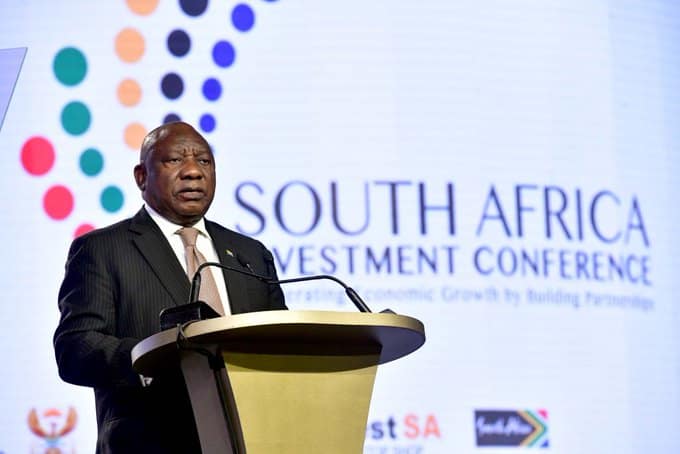
The lights of the Sandton Convention Centre will shine brightly once again today as President Cyril Ramaphosa steps up to the podium to address the Sixth South Africa Investment Conference (SAIC). But beyond the polished stage and the corporate suits lies a far grittier reality: millions of South African families are still waiting for the jobs, the growth, and the opportunity that previous investment summits have promised but not yet fully delivered.
With the country mired in persistently high unemployment—officially hovering above 32%, and nearing 45% when including discouraged work-seekers—and an economy that has struggled to expand beyond 1% annually in recent years, the stakes for this year’s conference could not be higher. Ramaphosa, who launched the investment drive in 2018 with an ambitious target of raising R1.2 trillion over five years, will now seek to reassure both domestic and international investors that South Africa remains a viable, attractive, and stable destination for capital.
The conference, which has become a fixture on the country’s economic calendar, brings together heads of state, cabinet ministers, captains of industry, and representatives from pension funds, development finance institutions, and multilateral organizations. Over two days, delegates will engage in plenary sessions, sector-specific roundtables, and one-on-one meetings designed to convert pledges into shovels in the ground. To date, the previous five conferences have attracted a cumulative R1.14 trillion in investment commitments—just shy of the original R1.2 trillion target, but still a formidable sum on paper.
However, the gap between pledges and implementation remains a persistent point of contention. Critics point out that a significant portion of announced investments are either repackaged existing projects, expansions already in motion, or memoranda of understanding that never mature into operational factories, power plants, or service hubs. According to independent tracking by academic and civil society groups, roughly half of the announced commitments have been fully or partially realized, while the rest remain stalled due to regulatory bottlenecks, municipal dysfunction, energy insecurity, or logistics failures.
It is precisely these structural obstacles that Ramaphosa is expected to address in his keynote address. The president is likely to highlight recent progress in stabilizing the country’s electricity supply—following months without loadshedding thanks to improved performance at Eskom’s coal-fired fleet and the rapid expansion of rooftop solar and private generation—as well as reforms in the logistics sector aimed at revitalizing Transnet and the struggling port and rail network.
“We are not here to celebrate promises. We are here to deliver results,” Ramaphosa said in pre-conference remarks released by the Presidency. “The Sixth Investment Conference must be the one where we move decisively from commitment to implementation. Our people cannot eat pledges. They need jobs. They need dignity. They need a growing economy that works for everyone.”
The conference also arrives against a backdrop of cautious optimism among some business leaders. Following the formation of the Government of National Unity (GNU) after the May 2024 general elections, which saw the African National Congress (ANC) share power with a coalition of parties, there has been a noticeable uptick in business confidence. Investors have welcomed the relative political stability and the appointment of technocrat-leaning ministers to key economic portfolios, including finance, trade and industry, and public enterprises.
Key sectors expected to feature prominently in this year’s announcements include renewable energy, green hydrogen, electric vehicle manufacturing, digital infrastructure, and agro-processing. Several large-scale projects are rumored to be on the verge of final financial close, including a multi-billion-rand wind farm in the Eastern Cape, a solar manufacturing facility in the Northern Cape, and an expansion of container-handling capacity at the Durban port.
Yet the shadow of structural inequality looms large. Even if the conference announces another impressive headline figure—say, R300 billion to R400 billion in new pledges—the distribution of those investments remains a sensitive issue. Much of the capital continues to flow into Gauteng and KwaZulu-Natal, while provinces like the Eastern Cape, Limpopo, and the North West struggle to attract large-scale private investment. Small, medium, and micro enterprises (SMMEs) also complain that the investment drive disproportionately benefits large corporations and foreign multinationals, leaving township and rural entrepreneurs behind.
Civil society organizations have planned a small protest outside the convention centre gates, demanding that the conference prioritize labor-intensive industries, enforce local procurement rules, and tie investment incentives to verifiable job creation targets. “We have seen five conferences already,” said a spokesperson for the Amandla Forum, a pro-worker advocacy group. “Where are the jobs? Where are the factories? Where is the fundamental change in the lives of the unemployed youth who are losing hope every single day?”
Ramaphosa, known for his measured and conciliatory tone, will likely acknowledge these frustrations while making the case that sustained investment—however imperfect—is the only path to long-term recovery. He is expected to reiterate his administration’s commitment to the Economic Reconstruction and Recovery Plan (ERRP), which prioritizes infrastructure, energy, and employment.
The president will also face questions from the media following his address, particularly regarding the slow pace of structural reforms, the ongoing fiscal constraints on state-owned enterprises, and the government’s ability to crack down on corruption and crime, which remain significant deterrents to foreign direct investment.
As the doors of the Sandton Convention Centre open to delegates this morning, the mood is one of guarded hope. The investment conference model has its critics, but few can offer a better alternative for mobilizing large-scale capital in a fiscally constrained environment. The real test, as always, will not be the applause inside the hall, but whether the pledges made today translate into factory floors, power lines, and paychecks tomorrow.
For the millions of South Africans watching from townships, informal settlements, and rural villages, the Sixth South Africa Investment Conference is not about luxury hotels or keynote speeches. It is about whether their children will have work. Whether the lights will stay on. Whether the trains will run. And whether, after six years of promises, the economy will finally begin to turn a corner.
About The Author