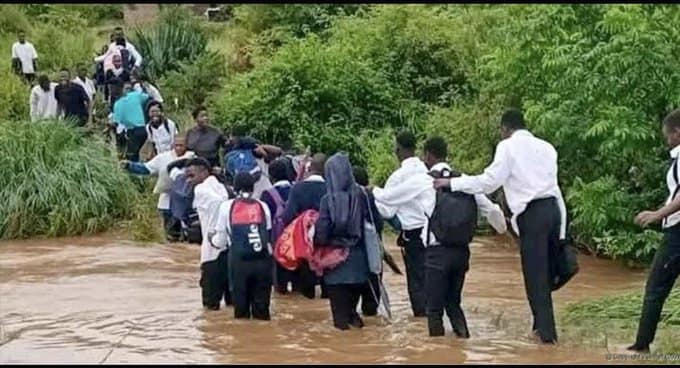
The bell did not ring at Mthatha’s Nkwanca Primary School on Tuesday morning. Nor did it ring at Ngangelizwe High, or at the scattered farm schools dotting the hillsides of the OR Tambo District. Instead, the sound that filled the air was the relentless drumming of rain on tin roofs, the gurgle of brown water swallowing roads, and the anxious murmurs of parents checking if the bridges to town were still standing.
Across vast swaths of the Eastern Cape, schools have been forced to shut their gates indefinitely as the worst flooding in nearly a decade sweeps through the province. The closures, announced on the morning of May 5, came as the South African Weather Service (SAWS) escalated its warnings to a high-level red alert for disruptive rain, severe thunderstorms, and life-threatening flooding lasting from Tuesday through Thursday.
By midday Tuesday, at least 200 schools had reported being either inaccessible or unsafe for occupation. That number is expected to rise as waters continue to rise and damage assessments trickle in from remote rural areas where connectivity is sparse and roads have become rivers.
“We are not taking any chances,” said Eastern Cape Department of Education spokesperson Malibongwe Mtima in a hastily arranged briefing. “We have urged school management teams in affected areas to close immediately if there is any risk to learners or staff. A missed day of learning can be recovered. A lost life cannot.”
The Rising Water
The flooding did not arrive suddenly. It came as a slow, creeping disaster. Rain began falling heavily over the eastern parts of the province on Sunday evening, intensifying through Monday. By early Tuesday morning, the cumulative rainfall in some areas had exceeded 200 millimeters—more than half of what some regions typically receive in the entire month of May.
The Mthatha River, which snakes through the heart of the city, burst its banks before dawn. Water poured into low-lying neighborhoods, submerging vehicles, flooding homes, and turning the streets of the city center into murky canals. In the township of Ncedo, residents waded through waist-deep water carrying children on their shoulders. In the rural communities outside Lusikisiki, bridges that were already precarious in dry weather simply disappeared beneath the torrent.
“It started as a trickle under the door. By breakfast, the water was up to my knees,” said Nomathemba Mzileni, a grandmother of six who lives in a low-cost housing unit near the Mthatha Dam. “I took the children and we climbed onto the neighbor’s roof. We sat there for four hours waiting for help. The school is on higher ground, but God help any child who tried to walk there today. The roads are gone.”
Schools as Sanctuaries, Now Shuttered
For many rural communities, schools are more than places of learning. They are emergency shelters, community hubs, and sometimes the only buildings with stable roofs and secure walls. The decision to close them, while necessary, has created a secondary crisis: thousands of children who rely on school feeding schemes for their only reliable meal of the day are now at home, with no guarantee of food.
“We have families who depend on the National School Nutrition Programme to feed their children breakfast and lunch,” said Mtima. “We are working with social development partners to identify the most vulnerable households and arrange alternative food drops. But reaching them is difficult when roads are cut.”
In some areas, schools that remain open have been converted into temporary evacuation centers. The department confirmed that at least 15 schools in the Alfred Nzo District are now housing displaced families, with classrooms repurposed as dormitories and school kitchens preparing meals for dozens of flood victims.
The Weather Warning
The South African Weather Service has described the weather system as “unusually intense for this time of year.” Senior forecaster Kabelo Mofokeng explained that a cut-off low pressure system, combined with a deep tropical moisture plume, has parked itself over the southeastern part of the country, funneling humid air from the Indian Ocean directly into the Eastern Cape.
“This is not a typical cold front. This is a slow-moving, high-energy system that will continue to produce heavy rainfall through at least Thursday,” Mofokeng told Newzroom Afrika. “We are warning specifically for the western parts of the Eastern Cape, including the Chris Hani and Sarah Baartman districts, as well as the southern parts of the OR Tambo District. Up to 300mm of additional rain is possible in some areas by Thursday night.”
The warnings have been accompanied by alerts for severe thunderstorms, large hail, and damaging winds—secondary hazards that could compound the flooding and further endanger learners and educators.
The Human Toll
As of Tuesday evening, no school-related fatalities had been reported. But the broader flooding has already claimed lives. Police confirmed that three bodies had been recovered from floodwaters—a woman in Butterworth swept away while trying to cross a low-water bridge, and two children in Port St. Johns whose informal structure collapsed into a swollen stream.
Eight other people remain missing across the province, including a teacher from Libode who reportedly attempted to drive through a flooded road on Monday night and has not been seen since. The South African National Defence Force has deployed rescue helicopters to assist in search and recovery operations.
“We are in a live emergency situation,” said Eastern Cape Cooperative Governance MEC Zolile Williams. “I am calling on all residents in low-lying areas to evacuate immediately. Do not wait for the water to reach your doorstep. The ground is saturated. Any additional rain will run off directly into rivers and low areas. This is not a drill.”
The Education Fallout
For the Department of Education, the closures come at a particularly sensitive time. The second term is now in full swing, and with matric preliminary exams looming in August, every lost day of instruction carries weight. The department has not yet announced whether school holidays will be adjusted or if Saturday classes will be introduced to recover lost time.
“We will cross that bridge when the water recedes,” Mtima said. “Right now, our only priority is the safety of children and staff. The curriculum can wait. Nature cannot.”
But for learners themselves, the closure is a mixed blessing. Some, like 17-year-old Siphesihle Dlamini, a Grade 11 learner at Mthatha’s St. John’s College, are anxious about falling behind.
“We were supposed to write a physics test tomorrow. I studied all weekend,” he said, standing on a dry patch of pavement outside his home, watching the rain sheet down. “But I also saw my neighbor’s house collapse. So maybe the test doesn’t matter right now.”
What Comes Next?
The rains are expected to continue through Thursday, with a gradual clearing forecast for Friday and Saturday. However, even after the skies clear, the danger will not immediately pass. Floodwaters take time to recede, and waterlogged roads can collapse days after the last raindrop falls. The Department of Education has advised schools to await official clearance from municipal disaster management teams before reopening.
“We will not pressure any school to reopen before it is safe,” Mtima said. “Principals know their communities best. If they believe the journey to school is dangerous, they must keep the gates closed.”
In the meantime, disaster response teams are fanning out across the province, delivering sandbags, bottled water, and high-energy biscuits to cut-off communities. The South African Red Cross Society has activated its Eastern Cape response unit, and the national government has pledged to release disaster relief funding once the scale of the damage is fully assessed.
A Province Weathered but Not Broken
The Eastern Cape is no stranger to hardship. It is a province of stark beauty and brutal poverty, of resilient people who have endured droughts, floods, fires, and political neglect. But even by its own stoic standards, the past 48 hours have tested its limits.
As dusk fell on Tuesday, the rain continued to fall. In a makeshift classroom-turned-shelter in a village outside Mthatha, a group of children sat on a concrete floor, wrapped in donated blankets, tracing letters in the condensation on the windows. Their school was closed. Their homes were under water. But their teacher, a woman named Mrs. Ndlovu who had refused to leave them, was leading a quiet spelling bee by candlelight.
“B-R-I-D-G-E,” spelled a six-year-old girl. “Bridge.”
“Good,” said Mrs. Ndlovu. “But we cannot cross it today.”
The children laughed—a small, defiant sound against the drumming rain. Outside, the river kept rising. But inside, a different kind of current flowed: the stubborn, unkillable current of learning, refusing to be washed away.
For now, the schools of the Eastern Cape are closed. But the classrooms that truly matter—the ones in the hearts of teachers and the minds of children—remain open, rain or shine.
About The Author