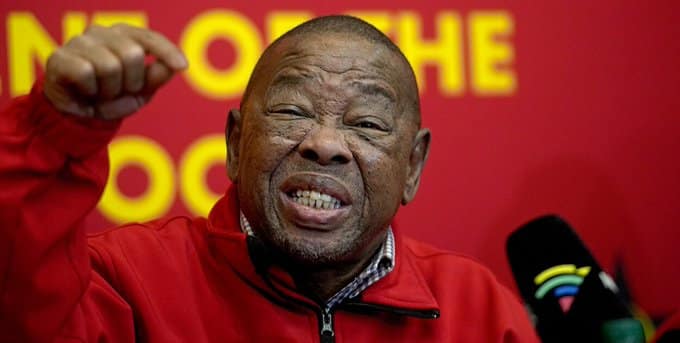
The South African Communist Party (SACP) is facing a significant internal rupture, as its Free State provincial executive committee (PEC) has launched a scathing public attack on the party’s National Chairperson, Dr. Blade Nzimande, accusing him of fostering division and undermining collective leadership through a controversial public document.
The rebuke, contained in a strongly-worded statement released on Monday, marks one of the most visible and severe internal criticisms of a senior SACP leader in recent years and exposes deep-seated ideological and strategic fractures within the party as it navigates its complex and often fraught alliance with the governing African National Congress (ANC).
The controversy stems from a public discussion document penned and released by Nzimande, titled “Navigating the Crossroads: The SACP’s Path in an Era of State Capture Recidivism and Capitalist Crisis.” While intended to stimulate debate ahead of the party’s next national congress, the document has been received by the Free State leadership as a “profoundly divisive” and “unilateral” act.
The Heart of the Contention
According to sources within the Free State PEC, Nzimande’s document advocates for a strategic posture that they interpret as an attempt to recommit the SACP to an uncritical and subservient role within the ANC-led Tripartite Alliance. The province alleges that the document downplays the need for the SACP to assert its own independent political profile and criticizes internal party factions pushing for a more decisive break with the ANC.
“The document reads less like a comradely discussion piece and more like a political justification for the status quo,” said a senior Free State PEC member who spoke on condition of anonymity due to the sensitivity of the matter. “It sidesteps the urgent need for a serious debate on our future as a vanguard party, independent of the ANC’s compromises and failures. It labels any critique of the alliance as ‘ultra-leftism,’ which is a tired and dismissive tactic.”
The Free State statement specifically condemns the “method and content” of the document’s release. It argues that by publishing it publicly before thorough internal discussion at the Lower Structures (Branch and District levels), Nzimande bypassed established party protocols and created a “public spectacle of our internal debates,” thereby weakening the party’s unity in the eyes of the public and its political rivals.
A Proxy for a Larger Battle
Political analysts view this clash as a proxy for a much larger battle over the soul of the SACP. On one side, represented by figures like Nzimande, is the traditionalist wing that, despite its criticisms, believes change is best achieved from within the structures of the ANC-led Alliance. On the other is a growing, more militant faction—with strongholds in provinces like the Free State, KwaZulu-Natal, and parts of Gauteng—that is increasingly impatient with the ANC’s governance and advocates for the SACP to contest elections independently.
“This is not just about a document; it’s about the fundamental strategic direction of the Communist Party,” said Dr. Makoena Mbeki, a political scientist at the University of the Free State. “The Free State is essentially accusing Nzimande of using his stature to pre-emptively shut down the debate on independence. For them, his document is a political manoeuvre to box the party into a corner and commit it to a subservient path for another political cycle.”
The statement from the Free State PEC also carries subtle undertones of a generational divide, positioning the province’s more youthful and militant leadership against the older guard represented by Nzimande, who has been a central figure in the party for decades and has served as a minister in every ANC government since 2009.
Implications for the Alliance
The public airing of this dirty laundry has immediate and severe implications for the Tripartite Alliance, which also includes COSATU. It reveals a SACP that is not just criticising its alliance partner, but is also bitterly divided against itself, thereby diminishing its collective bargaining power. For the ANC, which is itself embroiled in internal pre-election tensions, a weakened and fractured SACP is both a concern and an opportunity—it removes a coherent critical voice but also destabilizes a key component of its electoral machinery.
The SACP’s national spokesperson has yet to issue an official response to the Free State’s condemnation. All eyes are now on whether other provinces will rally behind the Free State’s position or come to Nzimande’s defence, setting the stage for a bruising internal contest at the party’s upcoming congress. The incident confirms that beneath the surface of Alliance unity, the tectonic plates of South African leftist politics are shifting violently, with potentially seismic consequences for the country’s political landscape.
About The Author