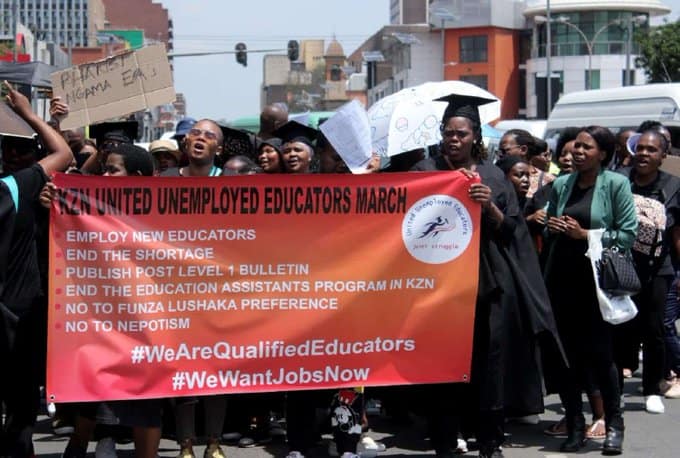
The streets of Pietermaritzburg’s central business district ground to a halt on Wednesday morning as more than 700 unemployed teachers, many clad in graduation gowns and clutching their teaching qualifications, marched on the KwaZulu-Natal Department of Education’s head office to demand something they say should be a basic right: permanent jobs.
The protest, organized by the South African Unemployed Educators Movement, stretched for nearly a kilometer as teachers snaked through Church Street and Langalibalele Street, singing struggle songs and carrying placards with messages such as “Qualified but Forgotten,” “Four Years of Study, Four Years of Hunger,” and “We Are Ready to Teach – Hire Us.”
By the time the crowd reached the department’s headquarters at 247 Burger Street, the mood had shifted from defiant to desperate. Many of the protesters had been waiting for years—in some cases, more than half a decade—for a permanent teaching post, despite holding degrees from accredited universities and completing their mandatory induction years.
“I finished my Bachelor of Education in 2021,” said Thandi Mkhize (29), a foundation phase teacher from Mpumalanga Township outside Durban who traveled to Pietermaritzburg by bus at 3 a.m. to join the march. “I have applied for over 200 jobs. I have attended 14 interviews. I have been told ‘we will keep your CV on file’ so many times I want to scream. I sleep on my mother’s couch. I cannot afford to move out. I cannot afford to start a family. I have a degree, but I have nothing.”
A Crisis of Numbers
The scene in Pietermaritzburg reflects a national crisis that has reached boiling point in KwaZulu-Natal, one of South Africa’s largest provinces by population. According to the South African Democratic Teachers Union (Sadtu), there are currently more than 15,000 qualified but unemployed teachers in the province alone.
The paradox is staggering: South Africa faces a well-documented shortage of qualified teachers in critical subjects such as mathematics, science, and early childhood development. Yet thousands of newly qualified educators cannot find work.
“The system is broken,” said Sanele Ngcobo, provincial secretary of Sadtu, who addressed the crowd before delivering a memorandum to department officials. “We have young people who have sacrificed everything to become teachers. Their families have scraped together money for tuition. They have spent years in lecture halls and in practical training. And when they graduate, we tell them: ‘Sorry, there is no budget.’ That is not a system. That is a betrayal.”
The Department of Basic Education has consistently cited budget constraints as the primary obstacle to hiring more teachers. In the 2025/2026 financial year, KZN Education received a total allocation of approximately R58 billion—the largest provincial education budget in the country. However, officials argue that the bulk of that money is consumed by existing salaries, infrastructure backlogs, and learner support materials.
“The money is simply not there to absorb all qualified teachers,” a senior departmental official told reporters on condition of anonymity. “We have a fixed establishment of posts. When a teacher retires or resigns, we fill that post. But we cannot create new posts without additional funding from national treasury.”
The ‘Contract Trap’
One of the marchers’ central grievances is the prevalence of short-term contracts. Many of the 700 protesters have worked as teachers—sometimes for years—but only on temporary contracts that offer no job security, no benefits, and no path to permanency.
“I have been a substitute teacher at three different schools in the past four years,” said Bongani Zuma (34), a high school history teacher from Ladysmith. “I have taught Grade 12 classes. I have marked matric exams. I have attended staff meetings. I have done everything a permanent teacher does. But every three months, I have to reapply for my own job. Sometimes they renew me. Sometimes they don’t. I am tired of living out of a box.”
Research by the Education Policy Consortium has found that contract teachers in South Africa earn, on average, 40% less than their permanent counterparts for doing the same work. They are also excluded from the Government Employees Pension Fund and the Government Employees Medical Aid Scheme.
“Contract teaching is a form of exploitation,” said Professor Mary Metcalfe, a former director-general of basic education. “It allows schools to access qualified labor without paying the full cost of that labor. But the human toll is devastating. These are professionals who cannot plan their lives, cannot buy a home, cannot take out a loan. They are trapped in a permanent state of precarity.”
The Memorandum
Shortly before noon, a delegation of five protesters—led by march organiser Noluthando Dlamini—was allowed inside the department’s headquarters to deliver a memorandum addressed to the MEC for Education in KwaZulu-Natal, Sipho Hlomuka, who was not present.
The memorandum listed six key demands:
- Immediate absorption of all qualified teachers who have completed their induction year and remain unemployed for more than 12 months
- Conversion of all contract posts to permanent positions for teachers who have served continuously for more than six months
- A moratorium on the use of teacher assistants in teaching roles, reserving those positions for qualified professionals
- Transparent publication of all vacant posts at school and district level
- Establishment of a provincial teacher placement bureau to match unemployed teachers with available positions
- An urgent meeting between the department and representatives of unemployed educators, to be scheduled within 14 days
“We do not want promises,” Dlamini told journalists outside the building after delivering the memorandum. “We have heard promises. We have heard ‘we are looking into it’ until we are blue in the face. We want action. We want jobs. We want to work.”
Departmental Response
The memorandum was received by Thobile Ngcobo, the department’s acting chief director for human resource management, who emerged from the building looking visibly uncomfortable as she faced the sea of chanting teachers.
“We have received your memorandum and we note your concerns,” Ngcobo said, reading from a prepared statement. “The department is aware of the challenges faced by unemployed teachers and is actively engaging with national treasury and the Department of Public Service and Administration to explore solutions. We commit to responding formally within 21 days.”
The response drew jeers from the crowd. “Twenty-one days is not good enough!” someone shouted. “We have been waiting 21 months!”
Ngcobo quickly retreated back into the building, and the march dispersed peacefully—though with no indication that any immediate relief was forthcoming.
Beyond the March
The Pietermaritzburg protest is part of a growing wave of teacher activism across South Africa. Similar marches have taken place in Gauteng, the Eastern Cape, and the Free State in recent months, with unemployed educators increasingly willing to take to the streets to make their voices heard.
Some political parties have seized on the issue. The Economic Freedom Fighters (EFF) and the uMkhonto weSizwe (MK) Party have both called for a “massive expansion” of the teaching corps, arguing that smaller class sizes and improved learner outcomes are impossible without more educators on the ground.
“The ANC government has failed our children and our teachers,” said EFF KZN chairperson Vusi Khoza. “They have billions for corrupt tenders but no money for classrooms. They have money for new luxury cars for officials but no money for new teaching posts. This must change.”
The governing African National Congress (ANC) has pushed back, arguing that the unemployment crisis among teachers is a symptom of broader economic challenges, not a failure of education policy specifically.
“We want to hire every qualified teacher,” said ANC provincial spokesperson Mafika Mndebele. “But the money must come from somewhere. We cannot print it. We cannot borrow endlessly. We need economic growth to generate the revenue that pays teachers. That is the real solution.”
Human Stories
Behind the placards and the chants are thousands of individual stories of struggle, sacrifice, and resilience.
Take Nomfundo Cele (27) from Richards Bay. She graduated cum laude with a degree in early childhood development in 2022. She has applied for jobs at 47 schools. She has worked as a cashier at a supermarket and a cleaner at a guesthouse to survive. “My mother tells people I am a teacher,” she said, tears streaming down her face. “I cannot tell her that I have never taught a single day. It would break her heart.”
Or Sipho Dube (41) from Newcastle. He was retrenched from a factory job in 2019 and decided to reinvent himself as a teacher. He completed his degree in 2023. He has not found work. His wife left him last year. “She said I was not a real man anymore,” he said quietly. “I had no answer for her. What do you say? That I am qualified? That does not pay the rent.”
Or the countless young women who entered teaching because it was supposed to be a “stable profession for women,” only to discover that stability is a mirage.
“I chose teaching because I wanted security,” said Nokuthula Mhlongo (25) from Hammarsdale. “I wanted to know that I would always have a job, always have a paycheck, always have a purpose. Instead, I have nothing. I am more insecure than ever.”
What Happens Next?
The 700 teachers who marched on Wednesday returned to their buses and taxis with empty hands but heavy hearts. The department has 21 days to respond formally—a deadline that many protesters view as a delaying tactic.
“We will be back,” said Noluthando Dlamini. “If they do not respond within 21 days, we will march again. If they respond with empty words, we will march again. We will not stop. We cannot stop. Our futures depend on it.”
For now, the unemployed teachers of KwaZulu-Natal will return to their cramped rooms, their parents’ couches, their precarious contract work, and their fragile hopes. They will continue to refresh job portals. They will continue to attend interviews. They will continue to dream of standing in front of a classroom, of hearing the sounds of children learning, of finally being what they trained to be.
“We are teachers,” said Thandi Mkhize, adjusting her graduation gown one last time before boarding the bus back to Durban. “That is who we are. That is what we will always be. The department can ignore us, but they cannot make us disappear. We are here. We are qualified. And we are not going away.”
About The Author