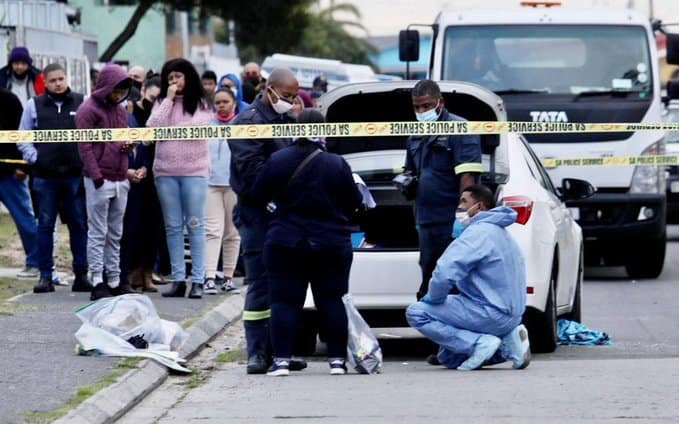
The Western Cape is reeling from a devastating wave of violence that claimed 1,058 lives between July and September 2025, establishing it as South Africa’s deadliest province during this period and laying bare the deep-seated crisis of gang warfare, systemic inequality, and strained law enforcement.
The Human Toll Behind the Numbers
Behind the staggering statistic lies a tapestry of human tragedy. The violence has not been confined to shadowy alleyways but has spilled into homes, schools, and public spaces. In the Cape Flats—a sprawling area of townships southeast of Cape Town—residents describe living in a state of perpetual siege.
“Every gunshot makes you flinch,” said Amina Jacobs, a community activist in Manenberg, where three children were caught in crossfire in August. “We’re not just talking about gang members killing each other. We’re talking about grandmothers hit by stray bullets, teenagers recruited before they turn 16, and mothers who’ve lost multiple children.”
Hospitals, particularly the trauma units at Groote Schuur and Tygerberg, have reported operating at “mass casualty” levels every weekend, with medical staff suffering from burnout and secondary trauma.
The Anatomy of the Crisis
Police reports and independent analyses point to several interconnected factors fueling the surge:
1. Escalating Gang Territorial Wars
A fragile truce between major syndicates—the “Hard Livings,” “Americans,” and “Sexy Boys”—collapsed in early July, triggering the most violent territorial disputes in a decade. The conflict has since drawn in at least seven other factions fighting for control of drug distribution routes from the ports to township streets.
2. Economic Desperation
With unemployment in some townships exceeding 60%, gang membership offers not just income but a perverse sense of structure and protection. “When the state fails to provide jobs or safety, the gang becomes the alternative government,” noted Dr. Luthando Biko, a sociologist at the University of Cape Town. “They settle disputes, offer loans, and, unfortunately, mete out brutal justice.”
3. Police Resources Stretched Beyond Capacity
The South African Police Service (SAPS) in the Western Cape faces severe constraints. Specialized units like the Gang and Drug Task Force have seen budget cuts, while court backlogs mean arrested suspects often return to streets within months. The province has just 10 functioning helicopters for aerial surveillance of an area spanning 129,000 square kilometers.
4. The Children in the Crossfire
A particularly harrowing aspect has been the impact on youth. Schools in affected areas report attendance drops of up to 40% on days following violent incidents. “We have counseling sessions where children draw pictures of coffins instead of houses,” said Principal Thembisa Nkosi of a primary school in Lavender Hill.
Community Responses and Grassroots Resistance
Amid the darkness, pockets of resilience emerge. Organizations like Mothers for Peace and Save Our Sons have organized nightly patrols and established “safe house” networks for families under threat.
In Khayelitsha, community leader Sipho Dlamini has brokered localized truces. “We convinced the gangs to move their fights away from playgrounds and clinics,” he explained. “It’s a small victory, but it saves lives.”
Religious institutions have opened their doors after hours, with several mosques and churches now offering overnight shelter during peak violence weekends.
Government Reactions and Controversies
The provincial government, led by Premier Alan Winde, has declared the situation a “humanitarian crisis” and renewed calls for national intervention. “We need the army back on the streets, and we need dedicated, permanent anti-gang units with proper funding,” Winde stated.
However, this position has sparked controversy. Police Minister Bheki Cele accused the provincial leadership of “alarmism” and pointed to a 15% reduction in gang-related murders in September compared to August as evidence that “strategies are working.”
Criminologists caution against militarized responses. “Soldiers in streets may provide temporary relief,” said Professor Anja Smith of Stellenbosch University, “but without addressing the root causes—housing shortages, educational gaps, economic exclusion—we’re just applying band-aids to bullet wounds.”
A Glimmer of Structural Hope?
Some initiatives show promise. The Western Cape Economic Mobility Initiative has placed over 2,000 at-risk youth in apprenticeship programs this year. The Peace Ambassador Program, which trains former gang members as conflict mediators, has reduced retaliatory killings in five hotspot areas by approximately 30%.
But these programs remain underfunded and geographically limited. “We have the blueprints for change,” said community organizer Rebecca Adams. “What we lack is the scale and consistency of investment.”
Looking Ahead
As the summer months approach—traditionally a period of increased violence due to longer days and school holidays—communities brace for further challenges. The provincial government has announced an emergency summit in November, bringing together police, community organizations, businesses, and national representatives.
For residents like Maria Peters, who lost her son to gang violence in August, the statistics are more than numbers. “Each one is someone’s child,” she said quietly, holding a photograph. “We need to remember that when we talk about solutions. We’re not fighting crime; we’re fighting for our children’s futures.”
The coming months will test whether South Africa’s most picturesque province can transform from a symbol of violent division to one of resilient recovery. The 1,058 lives lost between July and September stand as both a tragic tally and an urgent call to action.
About The Author