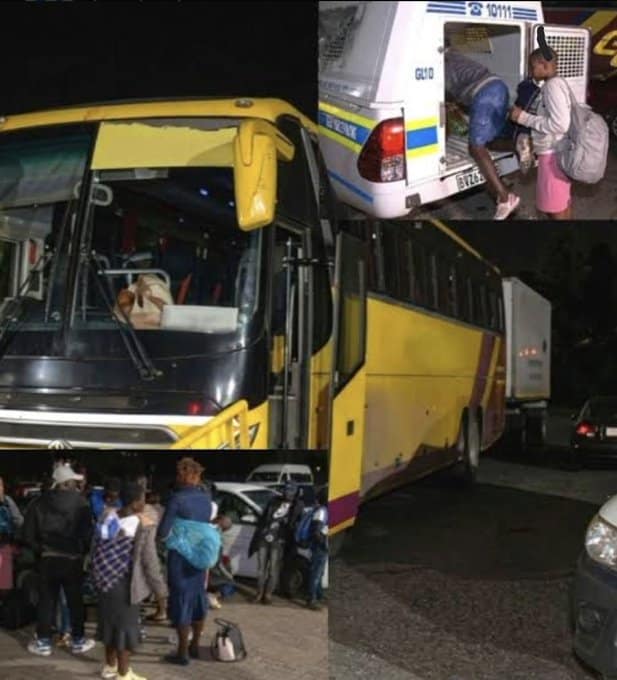
What began as a routine vehicle checkpoint along the N1 highway south of Bloemfontein in the early hours of Tuesday morning quickly unraveled into a scene of bureaucratic horror, humanitarian concern, and breathtaking negligence. Free State traffic officers, conducting a standard roadworthiness and documentation sweep, intercepted a long-distance passenger bus traveling from Zimbabwe to Cape Town—only to discover that the vehicle was carrying 29 undocumented passengers, including seven minors, was plagued with critical mechanical defects, and was being operated by a driver who had no valid license to be behind the wheel.
The Free State Department of Community Safety, Roads, and Transport has since described the interception as “one of the most alarming traffic stops in recent memory,” raising urgent questions about cross-border transport regulation, passenger safety, and human trafficking vulnerabilities.
The Stop: A Routine Check Turns Alarming
At approximately 3:45 a.m. on Tuesday, a multi-disciplinary team comprising provincial traffic officers, Home Affairs immigration officials, and the South African Police Service (SAPS) set up a roadblock near the Winburg off-ramp, a known transit point for cross-border buses heading south toward the Western Cape. The team had been alerted by intelligence reports of a possible increase in undocumented cross-border movement, but even seasoned officers were unprepared for what they found.
The bus—a battered 2004 Marcopolo Paradiso with faded Zimbabwean registration plates—was waved into the inspection bay after officers noticed smoke trailing from its rear axle and a front tire that was visibly balding. When the bus shuddered to a halt, the driver, a 44-year-old Zimbabwean national later identified as Mr. T. Moyo, emerged from the cabin with a nervous smile. Asked to produce his professional driving permit (PrDP) and a valid driver’s license, Moyo fumbled through a stack of crumpled papers before handing over an expired Zimbabwean license that had lapsed in 2019.
“He could not produce a PrDP at all,” said Free State Traffic spokesperson Thabo Khoza in a media briefing. “When we ran his name through the system, there was no record of him ever having been issued a valid South African driving permit. He was operating a 60-seater passenger bus on one of the country’s busiest highways without a single shred of legal authority to do so.”
The Passengers: 29 Souls Without Papers
But the driver’s lack of credentials was only the first layer of a deepening crisis. When immigration officials boarded the bus to conduct a routine headcount and document inspection, they found 48 passengers in total—but only 19 could produce valid passports or asylum seeker documents. The remaining 29, including seven children between the ages of 3 and 14, had no identification whatsoever.
The passengers, mostly Zimbabwean and Malawian nationals, told officials through a Shona interpreter that they had boarded the bus in Harare and Bulawayo over 24 hours, paying between R800 and R1,200 each for the journey to Cape Town, where they hoped to find work in agriculture, domestic service, or the informal sector. Several said they had been told by the driver that “papers would be arranged at the border” — a promise that never materialized.
Among the group was a 16-year-old unaccompanied minor, a girl who gave her name only as “Precious.” She told social workers later that she had left a village outside Masvingo after her parents died of illness and that she was traveling to Cape Town to meet “an aunt” whose address she could not provide. She had no phone number, no written contact, and no means of identifying the relative.
“We see this pattern far too often,” said Nomasonto Dlamini, a provincial social worker who was called to the scene. “Vulnerable individuals—especially minors—are placed on buses with promises of jobs or family reunions. But there is no follow-up, no documentation, no safety net. They become invisible the moment they cross the border.”
The Bus: A Mechanical Death Trap
As immigration officials processed the passengers, traffic officers conducted a full mechanical inspection of the bus. What they found prompted an immediate impound order.
The vehicle’s defects included:
- Complete brake failure on the rear left axle – The bus had been running on only two functioning brakes.
- A cracked steering column – Compromising the driver’s ability to steer safely, especially in emergency conditions.
- Three tires worn below legal tread depth – One of which had exposed steel cord.
- No fire extinguisher or emergency first-aid kit – In violation of cross-border transport regulations.
- Faulty emergency exits – Two of the four rear emergency hatches were welded shut.
- Severe oil leakage – Creating a fire risk and causing the axle smoke that initially attracted officers’ attention.
“A bus in this condition has no business being on a road, let alone carrying 48 human beings across international borders,” Khoza said. “If this vehicle had attempted to descend Van Reenen’s Pass or any of the steep mountain roads into the Western Cape, a brake failure could have resulted in a mass casualty event. The fact that it made it as far as Winburg is nothing short of a miracle.”
The Driver: A Pattern of Evasion
Further investigation revealed that driver T. Moyo was not merely an opportunistic offender. Records obtained by provincial enforcement agencies show that Moyo had been flagged at the Beitbridge border post three times in the past 18 months for documentation irregularities—but each time, he was allowed to proceed after paying an alleged “on-the-spot fine” to unnamed officials. The Free State Department of Community Safety has since referred this information to the Hawks for a possible corruption investigation.
Moyo was arrested at the scene and faces charges including:
- Driving without a valid license and a PrDP
- Operating an unroadworthy commercial vehicle
- Reckless and negligent driving
- Contravening the Immigration Act (by transporting undocumented persons)
- Child endangerment (seven counts)
He is expected to appear in the Winburg Magistrate’s Court on Thursday. The state has indicated it will oppose bail, citing the severity of the charges and the risk that Moyo may flee the country.
The Passengers’ Fate: Between Detention and Protection
The 29 undocumented passengers were transported to a temporary holding facility in Bloemfontein, where Home Affairs officials began the process of interviewing each individual to determine their status and needs. According to a statement from the Department of Home Affairs, the seven minors have been placed in the care of social workers while officials attempt to trace relatives or guardians.
“None of the 29 individuals will be deported immediately,” said Home Affairs regional manager Lerato Phiri. “We are required by law to screen for asylum claims, victims of human trafficking, and unaccompanied minors. However, those found to have no legal basis to remain in South Africa will be processed for voluntary return or removal.”
Human rights groups have since raised concerns about the conditions at the holding facility. Lawyers for Human Rights sent a monitoring team to Bloemfontein on Wednesday and confirmed that while basic needs were being met, several of the detained passengers had not been given access to legal counsel.
“These individuals are primarily economic migrants and asylum seekers,” said attorney Thabo Mchunu, who is representing four of the detained adults. “Criminalizing their presence without addressing the systemic failures at our borders—including corruption and lax enforcement against transport operators—solves nothing. The bus owner and the corrupt officials who waved this vehicle through checkpoints should be the primary targets of prosecution.”
Official Response: ‘Zero Tolerance’
Free State MEC for Community Safety, Roads and Transport, MaQueen Letsoha-Mathae, issued a strongly worded statement on Wednesday afternoon, commending the traffic officers who made the discovery and warning transport operators that similar operations would intensify.
“This interception is a wake-up call,” Letsoha-Mathae said. “An unlicensed driver, a mechanically unsafe bus, and nearly thirty human beings with no documentation—traveling through the night, including small children. This is not a victimless violation. It is a direct threat to public safety and a potential humanitarian crisis waiting to happen. We will be pursuing the owner of this bus, and we will be asking tough questions about how this vehicle was allowed to cross Beitbridge.”
She added that the department would be launching a month-long special operation targeting cross-border buses along the N1, N3, and N6 routes, with a focus on mechanical fitness, driver documentation, and passenger manifests.
A Narrow Escape
For the 48 passengers originally aboard the bus, the journey to Cape Town has been indefinitely suspended. The 19 documented passengers were eventually rebooked on a different, compliant bus service and continued their trip on Tuesday evening—arriving in Cape Town nearly 14 hours behind schedule.
The remaining 29 remain in limbo, waiting in a Bloemfontein holding facility behind razor wire, their hopes of work and reunion replaced by interviews, fingerprints, and legal proceedings.
Among them is Precious, the 16-year-old girl who left her village with nothing but a plastic bag of clothes and a crumpled photograph of a woman she believes to be her aunt. When a social worker asked her if she understood what was happening, she reportedly replied in broken English: “I just wanted to get there. I didn’t know the bus was bad. I didn’t know I needed papers. I just wanted to start my life.”
Her life will now begin—at least for now—in the gray corridors of a government facility, waiting for a system that rarely moves quickly to decide whether she is a victim, a migrant, or simply invisible.
About The Author