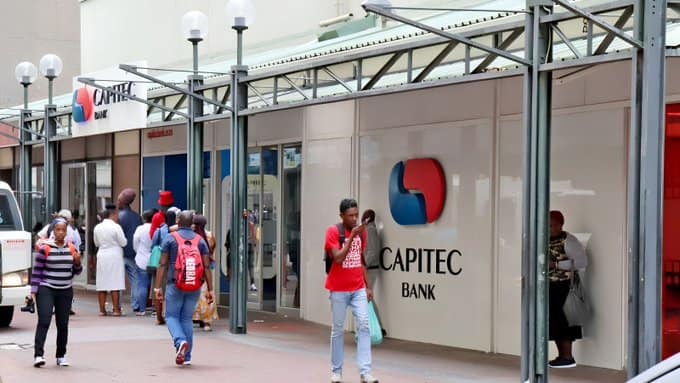
In a year marked by economic uncertainty, high interest rates, and relentless pressure on household finances, one South African institution has not only survived but thrived. Capitec Bank, the challenger that upended the country’s banking landscape two decades ago, has once again delivered a set of results that will force its rivals back to the drawing board.
The Stellenbosch-based lender reported headline earnings of R16.84 billion for the year ended 28 February 2026, a staggering 22% increase from the previous year. The record-breaking performance was driven by double-digit growth across its core banking business, a standout contribution from its insurance division, and the continued expansion of its digital and international operations.
But perhaps the most telling statistic was this: Capitec now serves 26 million clients. That is more than one in three South African adults. It is a client base that rivals, and in some cases exceeds, the populations of entire African nations. It is a testament to a strategy that has remained remarkably consistent since the bank opened its doors in 2001: simplicity, affordability, and accessibility.
“We are not trying to be all things to all people,” said Capitec CEO Gerrie Fourie, speaking from the bank’s headquarters in Stellenbosch. “We are trying to be the best bank for the majority of South Africans. That means keeping it simple. That means keeping it affordable. That means being there when our clients need us. The results speak for themselves.”
The Numbers: A Deep Dive
Capitec’s full-year results, released on Thursday morning, exceeded market expectations across almost every metric.
Headline Earnings: R16.84 billion, up 22% from R13.81 billion in the prior year. This represents the bank’s highest ever profit, surpassing even the most optimistic analyst forecasts.
Earnings Per Share (EPS): 5,431 cents, up from 4,452 cents. Diluted EPS came in at 5,413 cents.
Return on Equity (ROE): An impressive 31.2%, down slightly from 32.5% in the prior year but still among the highest in the global banking sector.
Net Interest Income: R47.2 billion, up 18% year-on-year, driven by loan book growth and disciplined pricing.
Non-Interest Revenue: R22.1 billion, up 15%, reflecting strong fee income from transaction accounts and card usage.
Credit Loss Ratio: 6.9%, up from 6.1% in the prior year, reflecting the challenging economic environment and higher levels of consumer stress. However, the ratio remains within the bank’s target range of 6-8%.
Cost-to-Income Ratio: 38.2%, down from 39.5%, indicating improved operational efficiency despite inflationary pressures.
Dividend: The board declared a final dividend of 2,150 cents per share, bringing the total dividend for the year to 3,450 cents, up 23% from the prior year.
“The results are exceptional,” said a banking analyst at a major Johannesburg brokerage. “Capitec continues to execute flawlessly. They are gaining market share in a stagnant market. They are growing profits in a high-interest-rate environment that is crushing their competitors. It is a masterclass in banking.”
The Drivers: What Is Fueling Capitec’s Growth?
Capitec’s success is not accidental. It is the result of a multi-pronged strategy that has been executed with discipline and consistency.
1. Core Banking Growth: Capitec’s traditional business—transaction accounts, savings accounts, and personal loans—continues to be the engine of growth. The bank added 1.8 million new clients during the year, bringing its total active client base to 26 million. Transaction volumes rose by 20%, and card swipes increased by 19%.
“Our clients are using us more,” said Fourie. “They are not just using us for loans. They are using us for their everyday banking—for groceries, for bills, for savings. We have become their primary bank.”
The shift from “loan provider” to “primary bank” has been a deliberate strategy. Capitec has invested heavily in its digital platform, making it easier for clients to manage their money, pay bills, buy airtime and data, and even invest in fixed deposits. The result: higher engagement, higher loyalty, and higher profitability.
2. Insurance Division Standout: Capitec’s insurance division, which offers credit life insurance, funeral cover, and other products, delivered a standout performance. Gross written premiums rose by 32% to R6.5 billion, while underwriting profits more than doubled.
“Insurance is a natural adjacency for us,” said Fourie. “Our clients trust us. They already have their accounts with us. Adding insurance is a simple, low-cost way to provide more value.”
The insurance division’s success has caught the attention of competitors, many of whom have struggled to make their own insurance offerings profitable. Capitec’s secret: distribution. By selling insurance through its existing banking channels—branches, app, call centre—the bank avoids the high acquisition costs that plague traditional insurers.
3. Digital Expansion: Capitec’s digital platform, which includes its mobile app and internet banking, continues to evolve. The bank now has 18 million active digital clients, representing 69% of its total client base. Digital adoption is highest among younger clients, but even older clients are increasingly comfortable managing their money online.
“We are not forcing anyone to go digital,” said Fourie. “We still have branches. We still have human tellers. But more and more clients are choosing digital because it is convenient. That is their choice. We are just making it possible.”
The bank’s app, which has been rated as the best banking app in South Africa by several independent surveys, now offers features like budgeting tools, savings goals, and even investment advice. The app is free to download and use, with only transaction fees applying.
4. International Operations: Capitec’s international division, which offers cross-border payments and remittances, is still small but growing rapidly. Revenue from international operations rose by 45% to R850 million, driven by increased demand from South Africans working abroad and sending money home.
“The world is becoming smaller,” said Fourie. “South Africans are traveling more, working more, living more internationally. We want to be there for them wherever they are.”
Capitec has partnered with international payment providers to offer competitive exchange rates and low fees. The bank is also exploring the possibility of launching a digital-only bank in other African countries, though no firm plans have been announced.
The Competitive Landscape: How Capitec Stacks Up
Capitec’s results stand in stark contrast to those of its competitors. South Africa’s “Big Four” banks—Standard Bank, FirstRand (FNB), Absa, and Nedbank—have all reported slower growth, margin compression, and increased credit losses.
| Bank | Headline Earnings Growth (Most Recent Full Year) |
|---|---|
| Capitec | +22% |
| FirstRand | +8% |
| Absa | +5% |
| Standard Bank | +4% |
| Nedbank | +3% |
Why is Capitec outperforming? Analysts point to several factors:
- Simpler business model: Capitec does not have investment banking, corporate lending, or wealth management divisions. It focuses exclusively on retail banking. That focus allows it to allocate resources more efficiently and avoid the complexity that plagues larger banks.
- Lower cost base: Capitec’s cost-to-income ratio of 38.2% is significantly lower than its competitors, which average 55-60%. The difference is driven by lower branch costs (Capitec branches are smaller and less ornate), lower staff costs (Capitec pays competitive but not excessive salaries), and lower technology costs (Capitec uses off-the-shelf software rather than custom-built systems).
- Better credit risk management: Capitec’s credit loss ratio of 6.9% is higher than its competitors (which average 4-5%), but the bank’s lending is focused on higher-margin, higher-risk personal loans. The bank’s sophisticated credit scoring model allows it to price risk accurately and avoid the worst defaults.
- Stronger client relationships: Capitec’s clients are more engaged and more loyal than those of its competitors. The bank’s net promoter score (NPS), a measure of customer satisfaction, is consistently the highest in the industry.
“Capitec has cracked the code,” said a banking analyst. “They have built a business that is simple, scalable, and profitable. Their competitors are trying to copy them, but they cannot. They are too big, too complex, too set in their ways.”
The Economic Environment: Navigating Headwinds
Capitec’s results are even more impressive given the challenging economic environment. South Africa’s economy grew by just 0.8% in 2025, with high interest rates (the repo rate averaged 8.25% during the year), high inflation (averaging 5.2%), and high unemployment (32.1%) weighing on household finances.
“The consumer is under pressure,” said Fourie. “We see it in the data. More clients are drawing down their savings. More clients are using credit to cover basic expenses. More clients are falling behind on their payments. We are not immune to that.”
Capitec’s response has been to tighten its credit criteria, reduce loan sizes, and increase provisions for bad debts. The bank has also increased its focus on savings and insurance products, which are less cyclical than lending.
“We are not chasing growth at any cost,” said Fourie. “We are growing responsibly. That means saying no to clients who cannot afford credit. That means helping clients who are struggling. That means being a responsible lender. That is not just good ethics. It is good business.”
The Client Base: 26 Million and Growing
Capitec’s 26 million active clients represent a staggering 38% of South Africa’s adult population. The bank’s penetration is highest among lower- and middle-income households, but it is increasingly gaining traction among higher-income households as well.
“We are seeing more professionals, more business owners, more affluent clients choosing Capitec,” said Fourie. “They are attracted by our low fees, our simple products, and our digital platform. They may keep their investment accounts elsewhere, but for everyday banking, they choose us.”
The bank’s growth has not come at the expense of service quality. Capitec’s branch network, which consists of approximately 850 branches nationwide, remains open six days a week. The bank’s call centre is available 24/7. The bank’s app is consistently rated as the best in the country.
“Our clients are our shareholders,” said Fourie. “We work for them. That is our philosophy. That is our culture. That is why we keep winning.”
The Digital Future: What’s Next for Capitec?
Capitec is not resting on its laurels. The bank is investing heavily in its digital capabilities, with a particular focus on artificial intelligence (AI) and machine learning.
“We are using AI to predict client behaviour, to detect fraud, to personalise offers,” said Fourie. “The more we know about our clients, the better we can serve them. But we are very careful about privacy. We do not sell client data. We do not share client data. We use data only to improve our service.”
Capitec is also exploring the possibility of launching a “banking-as-a-service” platform, allowing third-party developers to build applications that integrate with Capitec’s systems. The platform could open up new revenue streams and attract a new generation of tech-savvy clients.
“We want to be the platform on which other businesses are built,” said Fourie. “That is a long-term vision. But we are already taking the first steps.”
The Risks: What Could Go Wrong?
Despite its stellar performance, Capitec is not without risks.
- Economic downturn: If the South African economy weakens further, credit losses could spike, and loan growth could slow. Capitec’s credit loss ratio is already elevated; a severe recession could push it above the bank’s target range.
- Regulatory changes: The National Credit Regulator (NCR) has been critical of Capitec’s lending practices in the past, and the bank remains under scrutiny. New regulations could limit the bank’s ability to charge high interest rates or collect debts aggressively.
- Competition: Competitors are copying Capitec’s playbook. FNB has launched a low-cost “digital bank” called “FNB Connect.” Absa has simplified its product range. Standard Bank has invested in its mobile app. The gap is narrowing.
- Key person risk: Capitec’s success is closely associated with its CEO, Gerrie Fourie, who has led the bank since 2013. If Fourie were to leave, the bank could struggle to maintain its strategic direction.
Fourie acknowledged the risks but expressed confidence in the bank’s resilience. “We have been through tough times before,” he said. “We survived the pandemic. We survived the riots. We survived the floods. We will survive whatever comes next. We are Capitec. That is what we do.”
The Analyst View: Bullish on Capitec
Market analysts are overwhelmingly bullish on Capitec. The bank’s share price has risen by 35% over the past year, outperforming the JSE All Share Index by a wide margin.
“Capitec is a buy,” said a research note from a major brokerage. “The bank’s growth trajectory is intact. Its competitive moat is widening. Its valuation is reasonable. We see further upside.”
Others were more cautious. “Capitec is a great bank, but it is not cheap,” said a fund manager. “The share price already reflects a lot of good news. Any disappointment—a slowdown in client growth, a spike in credit losses, a regulatory intervention—could trigger a sharp correction.”
Fourie dismissed the valuation concerns. “We do not manage the bank for the share price,” he said. “We manage the bank for the clients. If we serve the clients well, the share price will take care of itself.”
The Client Perspective: A Bank for the People
To understand Capitec’s success, one must talk to its clients.
“I switched to Capitec three years ago,” said a teacher in Soweto. “My previous bank was charging me R150 a month in fees. Capitec charges me R7. That is money I can use to feed my children. I will never go back.”
A small business owner in Durban echoed the sentiment. “I have a business account with Capitec,” he said. “It is simple. It is cheap. I can do everything from my phone. I do not need to visit a branch. I do not need to wait on hold. It just works.”
A retired pensioner in Cape Town was more cautious. “I am not tech-savvy,” she said. “I still like to go to the branch. The people at Capitec are friendly. They help me. They do not make me feel stupid. That is worth more than low fees.”
These stories, multiplied by 26 million, are the foundation of Capitec’s success. The bank has not just won clients. It has won hearts and minds.
The Final Word: Capitec’s Moment
Capitec’s record R16.84 billion profit and 26 million client base are not just numbers. They are a statement. They are a declaration that the challenger has become the champion. That the disruptor has become the establishment. That the bank for the people has become the bank for the majority.
“We are proud of what we have achieved,” said Fourie. “But we are not satisfied. We have 26 million clients. There are 44 million adults in South Africa. That means 18 million are still not with us. We want them. We will earn them. One client at a time.”
The road ahead is uncertain. The economy is fragile. The competition is fierce. The risks are real. But if Capitec’s past is any guide, the bank will navigate these challenges with the same discipline, the same focus, and the same commitment that brought it this far.
Capitec is no longer the underdog. It is the leader. And it is showing no signs of slowing down.
Capitec’s full annual report will be published on the bank’s website. The bank’s annual general meeting will be held on 15 June 2026. Gerrie Fourie will host a results presentation for analysts and investors on Friday, 25 April 2026.
About The Author