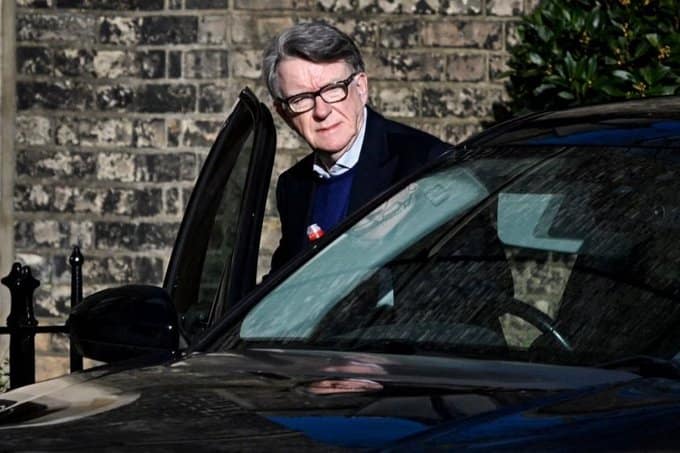
The arrest came just after 7 a.m. on a grey Tuesday morning in Primrose Hill, one of north London’s most coveted and discreet neighbourhoods. Residents on the tree-lined street, accustomed to the quiet comings and goings of celebrities and politicians, were startled by the sudden flash of blue lights. Unmarked police vehicles had converged outside a £6 million Georgian townhouse, and within minutes, the man known for decades as the “Prince of Darkness” was being led out in handcuffs.
Peter Mandelson, 72, a figure who has loomed over British politics for nearly forty years and who until recently served as the country’s ambassador to the United States, was arrested on suspicion of misconduct in public office. The charge, sources confirmed, is directly linked to his long-standing and deeply controversial connections with the late convicted sex offender and financier, Jeffrey Epstein.
The arrest of a man of Mandelson’s stature—a peer of the realm, a key architect of New Labour, and a former First Secretary of State—sent a seismic shock through the political establishment. For a government already grappling with crises of trust, the image of one of its most seasoned operators being taken into custody was nothing short of cataclysmic.
The Threads of a Damning Tapestry
The investigation that led to Mandelson’s front door is part of a sprawling, multi-national probe into the network of enablers and associates who facilitated Epstein’s decades-long abuse of young women and girls. While Epstein died by suicide in a Manhattan jail cell in 2019 while awaiting trial, the question of who helped him—and what they knew—has continued to haunt the corridors of power on both sides of the Atlantic.
For Mandelson, the threads connecting him to Epstein have been public knowledge for years, but were often dismissed as the tangential associations of a well-connected global figure. The friendship dates back to the late 1990s, when a rising Mandelson was introduced to the enigmatic financier. Over the following two decades, their paths crossed repeatedly.
Records show Mandelson travelled on Epstein’s infamous “Lolita Express” private jet on at least two occasions. Flight logs, which have been pored over by investigators and journalists alike, place him on flights to Epstein’s private island in the U.S. Virgin Islands, Little St. James—a location now synonymous with the trafficking operation. Mandelson has previously acknowledged the flights, describing them as brief visits to discuss geopolitical matters with the well-connected Epstein, whom he claimed to have regarded merely as a “friend of friends” and a source of introductions to the wealthy elite.
The “Ambassador” Connection
The crux of the new investigation, however, is believed to focus less on the travel itself and more on what Mandelson did—or failed to do—with the information he may have possessed. Sources close to the inquiry suggest that police are examining whether Mandelson used his powerful public positions to shield Epstein or to provide him with legitimacy, thereby committing misconduct in public office.
This line of inquiry is particularly pointed regarding his role as the UK’s Ambassador to the US between 2022 and 2025. Investigators are looking into whether Mandelson maintained or concealed communications with Epstein associates during his tenure in Washington D.C., and whether he leveraged his ambassadorial status to assist individuals connected to the Epstein network in exchange for influence or favours.
“Misconduct in public office is a serious charge that involves a public official wilfully neglecting their duty or abusing their position,” explained a legal analyst familiar with the case. “The prosecution would need to prove that Mandelson had a duty to act, that he knew something compromising about Epstein or his operation, and that he chose to bury it or actively facilitate their interests rather than report it.”
The charge carries a maximum sentence of life imprisonment, reflecting the gravity with which the British legal system views the corruption of public trust.
A Life of Comebacks Faces Its Greatest Test
For Peter Mandelson, the arrest represents the most severe crisis in a life defined by spectacular falls and even more spectacular comebacks. The grandson of Herbert Morrison, a towering figure of post-war Labour politics, Mandelson was the ultimate political insider. As a key strategist for Tony Blair and Gordon Brown, he was instrumental in dragging the Labour Party from the hard left to the electable centre, rebranding it as “New Labour.”
His career has been a rollercoaster of scandal and rehabilitation. He resigned from the Cabinet twice—once over a hidden home loan from a fellow minister, and again over allegations of favouritism in a passport application for an Indian billionaire. Each time, he returned, eventually serving as Business Secretary and ultimately as a peer in the House of Lords. His appointment as ambassador to Washington was seen as the ultimate rehabilitation, a recognition of his status as a global statesman.
Now, that legacy is in tatters. The arrest warrant, executed by officers from the Metropolitan Police’s specialist crime command, was the result of a lengthy investigation that intensified after the US Congress released thousands of pages of Epstein-related documents. Those documents included emails and contact lists that placed Mandelson in closer proximity to the operation than he had previously admitted.
The Political Fallout
The political reverberations were immediate. Inside the Houses of Parliament, the news dominated whispered conversations in Westminster Hall. Opposition leaders demanded a full inquiry into who knew what and when about Mandelson’s associations before he was appointed to sensitive public roles.
A spokesperson for the Foreign Office stated that Lord Mandelson’s ambassadorial duties had concluded last month and that they were “unable to comment on an ongoing police matter.” The Labour Party, of which Mandelson remains a life peer, released a terse statement noting that “the proper legal processes must now be allowed to take their course.”
Meanwhile, outside the police station in central London where Mandelson was taken for questioning, a small crowd of reporters and photographers gathered in the cold drizzle. By late afternoon, a police van emerged, its windows blacked out, whisking him to an undisclosed location for further interviews. He was later released on bail pending further investigation, a standard procedure in complex cases of this nature.
The Unanswered Questions
As the sun set over the city Mandelson once helped shape, the questions lingered. What did the “Prince of Darkness” actually know about the shadows cast by Jeffrey Epstein? Did he turn a blind eye to the source of his host’s wealth and hospitality? And most critically for the prosecutors, did he use the power of the British state to protect those secrets?
For the victims of Jeffrey Epstein, who have fought for years to hold enablers accountable, the arrest of a man of Mandelson’s rank is a significant, if long-overdue, step. It signals that the circle of accountability is widening, and that no matter how high a person has climbed, the connections to the disgraced financier may finally drag them down.
In Primrose Hill, the lights in Mandelson’s townhouse remained off. The man who spent a lifetime pulling the strings of power was now just another defendant, waiting to see how the rest of the story would be written.
About The Author