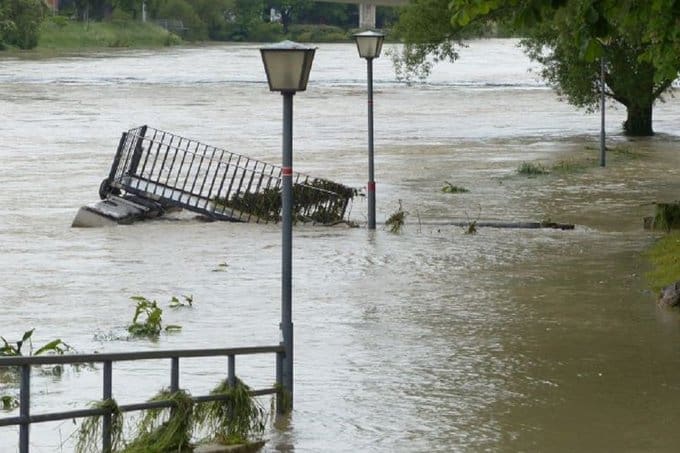
Learning has come to a grinding halt in the rural village of Disaneng, located just outside Mahikeng in South Africa’s North West province, after the nearby Setumo River burst its banks following three consecutive days of torrential rains. The flooding has forced the closure of at least eight schools, left hundreds of learners and dozens of teachers stranded, and turned roads into impassable rivers, raising urgent concerns about the safety of children in one of the province’s most flood-prone communities.
The disaster, which began in the early hours of Monday morning, 20 April 2026, has submerged large swathes of the village, with water levels reaching as high as 1.5 meters in some low-lying areas. Rescue teams have been deployed to evacuate stranded families, but the focus has now shifted to the educational crisis unfolding as the region’s schools remain inaccessible for a second consecutive day.
Schools Turned into Islands
By Monday morning, the situation had deteriorated rapidly. What began as a swollen river overflowing its banks on Sunday night had, by dawn, transformed the village’s main access roads into muddy, fast-flowing streams. The Disaneng Primary School, one of the largest in the area, found itself completely cut off, with water lapping at the gates and flooding the sports field.
“We arrived at 6 a.m. to find the entire school surrounded by water,” said Elias Mothibi, the principal of Disaneng Primary. “The bridge that connects the village to the main road was underwater. Some learners had already walked halfway to school before they realized they could not get through. I had to send messages to parents telling them to keep their children at home. It broke my heart because many of these children rely on the school for meals.”
Across the village, similar scenes unfolded. Disaneng Secondary School, Tshiamo Intermediate School, and six other primary and combined schools were forced to close their doors. In total, an estimated 2,500 learners have been affected, with many now stuck at home indefinitely.
“The water came so fast,” said 13-year-old Keitumetse Seboko, a Grade 7 learner at Disaneng Primary. “We were getting ready for school when my mother said we cannot go because the river is too big. I am worried about my exams. We have tests next week, but we cannot study because we have no electricity and no books at home.”
The River That Would Not Stay in Its Banks
The Setumo River, which flows along the eastern edge of Disaneng, is no stranger to seasonal flooding. However, residents say the intensity and speed of this week’s floods are unlike anything they have seen in over a decade.
According to the South African Weather Service (SAWS), the Mahikeng area received 187mm of rain between Friday and Sunday—more than double the average rainfall for the entire month of April. The deluge, caused by a persistent low-pressure system over the central interior, overwhelmed the river’s capacity, forcing it to burst its banks at three separate points along a 5-kilometer stretch.
“The ground was already saturated from rains earlier in the month. When this latest system arrived, there was nowhere for the water to go,” said SAWS forecaster Thandi Mokoena. “We issued a Level 6 warning for flooding in the area, but in rural communities like Disaneng, the infrastructure is simply not designed to handle this volume of water.”
The river’s flooding has not only affected schools but also destroyed several homes, washed away livestock, and contaminated the village’s main water supply. At least 200 families have been displaced, with many seeking refuge in a community hall that has been converted into an emergency shelter.
A Community on Its Knees
Walking through Disaneng on Tuesday morning, the devastation is everywhere. The main road through the village is now a muddy trench, littered with debris—tree branches, plastic containers, pieces of furniture, and the carcasses of chickens and goats. Children stand barefoot at the edges of the water, watching as rescue workers in inflatable boats ferry stranded residents to higher ground.
“We have lost everything,” said Mma-Nelly Moilwa, 58, a grandmother of six whose two-room house was inundated by knee-deep water. “My bed is ruined. My fridge is floating somewhere. And now my grandchildren cannot go to school. They are sitting in the dark because we have no electricity. I do not know how we will survive.”
The village’s only clinic has also been affected, with floodwaters damaging medical supplies and forcing staff to operate out of a mobile unit parked on a dry patch of land near the cemetery. Nurses are treating cases of hypothermia, diarrhea, and minor injuries, but they fear an outbreak of waterborne diseases if the floods do not recede soon.
“We need clean drinking water urgently,” said clinic sister Refilwe Modise. “Many families are drinking from the river because their taps are dry or contaminated. We have already seen three children with symptoms of gastroenteritis. If we do not get help, it will get worse.”
Education in Crisis
The closure of schools is perhaps the most immediate long-term concern for the community. Disaneng’s schools were already struggling before the floods—with overcrowded classrooms, a shortage of textbooks, and high dropout rates. Now, the additional disruption threatens to push vulnerable learners further behind.
“The timing could not be worse,” said regional education official Thabo Sebata, who visited the village on Tuesday. “We are approaching the end of the first term. Learners were preparing for their term tests. Now they have lost at least a week of learning. For Grade 12 students, this is especially devastating. Every day counts.”
The North West Department of Education has announced that all affected schools will remain closed until at least Monday, 27 April, pending a full assessment of the damage and a determination that the roads are safe for travel. However, many residents fear the closure could last longer.
“How can children go back to school when the toilets are flooded, when there is no clean water to drink, when the classrooms smell of mud and sewage?” asked Disaneng village headman, Kgoshi Lucas Moiloa. “We need the government to come and fix our schools. Not next month. Now.”
Government Response and Rescue Efforts
The North West Provincial Government has declared a local state of disaster in the Mahikeng area, unlocking emergency funds for relief efforts. Premier Lazarus Mokgosi visited Disaneng on Monday afternoon, wading through floodwaters to speak with displaced families and promising “immediate and sustained intervention.”
“I have seen with my own eyes the suffering of our people,” Mokgosi said. “We are deploying additional disaster management teams. We are arranging for mobile classrooms to be delivered. We are working with the Department of Social Development to provide food parcels, blankets, and mattresses. No one will be left behind.”
The South African National Defence Force (SANDF) has also been called in to assist, with helicopters airlifting stranded residents and delivering supplies to cut-off areas. The Department of Water and Sanitation is assessing the damage to the village’s water infrastructure, while the Department of Human Settlements has promised to provide temporary housing units for families whose homes were destroyed.
However, residents say the government’s response has been too slow. “Where were they on Sunday when the water was rising?” asked community activist Thabang Moiloa. “We had to rescue ourselves. We used ropes and old car tires to pull people out of their homes. The government only came after the cameras arrived.”
The Human Cost: Stories from the Water
Among the many heartbreaking stories emerging from Disaneng is that of the Molefe family. Mother of three, Nomsa Molefe, 34, was asleep with her children when water began pouring into their home at 3 a.m. on Monday.
“I woke up because I felt something wet on my feet. When I turned on my phone light, I saw water up to my ankles,” she recalled, her voice trembling. “I grabbed my youngest—she is only two years old—and I screamed for the others to follow me. We ran outside in our nightclothes. The water was already up to my waist. By morning, our home was gone.”
The family spent Monday night in the community hall, sleeping on a concrete floor with 80 other displaced residents. Nomsa’s children have not eaten properly in two days. Her eldest daughter, a Grade 10 learner, has been crying because she lost her school uniform and all her textbooks.
“I told her: ‘We will find a way,'” Nomsa said. “But I don’t know if we will. I don’t know anything anymore.”
Calls for Long-Term Solutions
While emergency relief is the immediate priority, residents and civil society groups are calling for long-term solutions to prevent future flooding disasters. Disaneng has flooded multiple times in the past decade, including major events in 2014, 2017, and 2021. Each time, the government has provided temporary relief. Each time, the underlying problems remain.
“You cannot keep doing the same thing and expect different results,” said Thapelo Moroka, a civil engineer and resident of Mahikeng. “The Setumo River needs proper flood defenses. The drainage systems in Disaneng need to be upgraded. The roads need to be raised. These are not luxuries. They are necessities. People’s lives depend on them.”
The Department of Water and Sanitation has acknowledged the need for infrastructure upgrades but says funding is limited. A proposed R50 million flood mitigation project for the Setumo River has been sitting in the planning phase since 2022, awaiting budget approval.
“How many more children must drown? How many more homes must be destroyed before they approve the budget?” asked Kgoshi Moiloa. “We are tired of promises. We want action.”
What Happens Next?
As the floodwaters slowly begin to recede—the SAWS has forecast clear skies for the remainder of the week—the focus will shift to recovery. The immediate priorities are:
- Reopening schools – Mobile classrooms and temporary sanitation facilities are being arranged.
- Restoring water and electricity – Technicians are working to repair damaged infrastructure.
- Providing emergency housing – Temporary units are being delivered for displaced families.
- Preventing disease outbreaks – Health officials are distributing water purification tablets and monitoring for cholera and typhoid.
The North West Department of Education has announced that catch-up programs will be implemented for affected learners once schools reopen. Extra classes on weekends and during the upcoming school holidays are being considered.
For now, however, the children of Disaneng remain at home—some in the ruins of their flooded houses, others in crowded shelters, and a lucky few with relatives in drier parts of the village. Their textbooks are soaked. Their uniforms are caked in mud. Their classrooms are silent.
A Final Reflection
In Disaneng, the river has always been a lifeline—providing water for drinking, washing, and farming. But this week, that same river became a destroyer. It tore through homes, swallowed roads, and stole the most precious thing of all: the education of a generation of children.
The waters will recede. The mud will dry. The schools will reopen. But for the 2,500 learners of Disaneng, the scars of this flood will remain. Some will never return to class—pulled out by parents who can no longer afford uniforms, or sent to work to help their families rebuild. Others will struggle to catch up, falling further behind in a system that already fails too many.
And somewhere, in a government office in Mahikeng or Pretoria, a file sits on a desk labeled “Setumo River Flood Mitigation – Proposed 2022.” It gathers dust. The budget remains unapproved. The plans remain unexecuted.
Until the next flood. Until the next tragedy. Until the next time a river reminds a village that it does not care about their exams, their homes, or their dreams.
The children of Disaneng are waiting. The question is: how long will they have to wait?
About The Author