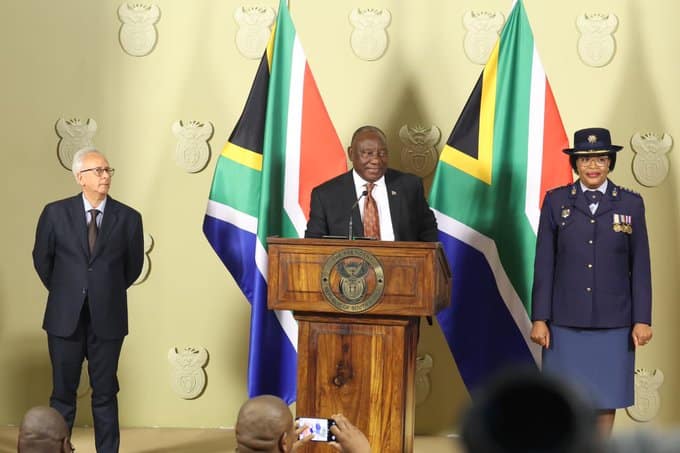
The wheels of justice turn slowly in South Africa, but occasionally, they grind with sudden, jarring finality. Just hours after President Cyril Ramaphosa concluded his tense media briefing at the Union Buildings—where he had stopped short of announcing a decision—the axe finally fell. General Fannie Masemola, the National Police Commissioner who had become a lightning rod for criticism over the spiralling crime crisis, was placed on precautionary suspension.
And in his place, with immediate effect, stepped Lieutenant General Puleng Dimpane.
The announcement, delivered in a curt, single-paragraph statement from the Ministry of Police late Thursday evening, sent shockwaves through the security establishment. Dimpane, a career officer with nearly three decades of service, is no stranger to the upper echelons of the South African Police Service (SAPS). But the acting commissioner role represents the most significant challenge of her career—a baptism by fire in an institution that is bleeding public trust.
“Lieutenant General Dimpane has been appointed as Acting National Police Commissioner effective immediately,” the statement read. “General Masemola’s suspension is precautionary and relates to an ongoing investigation into operational and administrative matters. The Ministry has full confidence in Lieutenant General Dimpane’s ability to lead the SAPS during this period.”
Masemola’s suspension, which many had predicted for weeks, was not accompanied by detailed reasons. But sources close to the investigation suggest it relates to allegations of irregular procurement, the mismanagement of intelligence resources, and a breakdown of accountability in the aftermath of the Thabo Bester prison escape. Masemola has denied any wrongdoing and is expected to challenge the suspension in court.
For now, however, the focus shifts to Dimpane. A woman of few words and formidable reputation, she now holds the most powerful position in South African policing—tasked with restoring morale, stemming the tide of violent crime, and navigating a treacherous political minefield.
The Rise of Puleng Dimpane: From the Streets to the Top
Lieutenant General Puleng Dimpane, 51, was born in Soweto, the daughter of a domestic worker and a factory labourer. She joined the SAPS in 1997, just three years after the advent of democracy, as a fresh-faced constable in the Johannesburg Central Police Station. In an organisation still dominated by white males and apartheid-era holdovers, she stood out: young, Black, female, and fiercely determined.
“She had fire in her belly,” recalls a retired senior officer who mentored her. “She was not afraid to speak truth to power. She was not afraid to arrest anyone, no matter how connected. She built a reputation for integrity in a system that often rewarded the opposite.”
Dimpane rose through the ranks steadily. She served as a detective in the Family Violence, Child Protection, and Sexual Offences unit, where she earned a commendation for securing a conviction against a serial rapist who had evaded capture for years. She later moved into visible policing, commanding stations in Soweto and the Johannesburg CBD, before being elevated to the rank of major general and placed in charge of policing in the Western Cape.
It was there that she made her name. The Western Cape, plagued by gang violence, extortion, and taxi-related killings, was a graveyard for police careers. Dimpane approached the challenge with a combination of community engagement and hard-nosed enforcement. She reopened community forums that had lain dormant. She purged corrupt officers from the Anti-Gang Unit. She ordered roadblocks in the most dangerous areas—and showed up to them herself, in the middle of the night.
“She was not a desk general,” says a Cape Town community activist who worked with her. “She was on the ground. She knew the names of the gang leaders. She knew the names of the victims. She was the first senior officer in years who actually listened.”
Dimpane’s success in the Western Cape brought her to the attention of national leadership. She was promoted to lieutenant general and appointed as Deputy National Commissioner for Policing in 2024, responsible for overseeing all operational policing across the country. It was a role that put her in direct line to succeed Masemola—though few expected the succession to happen this soon, or under these circumstances.
The First Hours: A Transition of Power
Within hours of the announcement, Dimpane was behind the desk in the commissioner’s office at the SAPS headquarters in Pretoria. The office had been cleared of Masemola’s personal effects—a jarring sight, according to one staff member who witnessed the handover.
“There was no bitterness,” says the staff member, who spoke on condition of anonymity. “General Masemola was dignified. He packed his things, shook hands with a few people, and walked out. General Dimpane arrived about an hour later. She asked for a cup of tea and a briefing on the weekend’s crime statistics. That was it. No grand entrance. No speech. Just tea and work.”
Her first official act was to summon the provincial commissioners of Gauteng, KwaZulu-Natal, and the Western Cape—the three provinces with the highest violent crime rates—to a crisis meeting at 6 AM the following morning. The meeting was not announced to the media. No photographs were taken. But a source who attended described it as “tense and businesslike.”
“She asked direct questions,” the source said. “She wanted to know why the murder rate in the Western Cape had increased by 8% in the first quarter of 2026. She wanted to know why the arrest rate for cash-in-transit heists in KZN had dropped to 12%. She wanted to know the names of the officers responsible for the failures. Not the unit names. The individual names.”
Dimpane also ordered an immediate audit of all specialised units, including the Hawks, the Tactical Response Team (TRT), and the Family Violence, Child Protection, and Sexual Offences units. The audit, she said, must be completed within 30 days.
“We have wasted too much time,” a source quoted her as saying. “The criminals are not waiting. The public is not waiting. Neither am I.”
The Challenges Ahead: A Mountain to Climb
Lieutenant General Dimpane inherits a police service in crisis. The statistics are brutal. The morale is low. The relationship between the SAPS and the communities it serves is fractured, often hostile.
Crime Statistics:
- Murder: 27,000 homicides in the past year—74 per day. The highest rate in two decades.
- Sexual offences: Over 53,000 cases reported, with conviction rates below 20%.
- Contact crimes (armed robbery, assault, carjacking): Up 7.2% year-on-year.
- Cash-in-transit heists: Back on the rise, with gangs operating with military precision.
Internal Challenges:
- Low morale: Officers are overworked, underpaid, and undersupported. Many work 12-hour shifts with no overtime. Suicides and stress-related illnesses are rampant.
- Corruption: From officers taking bribes to look the other way to commanders syphoning off budgets, corruption is endemic. The SAPS’s own anti-corruption unit is understaffed and often targets low-level offenders.
- Lack of resources: Many stations lack working vehicles, computers, or even basic stationery. Detectives carry caseloads that are impossible to manage. Forensic backlogs run into years.
- Political interference: The relationship between the police and the ministry has been dysfunctional, with ministers often bypassing the commissioner to issue direct orders to provincial commanders.
“Do not envy her,” says a former police commissioner. “She is walking into a nightmare. Her predecessor was eaten alive by the system. She may be eaten alive too. The only question is whether she can buy enough time to make a difference—and whether the President will give her the support she needs.”
The Political Dimension: A President’s Gamble
President Ramaphosa’s decision to suspend Masemola was a gamble. The president had resisted calls to act for months, conscious of the political fallout and the potential for legal challenge. But the pressure had become unbearable—from opposition parties, from civil society, from within the ANC itself.
“Suspending the national commissioner is not a decision a president takes lightly,” says political analyst Professor William Gumede. “It signals that the president believes the problem is not just the system but the leadership of the system. It is a vote of no confidence. And it raises the stakes for Dimpane. If she fails, the president fails.”
Ramaphosa’s allies insist that the president is committed to “rooting out incompetence” in the security cluster. They point to the appointment of Acting Police Minister Professor Firoz Cachalia as evidence that the president is willing to bring in “clean, capable” leadership.
“President Ramaphosa understands that safety is the number one issue for South Africans,” says an ANC NEC member. “He knows that if he does not fix the police, he will lose the 2029 election. Masemola was part of the problem. Dimpane is the solution. We hope.”
But others are more sceptical. “Masemola was appointed by Ramaphosa,” says an opposition MP. “He was a Ramaphosa man. Now Ramaphosa is throwing him under the bus to save himself. That is not leadership. That is survival. And Dimpane should be careful. She could be the next one thrown.”
The Reaction: A Nation Watches
The reaction to Masemola’s suspension and Dimpane’s appointment has been mixed, but the dominant tone is one of cautious hope.
Political Parties:
- Democratic Alliance (DA): “The suspension of Masemola is long overdue. But a new face is not enough. We need structural reform, a complete overhaul of the SAPS, and genuine accountability. We will hold Lieutenant General Dimpane to account.”
- Economic Freedom Fighters (EFF): “Masemola was a symptom, not the disease. The disease is the ANC’s criminal neglect of the people. Dimpane is just another pawn in the same rotten system. Nothing will change.”
- Inkatha Freedom Party (IFP): “We welcome the appointment of Lieutenant General Dimpane. She has a strong record. We wish her well. But we will be watching.”
Civil Society:
- South African Policing Union (SAPU): “We welcome the change in leadership. We call on Lieutenant General Dimpane to prioritise the welfare of frontline officers. They have been neglected for too long.”
- Gun Free South Africa: “We hope the new commissioner will take decisive action to address the illegal firearm epidemic. Without that, the murder rate will not drop.”
- #TotalShutdown: “We have seen commissioners come and go. They promise change. They deliver nothing. Dimpane must prove that she is different. The clock is ticking.”
The Public:
On social media, the reaction has been generally positive, though tempered with scepticism.
“Finally. Masemola had to go,” tweeted one user. “But Dimpane? Who is she? I hope she is not just another politician in uniform.”
Another user, a self-identified police officer, wrote: “General Dimpane is one of us. She knows the streets. She knows the struggle. For the first time in years, I am proud to put on my uniform.”
Dimpane’s First Address: A Message of Resolve
On Friday morning, Lieutenant General Dimpane released a short video address to the SAPS rank and file. It was unpolished, recorded on a cellphone, but it struck a chord.
“To every constable, every sergeant, every captain, every general,” she began. “I know you are tired. I know you are angry. I know you feel abandoned. But I am here to tell you: I see you. I hear you. And I will fight for you. But you must fight with me.”
She spoke without notes, her voice steady. “We have a job to do. It is a hard job. It is a dangerous job. But it is a noble job. We protect the innocent. We bring criminals to justice. We are the thin line between order and chaos. Do not let anyone tell you otherwise.”
Dimpane also addressed the public directly. “To the people of South Africa: I know you have lost faith. I know you are scared. I cannot promise that crime will disappear overnight. That would be a lie. But I can promise you this: we will try. Every day. Every night. We will not give up. And I ask you not to give up on us. We need your help. We need your information. We need your trust. Trust is earned. I intend to earn it.”
The video was viewed over 2 million times in its first six hours. It was shared by police officers, by victims’ families, by ordinary citizens. For a brief moment, there was something rare in South African policing discourse: hope.
The Road Ahead: 100 Days of Action
Dimpane has privately set herself a 100-day deadline to demonstrate progress. Within that period, she has committed to:
- Reducing the murder rate in priority precincts by at least 5% through targeted, high-visibility operations.
- Clearing the forensic backlog by outsourcing to private labs and redeploying analysts from non-critical roles.
- Launching a dedicated anti-corruption hotline for citizens to report police misconduct, with guaranteed anonymity and a promise of action within 7 days.
- Reopening all closed police stations that were shut down due to lack of resources, starting with 15 stations in the Eastern Cape and KZN.
- Publishing monthly, precinct-level crime statistics in an accessible, public dashboard, allowing citizens to see exactly how their local police are performing.
“These are ambitious targets,” says a senior police source. “Probably too ambitious. But that is Dimpane. She would rather aim high and miss than aim low and hit. That is what sets her apart.”
The Masemola Factor: A Cloud of Uncertainty
Masemola’s precautionary suspension is not a dismissal. He remains an employee of the SAPS, on full pay, pending the outcome of the investigation. That investigation could take months. In the meantime, Masemola is expected to launch a legal challenge, arguing that the suspension was procedurally flawed and substantively unfair.
If Masemola wins his challenge, Dimpane could be removed from the acting role just as she is finding her feet. It is a sword hanging over her head—one that her detractors will not hesitate to use against her.
“Masemola is not going quietly,” says a legal expert close to the case. “He has powerful allies. He has money. He has a legal team. This could drag on for months. In the meantime, Dimpane is acting. But ‘acting’ is not ‘permanent.’ It undermines her authority. Every decision she makes, every order she gives, can be questioned on the grounds that she is not the real commissioner.”
Dimpane has addressed the issue privately, telling confidants that she is “not worried about the politics.” “I was asked to do a job,” she said. “I will do it. If the courts say I cannot, I will leave. But until then, I am the commissioner. And I will act like it.”
The International Dimension: A Reputation at Stake
South Africa’s policing crisis is not just a domestic issue. It is an international embarrassment. The country has one of the highest murder rates in the world. Foreign governments issue travel advisories warning their citizens about the danger. Investors cite crime as a barrier to doing business.
The appointment of a new police commissioner—even an acting one—is therefore watched not just in Pretoria and Johannesburg, but in London, Washington, Beijing, and Frankfurt.
“The international community wants to see action,” says a foreign diplomat based in Pretoria. “Not just promises. Not just press conferences. Real, measurable action. If Dimpane can reduce the murder rate by even 5% in 100 days, that will send a powerful signal. If she cannot, the perception will be that nothing has changed.”
Dimpane is acutely aware of the international dimension. In her first meeting with the media—scheduled for Monday—she is expected to announce a series of partnerships with international law enforcement agencies, including the FBI, Interpol, and the EU’s law enforcement agency, Europol.
“We have much to learn from others,” a senior SAPS source said. “And they have much to learn from us. But the first step is admitting that we have a problem. General Dimpane has admitted it. Now she is acting.”
The Legacy of Masemola: A Cautionary Tale
As Masemola leaves the SAPS headquarters for what may be the final time, the question being asked in police canteens across the country is: what went wrong?
Masemola, a former spy chief, was appointed because of his intelligence background. The idea was that he would bring a “data-driven, analytical” approach to policing. He would target hotspots. He would disrupt criminal networks. He would modernise the SAPS.
But intelligence and policing are different crafts. Spies operate in the shadows; police are meant to be visible. Spies accumulate information; police act on it. Spies are accountable to their handlers; police are accountable to the public. Masemola never fully made the transition.
“He was a good man, but the wrong man for the job,” says a retired police general. “He did not understand community policing. He did not understand the importance of visibility. He thought he could fight crime from a computer screen. You cannot. You have to be on the ground. You have to be in the streets. You have to be seen.”
Masemola’s defenders argue that he was set up to fail. “He inherited a mess,” says a former colleague. “Years of neglect. Years of corruption. Years of political interference. No one could have fixed it in four years. He was a scapegoat. And Dimpane will be the next scapegoat if she is not careful.”
The First Test: This Weekend’s Operations
Dimpane’s first real test comes this weekend. She has ordered a nationwide “high-density” operation, code-named Operation Reclaim, targeting crime hotspots in Gauteng, KZN, and the Western Cape.
Thousands of officers have been deployed. Roadblocks have been set up on major highways. Raids are planned in known drug dens and hijacking hotspots. The operation is designed to send a message: the new sheriff is in town.
“The criminals are watching,” says a senior police source. “They will test her. They will see if she is serious. She is. This weekend, they will feel it.”
Dimpane herself is expected to be on the ground, moving between operations in Soweto, Umlazi, and Manenberg. She will not be in uniform, but she will be there—watching, listening, learning.
“I do not lead from behind a desk,” she said in her video address. “I lead from the front. You will see me. You will hear me. And you will know that I am with you. Every step of the way.”
The Final Word: A New Dawn or a False Hope?
Lieutenant General Puleng Dimpane is not a saviour. She is a police officer. A good one, by all accounts. But no single individual can fix the systemic rot that has infected the SAPS over three decades.
The challenges are too deep. The resources are too scarce. The politics are too brutal. And the criminals are too well-organised.
But Dimpane brings something that has been missing from the top of the SAPS for years: credibility. She has walked the walk. She has bled the blood. She knows the names of the fallen. She has attended the funerals. She has looked into the eyes of grieving mothers and told them the truth.
That may not be enough. It probably is not. But it is a start.
And for a nation that has lost hope, a start is everything.
“The police are back,” Dimpane said at the end of her video address. “We never left. But now, we are back. Watch us.”
The country is watching. The criminals are watching. History is watching.
Lieutenant General Puleng Dimpane, Acting National Police Commissioner of South Africa, is in the hot seat.
About The Author