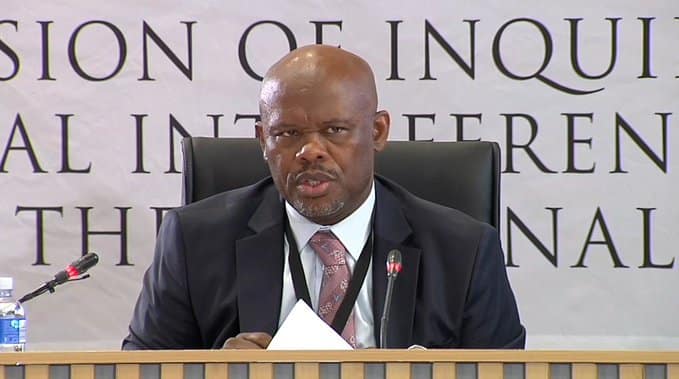
PRETORIA – The polished brass and epaulettes of high office seemed a distant memory for suspended Deputy National Commissioner for Crime Detection Lieutenant-General Shadrack Sibiya on Tuesday, as he sat alone in the witness box at the Madlanga Commission, offering a portrait of a man stripped of his power and cornered by his own testimony.
After days of grueling cross-examination that methodically peeled back the layers of his connections to alleged underworld figures, a visibly weary Sibiya told the commission he felt “helpless” and “pushed into a corner,” unable to escape the mounting evidence and repeated patterns that have come to define his testimony.
The commission, chaired by retired Justice Sisi Khampepe, has become the stage for a dramatic unraveling of Sibiya’s once-stellar career. What began as an inquiry into allegations of corruption and misconduct within the South African Police Service has widened into a sprawling examination of the murky relationship between high-ranking police officials and the criminal networks they are meant to be pursuing.
“I have given my account. I have answered every question put to me,” Sibiya said, his voice carrying a weariness that seemed to fill the sterile hearing room. “And yet, I am made to feel helpless, as if my explanations count for nothing. I am pushed into a corner with no way out.”
But if Sibiya hoped to elicit sympathy, the evidence presented immediately following his testimony suggested the commission was in no mood to let up.
The Ekurhuleni Dimension: A New Front Opens
Even as Sibiya stepped down, fresh testimony was being entered into the record that threatened to further implicate him and, more broadly, to expose deep and systemic rot within the Ekurhuleni Metropolitan Police Department (EMPD).
Whistleblower testimony and documentary evidence presented to the commission detailed a web of corruption inside the EMPD that investigators allege has been operating for years with near-impunity. The testimony pointed to a culture of bribery, tender fraud, and the protection of illegal mining operations—known as zama zamas—in exchange for payoffs to senior officers.
“The EMPD has been captured,” alleged a witness whose identity was protected by the commission. “Not by politicians, but by criminals. There are officers who are not enforcing the law; they are selling its protection. If you pay, you operate. If you don’t, you are raided.”
The connection to Sibiya, according to evidence leaders, lies in the repeated pattern of police intelligence being shared with cartel figures, allowing them to evade capture. The commission heard that Sibiya, during his tenure, had been briefed on multiple occasions about corrupt elements within metro police departments but had failed to act decisively.
“General Sibiya had the authority, the resources, and the intelligence to move against these networks,” argued evidence leader Advocate Thando Mkhabela. “And yet, time and again, operations were delayed, intelligence was compromised, and the criminals walked free. The question we must answer is why.”
Patterns of Association
The commission has meticulously documented Sibiya’s associations with several individuals identified by the State Security Agency and Hawks as being linked to organized crime. Phone records, meeting logs, and financial tracing have revealed a pattern of contact that Sibiya has struggled to explain.
“I am a police officer. I meet many people in the course of my work,” Sibiya offered in his defense. “These meetings were not secret. They were part of my efforts to gather intelligence and manage informants.”
But commissioners pressed him on why so many of these meetings occurred outside official channels, why they were not documented, and why the individuals involved were subsequently tipped off about police operations.
“The evidence suggests a pipeline,” Mkhabela continued. “Information goes in one end—from the police—and comes out the other—to the criminals. And General Sibiya is consistently at the center of the flow.”
A Culture of Impunity
The testimony regarding the EMPD painted a picture of a department that has, in the words of one analyst, “become a franchise for criminal enterprise.” Officers were alleged to run protection rackets at taxi ranks, take bribes from truck drivers overloaded on the N3 and N12, and provide armed escort for illegal mining operations in exchange for a cut of the gold.
The rot, the commission heard, extends from the lowest ranks to senior command. Whistleblowers described a system where promotions are bought, where internal investigations are sabotaged, and where officers who refuse to participate are ostracized or transferred to dead-end posts.
“This is not a few bad apples,” said criminologist and commission expert witness Professor Thuli Masilela. “This is a barrel that has been deliberately poisoned. The structure itself has been corrupted. You cannot simply remove individuals; you must dismantle the systems that allowed this to happen.”
Sibiya’s Fate Hangs in the Balance
For Sibiya, the commission’s findings could determine not only his career but his freedom. The evidence leader has hinted that referrals for criminal prosecution are likely, should the commission find sufficient grounds.
Sibiya’s legal team has maintained his innocence, arguing that he is being scapegoated for systemic failures that predate his tenure and extend far beyond his authority. They have pointed to the very EMPD testimony as evidence that the rot is widespread and that singling out Sibiya is unjust.
“My client is being made to carry the weight of failures that belong to an entire system,” said Sibiya’s attorney. “He is a convenient target, but he is not the cause.”
The commission, however, appears focused on accountability. Justice Khampepe has repeatedly emphasized that the inquiry’s purpose is not to assign collective blame but to identify specific individuals who enabled or participated in corruption.
“We are here to find the truth,” Khampepe said, “and the truth, as it emerges, will lead where it leads.”
The Human Cost
Beyond the legal maneuvers and political implications, the testimony has underscored the human cost of police corruption. Communities in Ekurhuleni, particularly those near mining sites, have lived for years under the shadow of criminal violence, with no faith in the officers meant to protect them.
Residents of Germiston and Springs, areas mentioned repeatedly in testimony, have described a landscape of fear. “The police are not our friends,” one community leader told journalists outside the hearing. “They are part of the problem. When you report a crime, you are reporting to the criminals.”
For Sibiya, once a rising star in the SAPS hierarchy, the fall has been swift and brutal. The man who once commanded crime-fighting operations now faces the prospect of being remembered as a symbol of the rot he was meant to eliminate.
As the commission adjourned for the day, Sibiya gathered his papers and walked slowly from the room, trailed by cameras and unanswered questions. Behind him, the testimony continued to build, a dam of evidence slowly filling, with the pressure mounting toward an inevitable breaking point.
The Madlanga Commission continues its hearings, with more witnesses expected to testify in the coming weeks. For Sibiya, and for the embattled Ekurhuleni Metropolitan Police Department, the worst may be yet to come.
About The Author