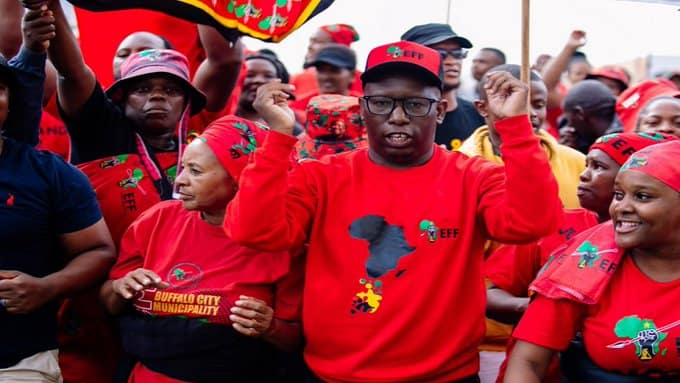
The political fallout from Wednesday’s near-total shutdown of the Johannesburg Central Business District (CBD) has entered a new and heated phase. The Economic Freedom Fighters (EFF) have strongly denied claims that their members forced businesses to close their doors following the sentencing of party leader Julius Malema, insisting that the shutdown was a “spontaneous expression of public anger” rather than an orchestrated campaign of intimidation.
Speaking at a media briefing at the party’s Johannesburg headquarters on Thursday afternoon, EFF deputy president Floyd Shivambu rejected allegations that EFF members had threatened shop owners, blocked entrances, or otherwise coerced businesses into participating in the shutdown.
“The EFF did not force anyone to close their business,” Shivambu said, his voice sharp and his finger stabbing the podium. “We have no need to force anyone. The people of Johannesburg are angry. The people of South Africa are angry. They closed their businesses voluntarily because they stand in solidarity with Commander-in-Chief Julius Malema, who was unjustly sentenced by a captured judicial system.”
Shivambu’s denial came just hours after the South African Police Service (SAPS) confirmed that it was investigating “multiple complaints” from business owners who alleged that they had been threatened with violence if they did not shut down on Wednesday.
“We have received at least 12 formal complaints,” said SAPS national spokesperson Brigadier Athlenda Mathe. “Business owners have reported that individuals wearing EFF regalia or identifying as EFF members visited their premises on Tuesday and Wednesday and instructed them to close. Some reported threats of looting or property damage if they refused. These complaints are being taken seriously.”
The allegations: What business owners say
The complaints paint a picture of coordinated intimidation. Several business owners in the CBD spoke to local media on condition of anonymity, fearing retaliation.
“They came on Tuesday afternoon,” said a spaza shop owner in the Denver area, who asked not to be named. “Three men in red berets. They said, ‘Tomorrow you must close. If you are open, we will make sure you regret it.’ I did not know what to do. I closed. I lost a day’s income. But I was scared for my family.”
A clothing retailer on Pritchard Street described a similar encounter. “They didn’t shout. They didn’t threaten violence exactly. But the message was clear: close, or face the consequences. I have been in business here for 15 years. I know when someone means business. I closed.”
Other business owners reported that the shutdown was voluntary and that they participated out of political conviction rather than fear.
“I closed because I support Malema,” said Ahmed Cassim, who owns an electronics store on Eloff Street. “No one threatened me. I saw the flyers on social media. I decided to close. That was my choice. I don’t like being told what to do, but I also don’t like injustice. Malema is a victim of political persecution. I wanted to show my support.”
The conflicting accounts have made it difficult for police to determine the extent of intimidation versus genuine voluntary participation.
The EFF’s defense: ‘A manufactured narrative’
Shivambu dismissed the intimidation allegations as a “manufactured narrative” designed to discredit the EFF and divert attention from what he called the “real issue”: the sentencing of Malema.
“Let us be clear,” Shivambu said. “The ANC and its allies in the media are trying to paint the EFF as a party of thugs and criminals. Why? Because they are afraid. They are afraid of the movement we are building. They are afraid of the support we have among the working class. So they invent stories of intimidation. They take anonymous complaints from people who may not even exist. It is propaganda. It is lies.”
Shivambu also pointed to the peaceful nature of the shutdown as evidence that no coercion was involved.
“If we were forcing people to close, where were the videos? Where were the confrontations? Where were the arrests?” he asked. “There were none. Because the shutdown was peaceful. It was organic. It was the voice of the people. The only violence that occurred was the violence of the state against our supporters — but even that was minimal because our people are disciplined.”
The video evidence: A contested record
Social media has been flooded with videos from Wednesday’s shutdown, some of which appear to show EFF members engaging with business owners. One widely shared video, which has been viewed over 500,000 times, shows a man in an EFF T-shirt standing outside a closed shop and telling a passerby: “We told them to close. They listened. Good.”
The EFF has not disputed the authenticity of that video but argues that the man in the T-shirt was not acting on party orders.
“We have millions of supporters,” said EFF national spokesperson Leigh-Ann Mathys. “We cannot control what every individual does. If a supporter told a business to close, that is their personal action. It is not party policy. The EFF did not authorize any such instructions. Anyone who made threats — if they made threats — acted alone.”
Critics have called that defense “convenient” and “implausible,” given the scale and coordination of the shutdown.
“You cannot have a near-total shutdown of the biggest business district in the country and claim it was spontaneous,” said Professor Susan Booysen, a political analyst at the University of the Witwatersrand. “Spontaneous protests happen. But they look different. They are messy. They are disorganized. Wednesday’s shutdown was not messy. It was efficient. It was widespread. That suggests coordination. That suggests planning. The EFF cannot have it both ways: they cannot take credit for the shutdown’s impact while disclaiming responsibility for its methods.”
The economic impact: A city counts the cost
Whatever the truth about the shutdown’s origins, its economic impact is undeniable. The Johannesburg CBD lost an estimated R100 million to R150 million in economic activity on Wednesday, according to preliminary estimates from the Johannesburg Chamber of Commerce and Industry (JCCI).
“That is money that will never come back,” said JCCI CEO Busi Mavuso. “Workers lost wages. Perishable goods were wasted. Small businesses lost customers. The ripple effects will be felt for weeks. We are not taking sides in the political debate. We are simply stating the facts: the shutdown hurt real people, real families, real livelihoods.”
Mavuso called on all political parties to “refrain from using the economy as a bargaining chip” and to resolve their differences through dialogue rather than disruption.
“The right to protest is sacred,” she said. “But the right to work is also sacred. There must be a balance. Wednesday’s shutdown was not balanced. It was a sledgehammer. And the people who felt it most were not politicians or judges. They were ordinary workers trying to feed their families.”
The political blame game: ANC vs EFF
The shutdown has intensified the already bitter rivalry between the EFF and the African National Congress (ANC), which governs South Africa nationally and leads a fragile coalition in Johannesburg.
The ANC has called for a full investigation into the shutdown and has accused the EFF of “economic sabotage.”
“This was not a protest. It was a shakedown,” said ANC national spokesperson Mahlengi Bhengu-Motsiri. “The EFF used fear and intimidation to shut down the economic heart of our country. That is not politics. That is thuggery. The police must arrest those responsible, and the EFF leadership must be held accountable.”
The EFF has fired back, accusing the ANC of hypocrisy and desperation.
“The ANC is the party of the Gupta-era state capture,” Shivambu said. “The ANC is the party of corruption. The ANC is the party that has destroyed our economy. And now they want to lecture us about thuggery? They should be ashamed. They should be in jail. Instead, they are pointing fingers at us. The people are not fooled.”
The Malema factor: A leader in absentia
Notably absent from the EFF’s defense of the shutdown was Julius Malema himself. The party leader, who was sentenced to five years in prison last month but released on bail pending appeal, has not publicly commented on the CBD shutdown. His social media accounts have been silent on the matter.
Some political analysts have suggested that Malema is deliberately keeping his distance to avoid giving the state grounds to revoke his bail.
“Malema’s bail conditions almost certainly include a prohibition on inciting violence or lawlessness,” said legal analyst Nthabiseng Mokoena. “If he were to publicly endorse a shutdown that involved intimidation, he could be accused of violating those conditions. His silence is strategic. He is letting his deputies do the talking — and taking the risk.”
Others have speculated that Malema is unhappy with the shutdown’s execution and is quietly distancing himself from a tactic that may have backfired.
“Malema is a populist, but he is also a politician,” said Booysen. “He knows that shutting down the CBD hurts his own support base — the working class, the unemployed, the informal traders. He may have concluded that the costs of the shutdown outweigh the benefits. But he cannot say that publicly without looking weak. So he says nothing. And his lieutenants clean up the mess.”
The way forward: Dialogue or further disruption?
As Johannesburg’s businesses reopened on Thursday — many still jittery, some still closed out of lingering fear — the question on everyone’s mind was whether the shutdown was a one-off event or the beginning of a sustained campaign of disruption.
The EFF has not announced any further actions. But party insiders have told local media that the leadership is “reviewing its options” and that “everything is on the table.”
“The sentencing of Comrade Julius Malema was an act of judicial warfare,” said an EFF source who spoke on condition of anonymity. “We cannot simply accept it. The people must continue to resist. But the form of that resistance — that is what we are debating. Some want more shutdowns. Others want different tactics. We will announce our decision soon.”
The ANC, meanwhile, has called for a meeting between the party’s leadership and the EFF to de-escalate tensions. No meeting has been scheduled.
“There can be no dialogue with a party that uses intimidation as a political tool,” said Bhengu-Motsiri. “The EFF must first condemn the actions of its members and commit to peaceful protest. Until then, there is nothing to discuss.”
The view from the ground: ‘We just want to work’
Back on the streets of the Johannesburg CBD, the shutdown was already becoming a memory — but not a forgotten one. Vendors set up their stalls. Office workers streamed into buildings. Taxis honked. The city’s chaotic heartbeat resumed.
But the fear lingered.
“I was closed yesterday,” said Precious Mthembu, a fruit vendor on Pritchard Street. “I was scared. Today, I am open. But I am still scared. What if they come back? What if they tell me to close again? I cannot afford another day like yesterday. My children need to eat. My landlord needs his rent. I need to work.”
Mthembu paused, wiping sweat from her forehead. “I don’t know who is right and who is wrong,” she said. “I don’t know about Malema or the EFF or the ANC. I know that yesterday I made no money. Yesterday my children ate bread and water. That is all I know. Politics is for rich people. The poor just want to survive.”
Her words captured the essence of the dilemma facing South Africa’s political class: in the battle between the EFF’s revolutionary tactics and the ANC’s defensive governance, ordinary citizens are caught in the middle. They are asked to choose sides, to sacrifice income for ideology, to close their doors for a cause they may not fully understand.
And when the protests end and the politicians move on, they are left to pick up the pieces.
Conclusion: A story not yet finished
The EFF’s denial of responsibility for the CBD shutdown has done little to settle the controversy. Business owners, police, and political opponents continue to point fingers. The party insists it is being unfairly maligned. And the workers and traders of Johannesburg — the people who actually bore the cost of Wednesday’s lost day — wait to see what happens next.
One thing is certain: the sentencing of Julius Malema has opened a new and unpredictable chapter in South African politics. The EFF has shown that it can mobilize its supporters to disrupt the economy on a massive scale. The state has shown that it is reluctant — or unable — to prevent that disruption. And the public is left to wonder: how many more Wednesdays like this one will there be?
For now, the streets of Johannesburg are open. The vendors are selling. The taxis are running. But the tension remains, coiled like a spring beneath the city’s surface.
And somewhere, in the red beret brigades, plans are being made. The question is not whether the EFF will act again. It is when — and how — and at what cost to the people of Johannesburg.
The city holds its breath. The politicians argue. And the poor, as always, wait to see who will pay.
About The Author