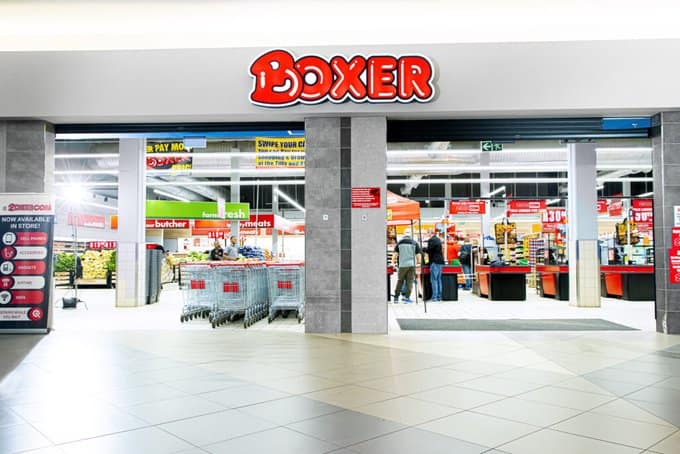
Discount retailer Boxer has declared its first annual dividend since its landmark JSE listing in 2024, underpinned by stellar financial results that saw turnover surge past R46 billion and trading profit climb 14.3%. The company also announced the creation of 3,400 new jobs over the past financial year – a powerful testament to its aggressive expansion strategy and the resilience of the discount retail model in a cost-of-living crisis.
The results, released on Tuesday morning, represent a major milestone for the low-cost supermarket chain, which has rapidly transformed from a regional player into one of South Africa’s most formidable mass-market retailers. Boxer’s performance stands in stark contrast to many of its competitors, who have struggled with load-shedding disruptions, supply chain inflation, and squeezed consumer wallets.
“We said at the time of our listing that Boxer was built for tough times,” said CEO Marek Masojada in a briefing at the company’s head office in Westville, Durban. “Today’s results prove that. When consumers have less money, they don’t stop buying – they buy smarter. They come to Boxer. Our model of everyday low prices, right-sized stores, and a relentless focus on the basics has never been more relevant.”
Turnover and Profit: Double-Digit Growth Across the Board
Boxer reported turnover of R46.7 billion for the financial year ended March 2026, a robust 12.3% increase from the previous year. Trading profit rose even faster – up 14.3% to R2.6 billion – reflecting improved margins driven by better supply chain efficiencies, lower wastage, and strategic sourcing.
The company’s bottom line was strong enough to allow its first dividend payout since going public. Boxer declared a maiden dividend of 85.6 cents per share, representing a payout ratio of 30% of headline earnings. The move is likely to be warmly received by investors, many of whom bought into the November 2024 initial public offering (IPO) that valued the company at roughly R15 billion.
“Declaring a dividend in our first full year as a listed entity is a statement of confidence,” said Chief Financial Officer Helene Visser. “It says we are generating real, sustainable cash flow. It says we are not just growing – we are growing profitably. And it says we are committed to returning value to shareholders while continuing to invest in expansion.”
From Debt to Net Cash: A Balance Sheet Turnaround
Perhaps the most striking financial metric is Boxer’s balance sheet transformation. The company ended the financial year with R709 million in net cash – a dramatic reversal from the prior year, when it carried net debt of R412 million. The swing of over R1.1 billion was driven by strong operating cash flows, prudent working capital management, and the injection of IPO proceeds.
“We are now in a position of financial strength we have never enjoyed before,” Visser added. “We have firepower. We can open new stores. We can invest in our distribution network. We can weather any storms in the economy. And we can do it all without borrowing a cent.”
3,400 New Jobs: Expansion as Employment Engine
Boxer’s physical expansion has been nothing short of remarkable. The company opened 51 new stores during the financial year, bringing its total footprint to 576 outlets across South Africa and select neighboring countries. Each new store typically employs between 60 and 100 people, depending on size and location, explaining the creation of 3,400 new jobs.
The bulk of new openings were in underserved townships and rural areas – a strategic choice that Masojada describes as “both commercial and moral.”
“There are millions of South Africans who live in communities where the nearest supermarket is 20 or 30 kilometers away,” he said. “They pay more for transport, more for food, more for everything. Boxer brings affordable groceries to their doorstep. And in doing so, we create jobs where jobs are needed most – not in Sandton or Umhlanga, but in places like Thohoyandou, eMalahleni, and Mthatha.”
Of the 3,400 new hires, approximately 2,100 are store-level workers – cashiers, packers, shelf-stockers, and cleaners – while the remainder are in management, logistics, and support functions. The company has also invested in an internal training program called “Boxer Academy,” which has upskilled over 1,000 employees during the year, many of whom were promoted from within.
“I started as a trolley collector six years ago,” said Nomsa Dlamini, now a store manager at a new Boxer outlet in KwaMashu. “Today I manage a team of 84 people. Boxer gave me a career, not just a job. This dividend they’re talking about – to me, the real dividend is seeing young people from my community put on uniforms and earn a decent wage.”
Store Format Evolution: Bigger, Better, Faster
Boxer’s store expansion has been accompanied by a subtle but significant evolution in its retail format. While the company remains committed to its core “no-frills” discount identity, newer stores are larger – typically 1,200 to 1,500 square meters compared to the legacy average of 800 square meters – and include expanded fresh produce sections, butchery counters, and in-store bakeries.
“We listened to our customers,” Masojada explained. “They wanted more fresh food. They wanted to buy bread that was baked that morning and meat cut that same day. We can do that while still keeping prices lower than the competition. It’s not magic. It’s just better buying, better logistics, and lower overheads.”
The company has also accelerated its rollout of Boxer Liquor and Boxer Build (hardware) sections within larger stores, diversifying its revenue mix and increasing average basket size.
Competitive Landscape: Winning the Price War
Boxer operates in one of South Africa’s most cutthroat retail environments, competing head-to-head with Shoprite’s Usave and OK Power Express, Pick n Pay’s Boxer-style no-frills formats, and emerging discounters like Dis-Chem’s Baby City and various independent cash-and-carries.
Despite the heat, Boxer has managed to maintain its position as the price leader. An independent basket survey conducted by the research group Trade Intelligence in February 2026 found that a typical 50-item grocery basket cost 6.8% less at Boxer than at the nearest competitor – a gap that widened from 5.2% the previous year.
“We are not trying to be everything to everyone,” Masojada said. “We are trying to be the cheapest for the things people buy every week. Maize meal. Cooking oil. Sugar. Milk. Soap. Bread. Tea. If you cannot beat everyone on those basics, you have no right to call yourself a discounter.”
Supply Chain Investment: The Backbone of Growth
Behind the store openings and job creation is a significant investment in logistics. Boxer has completed the expansion of its flagship distribution centre in Hammarsdale, KwaZulu-Natal, doubling its capacity to 120,000 pallets. A new regional distribution hub in Gauteng is under construction and expected to open in early 2027, further improving stock availability and reducing transport costs.
“We used to run our supply chain on a shoestring,” Visser admitted. “Now we are building infrastructure for a 1,000-store future. That takes capital, yes. But it also takes vision. We are not just growing for next year. We are growing for the next decade.”
Investor Reaction: A Solid Debut
Boxer’s shares reacted positively to the results, rising 4.2% in late morning trade on the JSE. Since its listing at R22 per share in November 2024, the stock has climbed to R29.40, delivering a total return (including the maiden dividend) of approximately 38% – comfortably outperforming the All-Share Index over the same period.
“We saw a well-managed business with a clear niche and a loyal customer base,” said fund manager Mandla Mbambo of Mergence Investment Managers. “What we didn’t know was how they would handle the pressures of being a public company – quarterly reporting, analyst scrutiny, investor demands. So far, they have handled it beautifully. This dividend is the cherry on top.”
Challenges Ahead: Load-Shedding and Inflation
Despite the glowing results, Boxer is not immune to South Africa’s broader economic headwinds. Persistent load-shedding – though less severe in recent months – remains a major operational cost, with the company spending R187 million on diesel for backup generators during the year, up from R112 million previously.
Inflation also remains a threat. While Boxer’s low-price model protects it somewhat, even the discount sector cannot fully shield consumers from rising food prices. The company reported that input costs for staples like maize, cooking oil, and poultry increased by an average of 9% during the year, though it managed to pass on only 5% of that to customers, absorbing the rest through margin compression.
“We have taken a conscious decision to protect our customers first,” Masojada said. “We would rather make slightly less profit than force people to choose between feeding their children and paying for electricity. That is not just good business. That is good citizenship.”
Looking Ahead: 600 Stores and Beyond
Boxer has set a target of reaching 600 stores by the end of the 2027 financial year, requiring another 24 openings in the next 12 months. The company also confirmed it is exploring entry into Botswana and Eswatini, following its successful expansion into Namibia and Lesotho in prior years.
“We have proven that the Boxer model works anywhere where there are price-sensitive consumers and underserviced communities,” Masojada said. “That is most of Africa. But we will grow responsibly. We will not open a store just to hit a number. Every store must be profitable. Every store must serve a real need. Every store must create real jobs.”
Conclusion: A Retail Success Story with Social Impact
Boxer’s first-year results as a listed company tell a story of disciplined execution, customer-centric strategy, and – perhaps most importantly – tangible economic impact. The creation of 3,400 jobs in a country with a persistent unemployment crisis is no small achievement. The declaration of a dividend in a tough retail environment is a signal of financial maturity. And the transformation from debt to net cash positions the company for a future of sustainable growth.
“I remember walking into our first Boxer store in 2002,” Masojada reflected. “It was small. It was messy. It was beautiful. Today we have 576 stores, 3,400 new jobs, and a dividend check for our shareholders. But the mission has not changed. We are still that small store in that small town, trying to help people stretch their rands a little further. That will never change.”
For South African consumers feeling the pinch of an unforgiving economy, Boxer’s growth is welcome news – not just for the jobs it creates, but for the downward pressure it puts on grocery prices across the board. And for investors who backed a discount retailer in uncertain times, the maiden dividend is proof that sometimes, the simplest business models are the most successful.
Boxer Financial Snapshot FY2026
| Metric | FY2026 | FY2025 | Change |
|---|---|---|---|
| Turnover | R46.7 billion | R41.6 billion | +12.3% |
| Trading profit | R2.6 billion | R2.27 billion | +14.3% |
| Net cash/(debt) | +R709 million | -R412 million | +R1.12 billion |
| New stores opened | 51 | 38 | +13 |
| Total stores | 576 | 525 | +51 |
| New jobs created | 3,400 | 2,500 | +900 |
| Dividend per share | 85.6 cents | — | — |
The results mark a new chapter for Boxer – one in which the scrappy discount retailer has matured into a listed heavyweight without losing its soul. As one retail analyst put it: “Boxer is no longer the underdog. It is the one everyone else is chasing. And right now, no one is catching up.”
About The Author