For three decades, they have sung the same struggle songs. They have sat in the same cabinet meetings, negotiated under the same banner, and buried their dead under the same soil of a shared liberation history. The African National Congress (ANC) and the South African Communist Party (SACP) are not merely allies; they are twins born of the same anti-apartheid womb, bound by blood, ideology, and the long walk to freedom.
But on a crisp autumn morning in Johannesburg, that bond snapped.
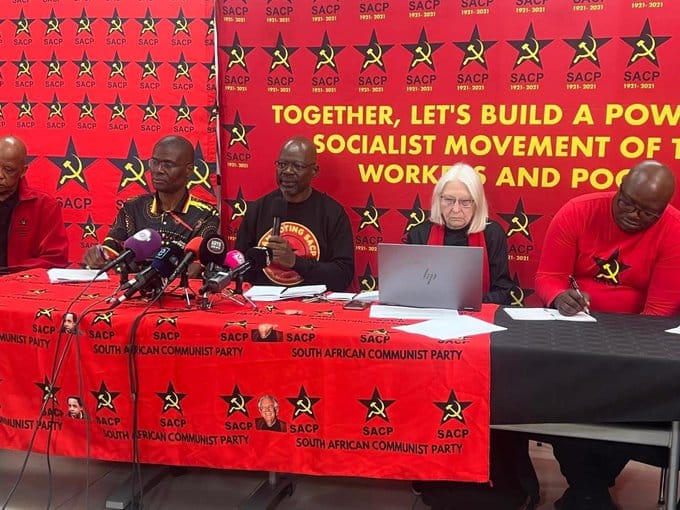
The SACP, led by its firebrand general secretary Solly Mapaila, has delivered a stinging rebuke to the ANC, rejecting what it describes as a “bullying ultimatum” over the contentious issue of dual membership. And in a move that will reshape the political landscape ahead of the 2026 local government elections, Mapaila declared that the Red Berets will “contest independently without fear.”
“We are not children of the ANC,” Mapaila said, his voice resonant with the cadences of a man who has spent a lifetime on the podium. “We are not an appendage. We are not a voting bloc to be summoned and dismissed. The SACP is a political organisation in its own right, with its own history, its own ideology, and its own constituency. And we will no longer accept the bullying tactics of a ruling party that has forgotten its own principles.”
The room erupted in applause from the red-shirted delegates packed into the party’s Johannesburg headquarters. Outside, communist flags fluttered in the wind. Inside, the mood was one of liberation—not from apartheid, but from a political marriage that has grown increasingly toxic.
The Ultimatum: What the ANC Wants
To understand the rupture, one must go back to December 2025, when the ANC’s National Executive Committee (NEC) held its annual lekgotla. Buried in the dense agenda was a seemingly procedural item: the issue of dual membership between the ANC and the SACP.
For decades, the alliance has operated on an understanding that members of the SACP could also be members of the ANC—indeed, many of the ANC’s most prominent leaders, from Oliver Tambo to Chris Hani to Joe Slovo, were communists first. The two organisations have shared leadership, shared branches, and shared electoral lists.
But the ANC NEC, in a closed session, reportedly passed a resolution calling for a “clarification” of the relationship. According to leaked minutes, the resolution suggested that ANC members who hold leadership positions in other political parties—specifically the SACP—could be required to choose one affiliation over the other.
While the resolution did not explicitly ban dual membership, it was widely interpreted as an ultimatum: the SACP must decide whether it is an independent party or a faction within the ANC. And if it chooses independence, it must contest elections alone.
“The ANC is trying to force us into a corner,” said an SACP central committee member who spoke on condition of anonymity. “They want us to either dissolve into the ANC like a glorified youth league or leave. They do not want an independent communist party. They want a tame ally that does what it is told.”
Mapaila went further, accusing the ANC of “anti-communist paranoia” and of “succumbing to the neoliberal agenda.”
“This is not about organisational clarity,” Mapaila thundered. “This is about silencing dissent. The ANC has moved to the right. It has abandoned the National Democratic Revolution. It has embraced tenderpreneurship, corruption, and the dictates of monopoly capital. And now it wants to silence the communists who remind it of its own promises.”
The History: A Marriage of Convenience and Conviction
The ANC-SACP alliance dates back to the darkest days of apartheid. In 1950, the Communist Party was banned, forcing its members underground. Many joined the ANC, and the two organisations became inseparable in the struggle. The Freedom Charter, adopted in 1955, was a joint project. The armed struggle, waged by Umkhonto we Sizwe (MK), was led by communists like Slovo.
After 1994, the alliance became the bedrock of the tripartite alliance (which also includes COSATU, the trade union federation). The SACP did not contest elections independently, instead placing its members on ANC lists. In exchange, the SACP gained influence over policy, particularly in areas like the Reconstruction and Development Programme (RDP) and, later, the push for economic transformation.
But the relationship has been strained for years. The SACP has grown increasingly critical of the ANC’s neoliberal economic policies, its tolerance of corruption, and its abandonment of the working class. In 2017, the SACP went so far as to urge its members not to vote for Jacob Zuma’s ANC—a dramatic break from tradition.
Since Ramaphosa took power, the tensions have eased but never disappeared. The SACP has supported Ramaphosa’s anti-corruption drive but has been critical of his economic policies, particularly his embrace of private sector involvement in state-owned enterprises.
“The SACP has always been the conscience of the alliance,” said political analyst Professor William Gumede. “But the ANC has stopped listening. The ultimatum on dual membership is the ANC’s way of saying: ‘We no longer need a conscience. We want loyalists, not critics.'”
Mapaila’s Rebuttal: ‘We Will Contest Independently Without Fear’
Mapaila’s speech on Wednesday was the most forceful rebuttal yet. Standing before a portrait of Karl Marx and a banner reading “Workers of the World Unite,” he laid out the SACP’s position in uncompromising terms.
“Let me be clear,” Mapaila said. “The SACP is not a retirement home for disgruntled ANC members. We are not an auxiliary. We are not a caucus. We are a political party. And we have the constitutional right to contest elections, to field candidates, to govern. We have never exercised that right because we believed in the alliance. But if the alliance is dead, we will not cling to its corpse.”
Mapaila announced that the SACP would immediately begin preparations for the 2026 local government elections, scheduled for October. The party will field its own candidates for municipal councils, mayoral positions, and ward seats.
“We are not afraid,” Mapaila said. “The ANC has become arrogant. They think they are invincible. But we have seen the polls. We have seen the anger in the townships. People are tired of an ANC that promises everything and delivers nothing. They are ready for an alternative. And the SACP is that alternative.”
Mapaila also rejected any suggestion that the SACP’s move would split the anti-corporate vote and benefit the Democratic Alliance (DA) or the Economic Freedom Fighters (EFF).
“We are not splitting anything,” he said. “The ANC has already split itself. Its internal factions have destroyed its credibility. Its corruption has destroyed its moral authority. The only thing we are doing is offering voters a choice: a communist party that fights for workers, for the poor, for socialism—not a corrupt, neoliberal, nationalist party that has betrayed its own revolution.”
The ANC’s Response: ‘Regrettable but Not Unexpected’
The ANC’s reaction was measured but firm. In a brief statement issued shortly after Mapaila’s address, ANC national spokesperson Mahlengi Bhengu-Motsiri said the party had “taken note” of the SACP’s position.
“The ANC values its historic alliance with the SACP and COSATU,” the statement read. “The alliance has been a pillar of our democracy. However, the ANC is a political party in its own right, with its own constitution, its own membership, and its own electoral mandate. The issue of dual membership is a matter of organisational clarity, not hostility. We regret the SACP’s decision to contest elections independently, but we respect their right to do so.”
Behind the diplomatic language, however, there was anger. Senior ANC officials, speaking anonymously, accused Mapaila of “grandstanding” and “playing to the gallery.”
“This is political suicide,” said one ANC provincial chairperson. “The SACP has no grassroots infrastructure outside the ANC. Their leaders are known because they are in the ANC. If they contest alone, they will be wiped out. They will get maybe 2% of the vote. And then they will come crawling back.”
Others saw the SACP’s move as a gift to the ANC, finally freeing the ruling party from the need to accommodate communist policies. “For years, we’ve had to water down our economic policies to appease the SACP,” said an ANC NEC member. “Now we can finally adopt pro-growth, pro-business policies without having to listen to their socialist sermons.”
The COSATU Factor: The Third Pillar Sways
The tripartite alliance is a three-legged stool: ANC, SACP, COSATU. With two legs at war, the third becomes the fulcrum. COSATU, the trade union federation, has not yet taken a position on the SACP’s decision. But its leaders are watching closely.
COSATU has its own grievances with the ANC, particularly over labour broking, the National Health Insurance (NHI) delays, and the government’s failure to create jobs. In recent by-elections, COSATU has refused to campaign for the ANC, a sign of growing alienation.
“If COSATU joins the SACP in breaking away, the ANC is in deep trouble,” said Gumede. “The alliance has been the ANC’s electoral machine. Without COSATU’s boots on the ground, without SACP’s ideological fire, the ANC is just another political party. And it will be defeated.”
COSATU general secretary Solly Phetoe has called for an urgent summit of alliance partners, but the SACP has rejected the overture, accusing COSATU of “trying to mediate a dispute that cannot be mediated.”
“We are past mediation,” said an SACP central committee member. “The ANC issued an ultimatum. We have responded. There is nothing to talk about.”
The Public’s View: Confusion, Exhaustion, and a Glimmer of Hope
Outside the SACP’s headquarters, a small crowd of supporters had gathered. They waved red flags and sang “Nkosi Sikelel’ iAfrika.” But among the faithful, there was also confusion.
“I am a member of the SACP and the ANC,” said a middle-aged man wearing a red T-shirt and an ANC cap. “I have been both for 30 years. Now I must choose? That is like asking me to choose between my mother and my father. I love both. I cannot choose.”
A younger woman, a first-time voter, was more enthusiastic. “I have never voted for the ANC,” she said. “They are corrupt. But I like the SACP. They talk about jobs, about housing, about workers. If they contest alone, I will vote for them. Finally, a party that represents me.”
The SACP’s decision has also drawn interest from the EFF, which views itself as the natural home for left-leaning voters disillusioned with the ANC. EFF leader Julius Malema, himself a former ANC Youth League leader, welcomed the SACP’s move.
“The communists have finally seen the light,” Malema said in a statement. “The ANC is a counter-revolutionary party. It serves capital, not workers. We welcome the SACP to the fight. We may be rivals for the same votes, but we are united in our opposition to the ANC.”
The Legal Implications: Can the SACP Contest Independently?
The SACP is a registered political party with the Independent Electoral Commission (IEC). It has the legal right to contest elections at any level—national, provincial, or local. The party has never exercised this right, but it has maintained its registration.
“Legally, there is no barrier,” said an IEC official. “The SACP is in good standing. They can field candidates tomorrow if they wish. The question is logistical, not legal. Can they organise enough candidates? Can they raise enough funds? Can they get their message out? Those are the real challenges.”
The SACP claims to have a membership of over 300,000, though independent estimates are lower. The party has a presence in most provinces, though it is strongest in Gauteng, the Eastern Cape, and the Western Cape.
“We are ready,” said an SACP organiser. “We have been waiting for this moment for years. The branches are excited. The members are motivated. We may not win many seats this time, but we will build. Election by election. Year by year. We are playing the long game.”
The International Dimension: A Shift in the Global Left
The SACP’s break with the ANC has implications beyond South Africa’s borders. The party is a member of the International Meeting of Communist and Workers’ Parties and has close ties to the Chinese Communist Party, the Cuban Communist Party, and the former South African Communist Party in exile.
A successful independent SACP could inspire other communist parties within ruling coalitions to break away, particularly in southern Africa, where liberation-era alliances are fraying.
“The SACP is watching the world,” said a foreign diplomat. “They see the rise of left-wing populism in Latin America, the resurgence of socialist parties in Europe, the confidence of the Chinese Communist Party. They believe the moment is ripe for a new socialist project in South Africa. They may be right. Or they may be delusional. But they are not acting from weakness. They are acting from conviction.”
The Road to 2026: A Bumpy Ride Ahead
The 2026 local government elections were already shaping up to be a watershed moment. The ANC’s support has been eroding for years, dropping from 62% in 2016 to 54% in 2021. The party lost control of key metros, including Johannesburg, Tshwane, and Nelson Mandela Bay.
With the SACP contesting independently, the ANC’s vote share could fall even further. The party risks losing not just metros but entire municipalities, particularly in urban areas where left-leaning voters have alternatives.
“The ANC is facing a perfect storm,” said Gumede. “The EFF is eating into its youth vote. The DA is reclaiming its middle-class base. And now the SACP is splitting the working-class vote. The ANC could fall below 45% nationally. That would be catastrophic.”
But the SACP also faces risks. If the party performs poorly—securing, say, 2-3% of the vote—its credibility will be shattered. Its members will question the leadership. Its allies will distance themselves. Its dream of a socialist alternative will be postponed indefinitely.
“We are not naive,” said Mapaila. “We know the road is hard. We know the odds are against us. But we are communists. We have faced harder odds. We fought apartheid. We built the freedom movement. We buried our comrades. We are not afraid of an election. We are afraid of betraying our principles. That is the only fear that matters.”
The Final Word: An Alliance on Life Support
The ANC-SACP alliance is not yet dead. There is still time for negotiation. There is still room for compromise. The ANC could withdraw its ultimatum. The SACP could suspend its independent plans. The tripartite alliance could stagger on, as it has for 30 years, held together by habit, fear, and the memory of a shared struggle.
But something has changed. The ultimatum was a line in the sand. The SACP’s response was a crossing of that line. The two parties are no longer allies in the same sense. They are competitors. Rivals. Potential enemies.
In the townships, in the union halls, in the party branches, the question is no longer whether the alliance will survive. The question is what will replace it.
“We are witnessing the end of an era,” said Gumede. “The tripartite alliance was a product of a specific historical moment: the anti-apartheid struggle. That moment is gone. The alliance is gone. We are entering a new moment, with new parties, new coalitions, new alliances. It will be messy. It will be unpredictable. But it is also exciting. South African politics has been stuck for too long. Now, finally, it is moving.”
At the SACP headquarters, the singing has stopped. The journalists have filed their stories. The leaders have dispersed. Mapaila sits in his office, a photograph of Chris Hani on the wall behind him.
He is asked: Are you afraid?
He smiles. It is not a happy smile. It is the smile of a man who has seen too much, lost too much, and is no longer capable of being surprised.
“We are communists,” he says. “Fear is a luxury we cannot afford.”
Outside, the red flags continue to flutter. The sun is setting over Johannesburg. And the alliance that helped free South Africa is breathing its last.
About The Author