The Union Buildings, that grand edifice of sandstone and power that has watched over the nation’s capital for more than a century, has seen many moments of high drama. Inaugurations. State funerals. The quiet surrender of apartheid’s architects. But on Thursday afternoon, as the autumn light begins to lengthen over the manicured lawns, the amphitheatre will host a different kind of theatre: a President under pressure, facing a crisis of confidence in the very institution meant to keep the nation safe.
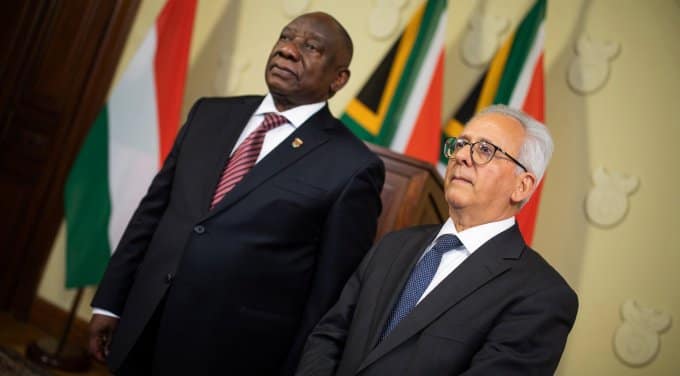
President Cyril Ramaphosa will address the media at 16:00. He will be joined by Acting Police Minister Professor Firoz Cachalia. The subject, sources confirm, is the leadership crisis gripping the South African Police Service (SAPS) and the uncertain future of National Police Commissioner General Fannie Masemola.
For weeks, the rumours have swirled through the corridors of the Civilian Secretariat for Police, through the blue-walled chambers of Parliament’s police portfolio committee, and through the encrypted WhatsApp groups of journalists who cover the security cluster. The whispers have grown too loud to ignore: Masemola, the former spy kingpin turned top cop, is on the brink. His relationship with the political principals is fractured. His leadership is questioned. And the crime statistics—stubbornly high, tragically violent—have become an unbearable political liability.
“The President has run out of road,” said a senior official within the security cluster, speaking on condition of anonymity. “He can no longer defend the indefensible. The time for silence is over. Today, we will know whether Masemola stays, goes, or is allowed a ‘graceful exit.'”
The Backdrop: A Commissioner Under Siege
General Fannie Masemola was appointed National Police Commissioner in March 2022, a veteran of the intelligence world who had served as the head of the State Security Agency (SSA). His appointment was seen as an attempt to bring intelligence rigour to policing—to use data, analysis, and covert methods to fight crime. But the transition from spymaster to top cop has been rocky.
Under Masemola’s watch, South Africa has continued to bleed. The latest crime statistics, released in February 2026, painted a grim picture:
- Murder: 27,000 homicides in the past year, a rate of nearly 74 per day.
- Sexual offences: Over 53,000 cases reported, with experts estimating that only a fraction are ever disclosed.
- Contact crimes (armed robbery, assault, carjacking): Up by 7.2% year-on-year.
- Cash-in-transit heists: After a brief decline, back on the rise, with gangs operating with near-military precision.
The numbers have become a political cudgel. Opposition parties brandish them in Parliament. Civil society organisations use them to demand action. And ordinary South Africans—those who barricade themselves behind electric fences and burglar bars—have lost faith that the police can protect them.
“I do not know who Fannie Masemola is,” said Thabo Mokoena, a taxi driver in Soweto, when asked about the crisis. “I do not know what he looks like. I just know that the police do not come when you call them. I know that the criminals are not afraid. If he is the boss, then he is not doing his job. Simple.”
But the crisis is not merely about statistics. It is about perception, about politics, and about the President’s own legacy. Ramaphosa has staked his political reputation on the promise of a “capable, ethical, developmental state.” A police service that cannot protect its citizens is perhaps the most visible symbol of state failure.
The Flashpoint: The Thabo Bester Escape and Beyond
While the crime statistics have been a slow burn, the catalyst for the current crisis was a specific, shocking failure: the escape of convicted murderer and rapist Thabo Bester from the Mangaung Correctional Centre in 2022. Bester, who faked his own death in a fire and walked out of the prison disguised as a delivery driver, remained on the run for nearly a year before being recaptured in Tanzania.
The subsequent investigation revealed a web of corruption, negligence, and collusion that implicated prison officials, police officers, and even the private security contractor running the facility. While Masemola was not directly implicated, the escape—and the police’s failure to recapture Bester quickly—became a symbol of systemic rot.
“The Bester escape was the moment the mask slipped,” said political analyst Dr. Naledi Mkhize. “It showed that the police were not just ineffective. They were corrupt. They were compromised. And the man at the top seemed either unwilling or unable to fix it.”
Since then, the pressure has only intensified. A series of high-profile assassination attempts on police officers. The resurgence of taxi violence in the Western Cape. The continued dominance of extortion gangs in the Eastern Cape. Each incident eroded confidence in Masemola’s leadership.
The Political Dimension: Cachalia’s Rise and the ANC’s Fractures
The presence of Acting Police Minister Professor Firoz Cachalia alongside the President is significant. Cachalia was appointed acting minister following the departure of Bheki Cele, who was moved to a different portfolio in a 2025 cabinet reshuffle. A respected academic and a veteran of the anti-apartheid movement, Cachalia was seen as a “clean pair of hands” – non-controversial, technocratic, and unlikely to rock the boat.
But Cachalia has surprised his critics. He has been outspoken about the need for police reform, publicly questioning the pace of disciplinary proceedings against corrupt officers and the lack of accountability in the top brass. His relationship with Masemola is said to be tense.
“There is no love lost between them,” said a source within the ministry. “Cachalia wants change. He wants heads to roll. He wants the police to be accountable to the minister, not to their own internal culture. Masemola resents that. He sees Cachalia as a political appointee who does not understand policing.”
The fracture inside the ANC is also relevant. Masemola is understood to have allies within the party’s security establishment—figures who value loyalty and discretion over public accountability. Ramaphosa, who has faced his own internal battles to consolidate control over the party and the state, must weigh the political cost of firing Masemola against the political cost of keeping him.
“If Ramaphosa fires Masemola, he alienates a faction of the party that believes in ‘protecting our own’,” said Mkhize. “If he keeps him, he alienates the public and the opposition, and he looks weak. It is a classic Ramaphosa dilemma: trapped between the need for reform and the reality of ANC politics.”
The Media Briefing: What to Expect
At 16:00, the President will step to the podium in the Union Buildings. The briefing will be carried live on all major news channels. The room will be packed with journalists, many of whom have been camped outside since dawn.
There are several possible outcomes:
Scenario One: Masemola Resigns or Is Fired
The cleanest outcome, from a political perspective, is that Masemola is asked to step down, or resigns voluntarily. Ramaphosa would thank him for his service, wish him well, and announce an acting commissioner while a permanent replacement is sought. This would be framed as a “new chapter” for the SAPS.
Scenario Two: A Commission of Inquiry
The President might announce a judicial commission of inquiry into the SAPS, with powers to investigate corruption, command failures, and the broader crisis of policing. This would allow Ramaphosa to signal action without immediately firing Masemola. The commissioner would be suspended pending the outcome of the inquiry.
Scenario Three: A Major Restructuring
Ramaphosa could announce a sweeping overhaul of the police leadership, including not just Masemola but his entire top management team. Deputy commissioners, provincial commissioners, and divisional heads could be removed or redeployed. This would be a “shock and awe” approach, designed to demonstrate that no one is safe.
Scenario Four: A Vote of Confidence
The least likely outcome. Ramaphosa could reiterate his confidence in Masemola, acknowledge the challenges, and announce a “turnaround plan” without changing leadership. This would be met with outrage from opposition parties, civil society, and the media.
Insiders suggest that Scenarios One or Two are the most probable. “Masemola is a soldier,” said a police insider. “He knows when the war is lost. He will not force the President to humiliate him. He will walk. The question is whether he walks today or whether there is a negotiated exit over the weekend.”
The Reaction: Opposition Parties Poised to Pounce
The opposition benches have been sharpening their knives for weeks. The Democratic Alliance (DA), the Economic Freedom Fighters (EFF), and smaller parties have all submitted parliamentary questions about Masemola’s performance. They have demanded his head.
“General Masemola has failed South Africa,” said DA shadow police minister Andrew Whitfield in a statement released hours before the President’s briefing. “Under his watch, the police have become a laughingstock. Criminals roam free. Citizens live in fear. The President must do what he should have done years ago: fire him and fire him today.”
The EFF was characteristically more aggressive. “Masemola is a product of a broken system,” said EFF spokesperson Sinawo Tambo. “He represents everything wrong with the ANC’s approach to safety: secrecy, incompetence, and a refusal to be held accountable. He must go. And if Ramaphosa does not fire him, then Ramaphosa must go as well.”
Civil society organisations have also weighed in. The South African Policing Union (SAPU) has called for “a complete reset” of police leadership. The Helen Suzman Foundation has threatened legal action to compel the President to act. And the #TotalShutdown movement has promised protests if Masemola remains.
The Succession: Who Could Replace Masemola?
If Masemola departs, the question of his successor will dominate the news cycle. Names being floated include:
- Lieutenant General Tebello Mosikili: The current Deputy National Commissioner for Policing. A respected career officer with experience in visible policing. Seen as a “safe pair of hands.”
- Major General Mthandazo Ntlemeza: A divisional commissioner with a reputation for integrity and a no-nonsense approach to corruption. Popular with the rank-and-file but controversial among politicians.
- Commissioner Nathi Mbhele: The head of the Independent Police Investigative Directorate (IPID). An outsider with a track record of holding police accountable. Would send a strong message about reform.
- A civilian candidate: Some have argued that the police commissioner need not be a career officer. A civilian with management and reform experience could bring fresh thinking. This would be radical and risky.
The appointment requires the President’s nomination and Parliament’s confirmation. The process could take weeks or months. In the interim, a deputy would act as commissioner.
The Broader Context: A Police Service in Crisis
The drama surrounding Masemola is not just about one man. It is about an institution that has been in crisis for decades.
The SAPS, established in 1995 after the merger of the apartheid-era police forces and the liberation movements’ armed wings, has struggled to shed its reputation for brutality and inefficiency. The post-apartheid promise of a “community-oriented” police service has never fully materialised. Instead, the SAPS remains militaristic, hierarchical, and resistant to accountability.
Systemic problems include:
- Low morale: Officers are overworked, underpaid, and undersupported. Many work 12-hour shifts with no overtime. Suicides and stress-related illnesses are rampant.
- Corruption: From officers taking bribes to look the other way to commanders syphoning off budgets, corruption is endemic. The SAPS’s own anti-corruption unit is understaffed and often targets low-level offenders.
- Lack of resources: Many stations lack working vehicles, computers, or even basic stationery. Detectives carry caseloads that are impossible to manage. Forensic backlogs run into years.
- Political interference: Commissioners have often been appointed based on political loyalty rather than competence. The relationship between the minister and the commissioner is often dysfunctional.
“Firing Fannie Masemola will not fix the SAPS,” said a former police commissioner, speaking on condition of anonymity. “It is necessary, perhaps. But it is not sufficient. The problems are structural. They are generational. They require a complete overhaul of how we think about policing in South Africa. That is not a speech. That is a ten-year plan.”
The Ramaphosa Legacy: A Defining Moment
For President Ramaphosa, the decision about Masemola is more than a personnel matter. It is a test of his leadership, his commitment to reform, and his ability to deliver on his promises.
Ramaphosa rose to power on a wave of hope, promising to clean up the corruption of the Jacob Zuma era and build a capable state. Six years later, the progress has been halting. The economy remains weak. Corruption persists. And crime has become the issue that defines daily life for millions of South Africans.
“If Ramaphosa cannot fix the police, what can he fix?” asked Mkhize. “That is the question voters will ask when they go to the polls. Safety is not a luxury. It is the most basic function of government. If you cannot keep people safe, you cannot keep power.”
The President has shown courage in the past, taking on powerful factions within the ANC, pushing through difficult economic reforms, and standing firm on anti-corruption measures. But he has also shown a tendency to hesitate, to consult too long, to seek consensus when confrontation is needed.
Today, South Africans will watch to see which Ramaphosa shows up: the reformer or the consensus-seeker.
The Public’s Verdict: Wait and See
Outside the Union Buildings, a small group of protesters had gathered by midday. They held placards reading “Masemola Must Fall” and “Safe Streets Now.” They chanted slogans and waved flags. A few police officers stood at a distance, watching the watchers.
“We are here because we are tired,” said one protester, a woman from Mamelodi whose son was killed in a hijacking last year. “We are tired of being afraid. We are tired of being told to wait. We want action. We want change. We want to know that our children can walk to school without being shot. That is not too much to ask.”
Her words echoed the sentiment of millions. The President’s briefing at 16:00 will be watched in taxi ranks, in shebeens, in living rooms, and on cellphones held up in crowded trains. It will be dissected on talk radio tomorrow morning and debated in Parliament next week.
For now, the nation waits. The cameras are set up. The podium is empty. The President is somewhere in the Union Buildings, reviewing his notes, making his final decision.
At 16:00, the silence will break. And South Africa will know the fate of its top cop.
The Final Word: A System on Trial
Whatever the President announces today, the crisis of policing in South Africa will not be solved by a single press conference. The problems are too deep, too entrenched, too systemic to be fixed by a change of personnel.
But leadership matters. Symbolism matters. And the message that the President sends today—about accountability, about performance, about the non-negotiable nature of public safety—will reverberate far beyond the Union Buildings.
If Masemola goes, it will be a victory for those who believe that no one is above accountability. If he stays, it will be a signal that the old rules still apply.
The nation watches. The clock ticks. And somewhere in Pretoria, General Fannie Masemola is waiting for a phone call that will determine the rest of his life.
About The Author