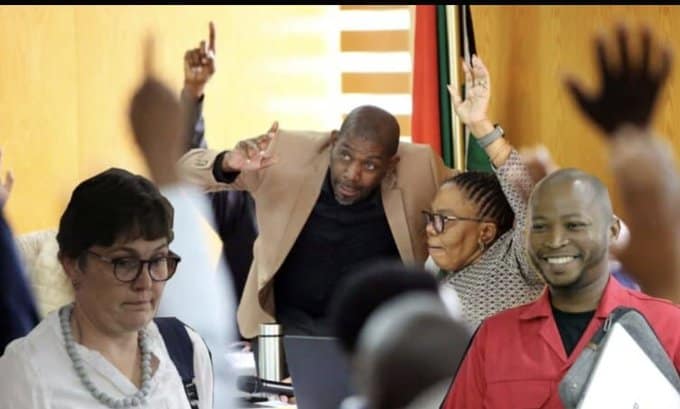
The heavy wooden door to the council chambers in Vereeniging slammed shut with a reverberating thud, but it could not contain the chaos boiling over inside. What should have been a procedural exercise—the tabling and approval of Emfuleni Local Municipality’s adjustment budget—had instead descended into a theatrical brawl that laid bare the festering tensions in one of Gauteng’s most embattled municipalities. By the time the dust settled, the Economic Freedom Fighters (EFF) were not just crying foul; they were alleging a brazen, organised assault on democratic process itself.
The date was set to be a routine fiscal recalibration. The ANC-led Emfuleni municipality, a sprawling region encompassing Vereeniging, Vanderbijlpark, and Sasolburg, has for years staggered under the weight of financial mismanagement, service delivery protests, and a R4 billion debt burden. The adjustment budget was meant to be a sober exercise in re-prioritising scant resources. But in the highly charged atmosphere of coalition politics and looming local government elections, sobriety was the first casualty.
According to a blistering statement released by the EFF’s Gauteng leadership on Wednesday, the trouble began long before the first item on the agenda was read. The party claims that the Speaker of the Council, an ANC functionary, orchestrated what they describe as a “premeditated ambush” designed to silence opposition and ram the budget through by any means necessary.
“From the moment we took our seats, it was clear that the ANC had no intention of allowing a free and fair process,” said Mandisa Mashego, the EFF’s caucus leader in Emfuleni, speaking to reporters outside the chambers after the session. “They came not to debate, not to deliberate, but to intimidate. This was not governance; this was thuggery dressed in a suit.”
The flashpoint, according to multiple eyewitness accounts and the EFF’s detailed complaint, occurred when the red-clad members of the Economic Freedom Fighters began raising points of order regarding what they termed “irregularities” in the budget documentation. They alleged that critical financial oversight reports were missing and that the adjustments proposed did not adequately address the water and sanitation crisis gripping large parts of the municipality.
As the EFF members pressed their case, their microphones were cut. When they rose physically to continue their protest, a contingent of what the EFF describes as “ANC-aligned security personnel and party enforcers” moved in. The scene that unfolded was one of pushing, shoving, and verbal altercations, captured partially on cellphone footage that has since circulated on social media, showing red-clad members being physically bundled towards the exit.
“It was a systematic purge,” said EFF Gauteng Chairperson Nkululeko Dunga. “They didn’t want witnesses. They didn’t want a record of dissent. They wanted a rubber stamp, and they were willing to use the fists of hired thugs to get it. The Speaker did not protect the house; he directed the attack on it.”
With the EFF members ejected or forcibly removed, the ANC and its remaining coalition partners swiftly passed the adjustment budget. The Speaker reportedly declared the vote carried without a formal count, citing a quorum still present.
The EFF has vowed to take the matter to the highest levels. Beyond a strongly worded condemnation, the party is preparing to lodge formal complaints with the South African Local Government Association (SALGA), the Gauteng Provincial Legislature’s portfolio committee on cooperative governance, and the office of the Premier. They are demanding an investigation into what they call “the criminalisation of council processes” and are threatening legal action to nullify the budget vote.
“This is not just about Emfuleni,” Mashego warned. “This is a dangerous precedent. If the ANC can use brute force to control a budget vote here, they will do it everywhere. They are showing us that when they cannot win through argument, they will win through intimidation.”
The ANC in Gauteng has, however, dismissed the EFF’s allegations as “the theatrical tantrums of a party that has run out of ideas.” In a brief response, provincial ANC spokesperson Lesego Makhubela characterised the incident as a minor disruption dealt with according to standing orders. “The budget had to be passed. The people of Emfuleni cannot wait for services while the EFF plays political games. The Speaker acted to restore order, and the business of the people was concluded.”
Yet, for the residents of Emfuleni—who face potholed roads, failing electricity infrastructure, and taps that often run dry—the fracas inside the council chambers is a symptom of a deeper paralysis. The adjustment budget, ostensibly designed to fix those very problems, was passed in an atmosphere of such toxicity that its legitimacy is now under a cloud of suspicion.
As the EFF prepares its legal and political offensive, the image that lingers is not of spreadsheets and fiscal projections, but of red uniforms being shoved through doorways, of microphones cut mid-sentence, and of a democracy, at the local level, seemingly held together by the thinnest of threads. The fight over Emfuleni’s budget is far from over; it has merely moved from the council floor to the courts, the media, and the court of public opinion.
About The Author