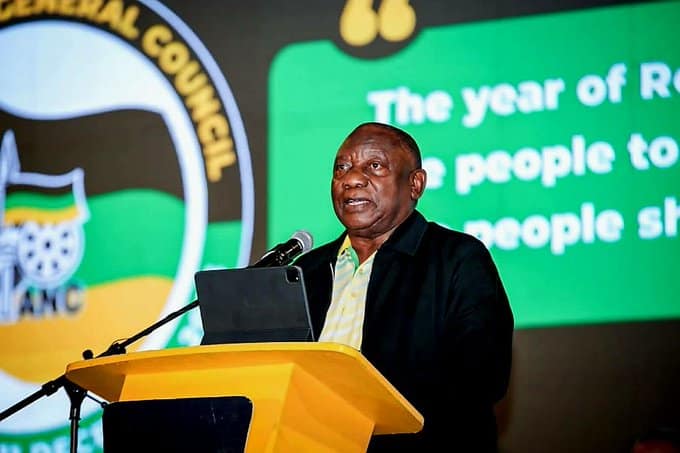
In a stark and uncompromising address that has sent tremors through the corridors of Luthuli House, African National Congress (ANC) President Cyril Ramaphosa issued a sweeping ultimatum to his own party this weekend: embrace radical, verifiable renewal or face irreversible decline at the ballot box.
Speaking at the closing of the party’s pivotal National Executive Committee (NEC) meeting, Ramaphosa transformed from party steward to political diagnostician, delivering a prognosis that was equal parts indictment and urgent prescription. He framed the coming months not merely as a pre-election period, but as a final proving ground for an organization grappling with its soul.
“A Fork in the Road”: The Anatomy of a Warning
“Our people are watching. Their patience is not exhausted; it has already expired in too many hearts and homes,” Ramaphosa stated, his tone somber. “Between where we stand now and the next election, there lies not just a campaign, but a choice for this organization. It is the choice between renewal and decline. Between integrity and irrelevance.”
Analysts are calling this his most definitive and high-stakes speech since the Phala Phala scandal, shifting the focus from internal factional management to a direct, public challenge to the party’s structures. The subtext was clear: the era of ambiguous sloganeering about “renewal” is over. It must now be manifest in visible, painful actions.
The Three Pillars of Ramaphosa’s Renewal Doctrine
Ramaphosa’s roadmap for renewal was built on three non-negotiable pillars, each a direct response to the party’s most damning public critiques:
- The Eradication of Self-Sabotage: He specifically named “bad habits” – a phrase widely interpreted as a euphemism for the corrosive practices of gatekeeping, vote-buying in internal elections, and the manipulation of candidate lists. “We cannot be a party that promises clean governance to the nation while our own internal machinery is gummed up with the grease of patronage,” he declared.
- The Unsparing Hunt Within: On corruption, Ramaphosa moved beyond past generalities. “The fight against corruption cannot be a sword we only wield outside. It must be the scalpel we use on ourselves,” he asserted. This is seen as a direct nod to growing public fury over the ANC’s failure to act decisively against members named in the State Capture Commission report and other scandals. The message: disciplinary processes must be swift, public, and untainted by factional loyalty.
- From Liberation Movement to Servant of the People: The most profound shift he articulated was psychological. “The ANC must cease to act as an entitled ruler and remember it is a humble servant. Our covenant is not with history; it is with the citizen struggling today.” This is a direct attempt to dismantle the culture of arrogance and incumbency that has alienated a generation of younger voters.
The Internal Schism: A Leadership Gambit
This clarion call is far from a unifying rallying cry. It is a high-risk political gambit that deliberately deepens the fissure between the so-called “reformist” and “traditionalist” camps within the ANC.
“Ramaphosa is essentially drawing a line in the sand,” political analyst Professor Mcebisi Ndletyana observed. “He is telling the party, ‘My leadership is conditional on this path of renewal. If you choose another, you choose it without me.’ He is betting his authority on forcing the structures to choose between his reform agenda and the old, discredited methods of politics.”
The immediate test of this doctrine will be the candidate selection process for the upcoming national and provincial elections. Any list featuring individuals embroiled in scandal or allegations of corruption will be hailed as proof of the hollowness of Ramaphosa’s challenge.
A Nation Weary of Promises
Public reaction has been dominated by skepticism born of long experience. “We have heard ‘renewal’ since the Nasrec conference in 2017,” said Thandiwe Nkosi, a community organizer in Soweto. “Yet when we look at our crumbling municipalities, the unfulfilled promises, and the same faces involved in scandals, we see only renewal of rhetoric, not action.”
Opposition parties were quick to pounce. The DA labeled the speech “a desperate act of political theater,” while the EFF mocked it as “the death rattle of a dying party trying to rebrand its own funeral.”
The Stakes: Existential
The underlying data fuels the urgency of Ramaphosa’s warning. With the ANC’s national support hovering near 50% and collapsing in key metropolitan areas, the 2024 elections represent an existential threshold. A fall below 50% would force the party into complex, unstable coalitions, fundamentally altering South Africa’s political landscape.
Ramaphosa has therefore framed the mission in stark terms: Renewal is no longer an internal project for a healthier party; it is the last, necessary campaign strategy to avoid electoral humiliation.
“The people of South Africa are not bound to us by history alone,” Ramaphosa concluded, his final words hanging in the air. “They will measure us by the content of our character today and the quality of our service tomorrow. We must become, once more, the answer to their hopes, not the source of their despair.”
The gauntlet has been thrown. Whether the ANC’s sprawling, fractious body will pick it up—or trample over it in a rush to preserve the status quo—will define not only the party’s future, but the trajectory of South Africa itself.
About The Author