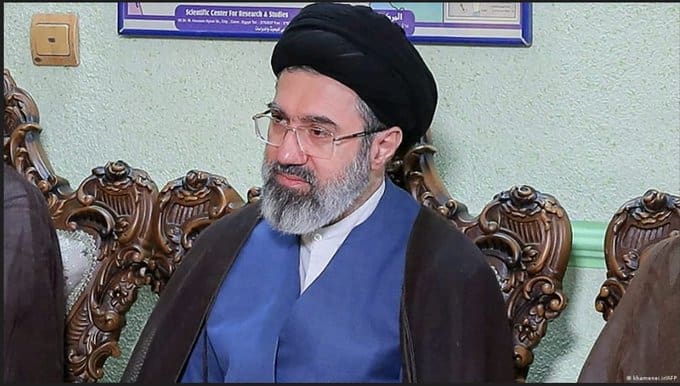
In a move that defies its enemies and solidifies hardline rule, Iran has named Mojtaba Khamenei as its new supreme leader, succeeding his father, Ayatollah Ali Khamenei, who was killed in joint US-Israeli strikes just over a week ago . The appointment, confirmed late Sunday by Iran’s Assembly of Experts, sends an unequivocal message of defiance to the West and sets the stage for a prolonged and volatile confrontation as the war-torn nation hurtles toward an uncertain future .
The 88-member Assembly of Experts, a body of clerics responsible for selecting the country’s top authority, announced its “decisive vote” in a statement carried by state media, formally appointing the 56-year-old Mojtaba as the third supreme leader of the Islamic Republic . Almost immediately, the powerful Islamic Revolutionary Guard Corps (IRGC) pledged its full allegiance, vowing to follow the new leader’s directives and defend the nation against its adversaries .
The transition, however, is anything but routine. It unfolds against the backdrop of “Operation Epic Fury,” the US-Israeli military campaign that decapitated Iran’s leadership on February 28, killing not only the elder Khamenei but also senior military commanders, defense officials, and several members of the supreme leader’s own family . Mojtaba himself survived the strike on the family compound in Tehran, but lost his mother, his wife Zahra Haddad-Adel (daughter of a prominent conservative politician), and other relatives in the attack . This personal tragedy, analysts suggest, will only harden his resolve.
“The world will miss the era of his father,” a regional official close to Tehran told Reuters. “Mojtaba will have no choice but to show an iron fist… even if the war ends, there will be severe internal repression” .
The ‘Shadow Commander’ Steps into the Light
For years, Mojtaba Khamenei has been described as the “eminence grise” of Iranian politics—a powerful but shadowy figure operating behind the scenes . Born in Mashhad in 1969, he is a mid-ranking cleric who studied in the holy city of Qom under prominent conservative scholars . Unlike his father, he lacks the senior religious credentials traditionally expected of the role, a fact that underscores the regime’s prioritization of political loyalty and iron-fisted control over theological authority.
His influence, however, has never been in doubt. Mojtaba’s close ties to the IRGC date back to the Iran-Iraq war, where he served with volunteer battalions connected to the revolutionary networks that would later form the bedrock of the security establishment . Over the decades, he is reputed to have acted as his father’s gatekeeper, amassing influence within the security apparatus and the vast economic empire it controls. Opposition figures have long accused him of playing a pivotal role in shaping election outcomes and coordinating crackdowns on dissent . The US Treasury sanctioned him in 2019 for his official representation of the supreme leader, despite his never holding elected office .
His appointment is a direct rebuke to US President Donald Trump, who had declared just days prior that Khamenei’s son was “unacceptable” and that Washington should have a say in selecting Iran’s next ruler . One Iranian cleric, Ayatollah Mohsen Heidari Alekasir, even framed the US opposition as a virtue, stating, “Someone opposed by the enemy is more likely to benefit Iran and Islam” . The Assembly’s choice confirms that the path of compromise and engagement with the West has been decisively rejected in favor of confrontation and endurance .
‘A Target for Elimination’: Israel’s Chilling Warning
The new leader steps into a role that comes with a bullseye on his back. Even before the appointment was official, Israel’s military leadership issued a stark warning: any successor to Ayatollah Ali Khamenei would be “an unequivocal target for elimination” . Defence Minister Israel Katz made it clear that Israel, alongside its American partners, would pursue anyone who continues “leading the plan to destroy Israel” . The Israeli army further warned that even members of the Assembly who participated in the selection could be treated as potential targets .
Despite these threats, Mojtaba Khamenei’s Iran is showing no sign of backing down. The IRGC has threatened to target energy facilities across the region, warning that oil prices could soar to $200 a barrel if the US and Israel “continue this game” . An IRGC spokesman declared that Iran’s armed forces can sustain high-intensity combat for at least six months and promised the imminent deployment of advanced long-range missiles .
Global Markets in Turmoil as Oil Hits $114
The escalating conflict and the defiant leadership change have lit a fire under global energy markets. On Monday, Brent crude, the international benchmark, smashed through the $100 psychological barrier, spiking more than 20 percent to top $114 a barrel—a level not seen since Russia’s 2022 invasion of Ukraine .
The surge is driven by the effective closure of the Strait of Hormuz, a narrow waterway through which about a fifth of the world’s oil passes . In retaliation for the strikes on Iran, shipping has ground to a halt, forcing major producers like Iraq, Kuwait, and the UAE to cut or shut in production as storage facilities fill up with nowhere to send their barrels . Attacks on energy infrastructure have compounded the crisis; over the weekend, Saudi Arabia intercepted drones heading to its massive Shaybah oil field, and Israel carried out its first strikes on Iran’s oil infrastructure, hitting storage facilities in Tehran .
The price shock is rippling through the global economy. Asian stock markets tumbled, with Japan’s Nikkei 225 plunging more than 7 percent, while US stock futures pointed to a sharply lower open on Wall Street . Analysts warn that if the disruption persists, it will fuel inflation and slow economic growth. JPMorgan Chase analysts projected that Middle East oil production shut-ins could expand to over four million barrels a day .
President Trump, who campaigned on lowering the cost of living, brushed off the spike in a post on Truth Social, calling it a “very small price to pay for U.S.A., and World, Safety and Peace,” and insisting prices will drop rapidly after the “destruction of the Iran nuclear threat” . On Sunday, he told ABC News he had not ruled out sending special forces to seize Iran’s enriched uranium stockpiles, stating that “all options are on the table” .
A New Era of Confrontation
With a grieving and hardline new leader in Tehran, a resolute Israel vowing to hunt him down, and a US president committed to crushing the Iranian regime’s capabilities, the war in the Middle East shows no signs of abating . Mojtaba Khamenei inherits a nation battered by war, its economy in tatters and its population weary of repression . But for the clerical establishment and the IRGC, the choice was clear: survival through solidarity, and leadership through unyielding hardness. As one analyst put it, “This is a hardline choice, made in a hardline moment” . The world now watches to see if this moment spirals into a wider, even more catastrophic regional war.
About The Author