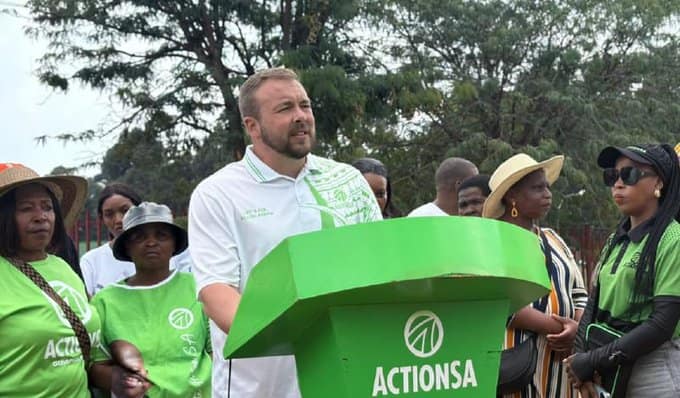
The deep-seated internal fissures within the African National Congress (ANC) in Gauteng have erupted into a public and vitriolic war of words, with a prominent branch secretary launching a blistering defence of the party’s regional leadership against what he terms a campaign of “divisive and dangerous” xenophobic attacks.
Steve Mahopo, the Secretary of the influential ANC Nazomdeni Branch, has issued a scathing condemnation of recent accusations made by Phapano Phasha, a former ANC member and political commentator. Phasha had publicly targeted members of the Greater Johannesburg Regional Executive Committee (REC), singling out its newly elected Chairperson, Comrade Loyiso Masuku, with rhetoric Mahopo describes as a “toxic cocktail of regionalism, tribalism, and xenophobia.”
In a detailed statement released on Monday, Mahopo accused Phasha of exploiting ethnic and nationalist sentiments to undermine the legitimacy of the democratically elected REC, which includes leaders with heritage from other Southern African nations, such as Zimbabwe. Phasha’s critiques, circulated widely on social media and in certain media outlets, had questioned the “authenticity” and “loyalty” of non-South African-born leaders within the ANC’s regional structures.
“This is not political critique; it is a poison designed to divide our movement and our communities,” Mahopo asserted. “When comrades who have dedicated their lives to the struggle in South Africa, who are legally and rightfully here, are subjected to questions about their origin as a means to disqualify their leadership, we have crossed into the territory of xenophobia. The ANC was built on Pan-Africanist ideals, and such attacks betray the very foundation of our movement.”
The controversy highlights the intense factional battles and jockeying for influence within the ANC’s Johannesburg region, a key political battleground ahead of the 2026 local government elections. The election of the new REC, including Masuku, was already a contentious process, and Phasha’s comments are seen by many as a proxy attack by factions that lost out.
Phasha, in her initial remarks, defended her position as a call for “local prioritisation” and questioned whether leaders with strong ties to other nations could fully prioritise South African interests. Her supporters argue that the issue is one of accountability and representation, not xenophobia.
However, Mahopo’s rebuttal frames the issue in starker terms, warning that such rhetoric could spill over into broader societal violence. “We have seen where this language leads—to hostility on the streets, to communities turning on each other. The ANC must be a firewall against such divisiveness, not a platform for it.”
The ANC’s provincial leadership in Gauteng has yet to issue an official statement on the matter, reflecting the sensitivity of the internal dispute. Political analysts suggest the silence indicates deep divisions at the provincial level on how to handle the issue, balancing the need for party unity against the rising tide of populist, nationalist sentiment within some sections of its base.
“This is a microcosm of a larger tension within the ANC and South African politics at large,” said political analyst Professor Mcebisi Ndletyana. “It pits a utilitarian, pan-African liberation identity against a more narrow, resource-conscious nationalism. How the party manages this conflict in Johannesburg, its economic heartland, will signal its direction nationally.”
As the war of words escalates, the ANC in Johannesburg finds itself at a crossroads, forced to confront whether its storied commitment to African unity can withstand the pressures of local politics, economic scarcity, and internal power struggles.
About The Author