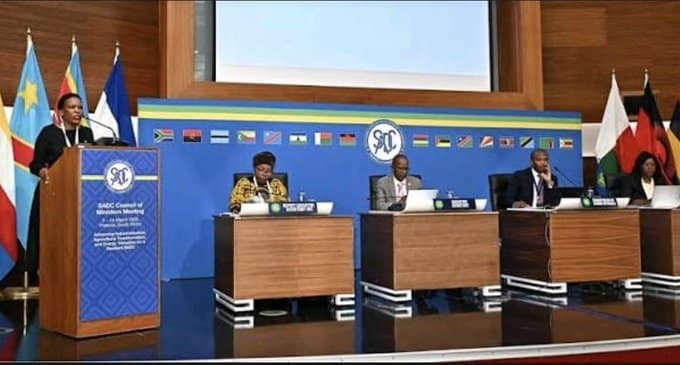
Pretoria – In a forceful and urgent address, the Executive Secretary of the Southern African Development Community (SADC), Elias Magosi, has issued a clarion call for member states to radically break from the colonial-era economic model of exporting raw minerals, arguing that the region’s future prosperity hinges on its ability to process its own resources and drive industrial growth.
Speaking at the official opening of the SADC Council of Ministers meeting in Pretoria on Thursday, 12 March 2026, Magosi delivered a stark assessment of the region’s economic trajectory. He warned that while the world clamours for the minerals buried beneath Southern African soil—minerals critical to the global green energy transition—the region itself is being left behind, shipping out its wealth only to import finished goods at a vastly higher cost.
“We find ourselves at a critical juncture,” Magosi told the assembled ministers and senior officials from the 16 member states. “The global economy is transforming. The demand for the very resources we possess—lithium, cobalt, platinum, manganese—is skyrocketing. Yet, we continue to export them in their raw form, creating jobs and value elsewhere. This must change. Urgently.”
The Paradox of Plenty
Magosi’s address laid bare the frustrating paradox that has plagued resource-rich Southern Africa for generations. The region is home to some of the world’s largest reserves of minerals essential for electric vehicle batteries, renewable energy storage, and clean technology. The Democratic Republic of Congo dominates global cobalt production; South Africa holds vast platinum group metals; Zimbabwe possesses significant lithium deposits; and Zambia and the DRC are major copper producers.
Despite this geological fortune, the economic benefits largely accrue elsewhere. Raw ore is shipped to processing hubs in China, Europe, and North America, where it is refined, manufactured into components, and ultimately sold back to African consumers as expensive finished products—batteries, electronics, and industrial machinery.
“The current model exports jobs, exports value, and perpetuates our dependency,” Magosi stated. “We cannot claim to be building resilient economies if we remain at the very bottom of the global value chain. Industrialisation must begin at home, with the resources God has given us.”
The Two-Day Agenda: Industrialisation, Agriculture, and Energy
Magosi’s call to action set the tone for the two-day Council of Ministers meeting, which is being held under the theme: “Advancing Industrialisation, Agricultural Transformation, and Energy Transition for a Resilient SADC.”
The theme reflects a holistic strategy. The push for mineral beneficiation is not seen in isolation but as a pillar of a broader economic transformation. The ministers are tasked with reviewing progress on the SADC Industrialisation Strategy and Roadmap (2015-2063) and identifying concrete steps to accelerate implementation.
Key discussions are expected to focus on:
- Harmonising Policies: Creating a unified regional approach to beneficiation, ensuring that one country’s processing incentives are not undercut by another’s raw material exports.
- Infrastructure and Energy: Addressing the crippling energy shortages and logistical bottlenecks that make local processing difficult. Without reliable and affordable electricity, smelters and refineries cannot operate.
- Attracting Investment: Crafting incentives to lure investment into processing facilities, battery manufacturing, and precursor industries, moving beyond simple extraction.
- Skills Development: Ensuring the region has the engineers, technicians, and scientists needed to operate advanced industrial plants.
Green Energy: An Opportunity Not to Be Missed
Magosi specifically highlighted the global energy transition as a generational opportunity. The shift away from fossil fuels is driving unprecedented demand for the very minerals SADC possesses. However, he warned, this opportunity will be squandered if the region continues to act merely as a quarry for the Green Revolution.
“The world wants our green minerals to power their green future,” he said. “That is acceptable. But it cannot be acceptable that they take our lithium and send us back lithium-ion batteries at a thousand times the price. We must position ourselves to participate in the entire value chain of the green economy.”
This sentiment resonates strongly with several member states. The DRC and Zambia have already initiated talks to collaborate on building a regional battery supply chain. Zimbabwe has imposed bans on raw lithium exports to force processing within its borders. However, implementation has been uneven, and the region still lacks the massive, coordinated investment needed to compete with established processing giants.
A Test of Political Will
As the Council of Ministers continues its deliberations in Pretoria, the challenge laid down by Magosi is ultimately one of political will. The path to beneficiation is fraught with difficulty. It requires massive capital investment, policy certainty, and a willingness to forego short-term revenue from raw exports for long-term industrial development.
It also requires a united front. If one SADC country sells raw minerals cheaply, it undermines the efforts of its neighbours to build processing capacity. Regional integration, a core tenet of SADC’s founding principles, is not just a political slogan in this context; it is an economic necessity.
As the ministers return to their respective capitals, they carry with them a clear and urgent message from the region’s top official: the era of digging and shipping must end. The wealth beneath Southern Africa’s soil must be used to build the factories, employ the youth, and power the future of the region itself. Whether they have the courage and coordination to answer that call remains the defining question for SADC’s economic future.
About The Author