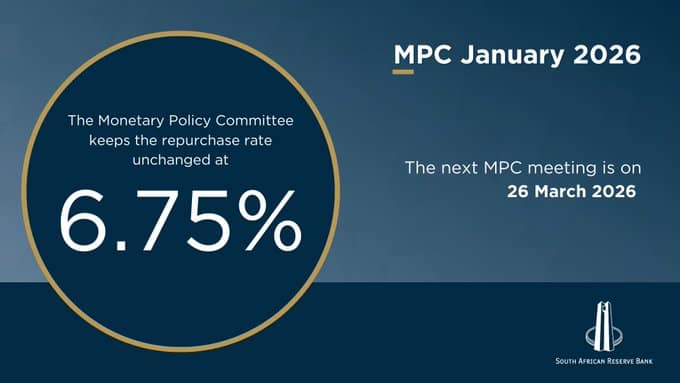
The South African Reserve Bank’s (SARB) Monetary Policy Committee (MPC) has opted for caution in its first policy decision of the year, announcing on Thursday that it will keep the benchmark repo rate unchanged at 6.75%. The decision, reached via a split vote, maintains the commercial prime lending rate at 10.25% and underscores the central bank’s delicate navigation between persistent domestic economic fragility and a cautiously improving inflation outlook.
This “hold” stance follows a welcome 25-basis-point cut in November 2025, which had marked a shift toward an easing cycle after a prolonged period of restrictive policy aimed at taming inflation. The MPC’s latest move reflects a pause to assess the impact of that cut amidst a complex global and local landscape.
Inflation: A Historic Low, Yet Risks Linger
A key factor in the deliberation was the continued favorable inflation trajectory. Governor Lesetja Kganyago confirmed that headline consumer price inflation (CPI) averaged a remarkable 3.6% for 2025 as a whole—the lowest annual average since 2004. The December 2025 print also came in at 3.6%, edging up slightly from November’s multi-year low but remaining comfortably within the SARB’s 3% to 6% target band.
“The disinflation trend is firmly established, driven by moderating food and core goods prices,” Kganyago stated. However, he struck a note of vigilance, highlighting that the path ahead is “subject to renewed risks.” The bank’s statement pointed to ongoing geopolitical tensions, particularly in the Middle East and their impact on global oil prices, and the volatility of the rand exchange rate as upside risks to the inflation forecast. Additionally, administered prices like electricity and water remain a persistent domestic pressure point.
Growth Concerns and a Divided Committee
The decision to hold was not unanimous, revealing a nuanced debate within the MPC. Governor Kganyago revealed that two of the five committee members advocated for an immediate 25-basis-point reduction. These members argued that the inflation outlook had improved sufficiently to warrant further support for an economy that remains mired in low growth. Recent data suggests the economy barely expanded in the fourth quarter of 2025, with persistent structural constraints—including record unemployment, logistical bottlenecks, and intermittent power supply—continuing to stifle any robust recovery.
The majority view, however, prevailed. The three-member majority, including the Governor, judged it prudent to “look through the near-term data and await more clarity,” Kganyago explained. They emphasized the need to anchor inflation expectations firmly around the midpoint of the target range (4.5%) and to guard against potential shocks in an uncertain global environment.
Market Reaction and the Path Forward
Financial markets had largely priced in a hold, and the reaction was muted. The rand showed slight volatility before stabilizing, while bond yields edged lower in anticipation of future easing. Economists broadly endorsed the MPC’s cautious approach.
“The SARB is wisely buying time,” said Isaah Mhlanga, chief economist at a leading financial services firm. “With inflation at its lowest in two decades, the space for easing is opening. However, with the Federal Reserve’s own cycle still uncertain and local risks ever-present, a data-dependent pause is the most prudent course. This maintains the Bank’s credibility and allows it to act more decisively later if conditions allow.”
The central bank’s forward guidance retained a mildly dovish tilt, signaling that the bar for further rate cuts is lowering. The MPC’s statement noted that “the policy stance is considered appropriately restrictive, but the Committee will continue to assess the balance of risks to determine the appropriate pace of any future easing.”
All eyes now turn to the next MPC meeting scheduled for March 26, 2026. The intervening weeks will be critical, with policymakers scrutinizing key data including the February inflation print, fourth-quarter GDP figures, budget announcements, and global monetary policy signals. The split vote today suggests that should the favorable inflation trend hold and growth indicators disappoint, the argument for a resumption of the easing cycle in March could gain decisive momentum.
About The Author