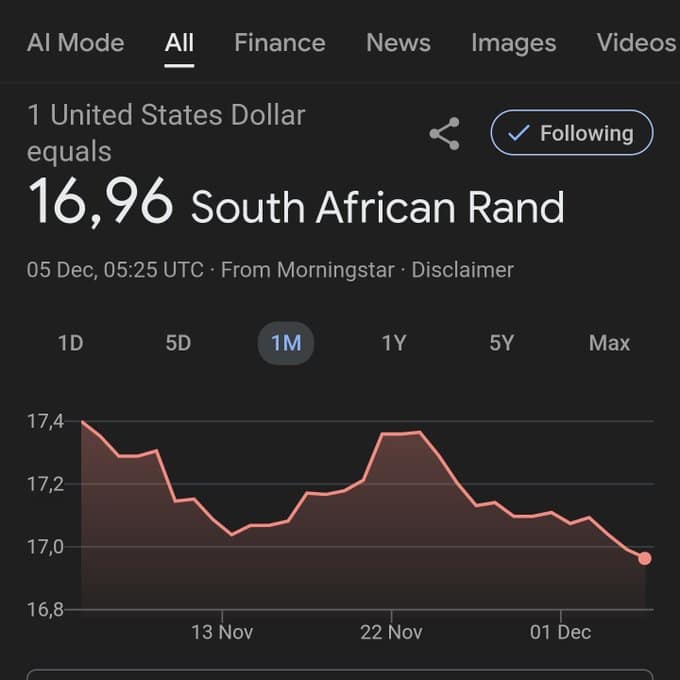
The South African rand surged past the significant R17-to-the-US-dollar threshold on Friday, marking its strongest position in over a year and igniting a complex debate about its causes, consequences, and durability. The currency gained approximately 0.3% on the day, building on a remarkable 6.5% appreciation over the past twelve months from its lows near R19.77.
The immediate catalyst for the rally is widely attributed to a broad-based weakening of the US dollar. Growing market conviction that the US Federal Reserve will begin cutting interest rates in early 2026 has prompted a global shift away from the greenback, benefiting emerging market currencies like the rand. This external windfall coincides with what analysts cite as improved domestic fundamentals.
“South Africa has entered this period of dollar weakness with a more stable foundation,” noted Thandeka Mokoena, chief economist at Ubuntu Capital. “Inflation has remained within the Reserve Bank’s target band, the current account deficit is manageable, and the recent budget signalled a tangible, if gradual, commitment to fiscal consolidation. The market is rewarding this relative stability.”
The political sphere was quick to claim a share of the credit. Home Affairs Minister Dr. Leon Schreiber acknowledged the currency’s move, linking it directly to the Government of National Unity (GNU). “The rand breaking through R17/$ is a vote of confidence in the stability and reform trajectory of the GNU,” Schreiber stated. “This administration’s focus on pragmatic policy is beginning to bear fruit, reducing the country’s risk premium.”
For ordinary South Africans, a stronger rand offers a potential pocketbook reprieve. It directly translates to cheaper imported goods, from electronics and clothing to crucial inputs for manufacturers. Most significantly, it lowers the cost of importing petroleum, raising the prospect of a decrease in fuel prices in the coming months—a critical factor for transportation and food costs.
However, the celebration is tempered by deep-seated caution. Economic observers and opposition voices question the rally’s staying power, pointing to formidable headwinds. “While welcome, this strength is externally driven and therefore fragile,” warned opposition finance spokesperson Michael van der Merwe. “It could reverse just as quickly on a shift in US data or a global risk-off event. We cannot confuse a weaker dollar for a fundamentally transformed South African economy.”
The primary concerns centre on two fronts: impending global uncertainty and unmet local imperatives. The incoming US administration’s trade and foreign policy direction remains a major unknown, capable of triggering volatility across emerging markets. Domestically, critics argue that currency gains must be leveraged to address structural crises, not seen as an endpoint.
“The real test is whether this breathing room is used to accelerate job creation, implement long-promised structural reforms at our ports and railways, and bolster border security to curb illegal immigration that strains public services,” said Busi Nkosi, a political analyst. “A strong rand that doesn’t translate into more jobs or greater security will feel hollow to millions.”
The South African Reserve Bank is likely to observe the moves closely. While a stronger currency helps contain inflation, an overly rapid appreciation could also hurt the competitiveness of the country’s crucial mining and agricultural exports.
As the rand consolidates around its new level, the consensus is one of cautious optimism. The break past R17/$ provides a psychological boost and tangible economic benefits, but it is widely viewed as a window of opportunity—one that demands decisive domestic action to ensure the gains are not fleeting in the face of an uncertain global landscape.
About The Author