From the hallowed halls of the Apostolic Palace, a desperate plea for peace echoed across a world on edge. In his most urgent and direct intervention since assuming the papacy, Pope Leo XIV issued a powerful and impassioned call for an immediate cessation of the escalating violence engulfing Iran and the broader Middle East, warning that the conflict, now in its second week, risks metastasizing into a wider, uncontrollable regional conflagration with devastating consequences for humanity.
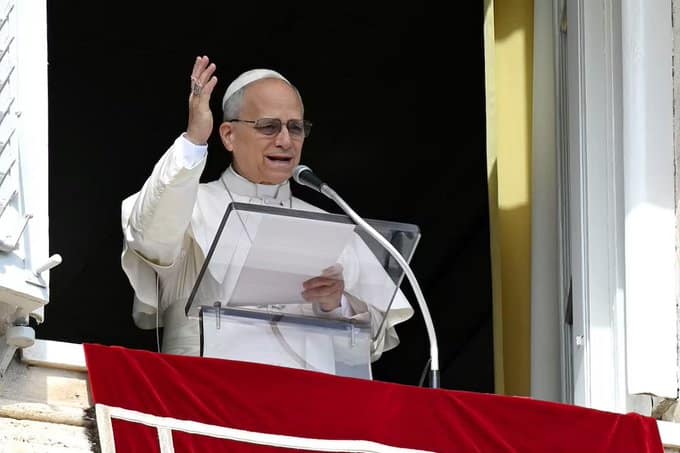
Speaking to a packed audience in St. Peter’s Square during the weekly Angelus blessing, the Pontiff’s voice was heavy with concern as he addressed the spiraling crisis triggered by the joint US-Israeli strikes that killed Iran’s former leader and the subsequent hardline succession and market turmoil.
“My heart is heavy, and my spirit is anguished as I observe the flames of conflict growing ever higher in the beloved lands of the Middle East, particularly in Iran,” Pope Leo said, his words translated into multiple languages and broadcast globally. “I raise my voice to plead with all parties involved, and with the international community, to immediately halt this spiral of violence. War is always a defeat. It is a failure of politics and a failure of humanity.”
The Pope’s remarks come at a critical juncture. The conflict, which began with targeted military action, has since spiraled into a multi-front confrontation, with Iran launching retaliatory strikes, the closure of the Strait of Hormuz sending global oil prices soaring above $100 a barrel, and world powers nervously watching for further escalation. The installation of Mojtaba Khamenei as Iran’s new Supreme Leader, a move seen as a hardline consolidation of power, has further dimmed hopes for a diplomatic off-ramp.
A Plea Rooted in Prophetic Tradition
Pope Leo’s intervention is not merely a political statement; it is a deeply theological one, rooted in the Church’s longstanding tradition of advocating for peace and the protection of innocent life. He specifically invoked the plight of civilians caught in the crossfire, the “forgotten victims of war” who face displacement, injury, and death.
“I think especially of the children, the mothers, the elderly, and the sick. I think of all those who have been forced to flee their homes with nothing but the clothes on their backs,” he continued, his gaze sweeping over the thousands of faithful gathered below. “I think of the families in Msinga, in South Africa, who mourn their dead from floods, and I think of the families in Tehran, in Tel Aviv, in Baghdad, and in Gaza, who tremble at the sound of explosions. They do not ask for war. They ask for bread, for work, for a future. They ask for peace.”
The Pontiff made a direct appeal to political and military leaders, urging them to choose the path of dialogue, however difficult it may seem. “To those who hold the levers of power and the fate of nations in their hands, I say: Stop. Listen to the cry of the poor and the powerless. The logic of arms is the logic of death. The logic of encounter, of negotiation, of sincere dialogue, is the only logic that leads to life.”
‘The World is a Single Family’
Pope Leo’s message also carried a universalist theme, reminding the global community that the consequences of a Middle East war would not be contained within the region. The economic shockwaves—the spike in oil prices, the disruption of global trade, the potential for a new refugee crisis—would be felt on every continent, further destabilizing fragile economies and societies.
“The world is a single family,” he declared. “When one part of the body suffers, the whole body suffers with it. The instability sown in the Middle East today will be the harvest of sorrow reaped by all of humanity tomorrow. We cannot stand idly by.”
His words resonated far beyond the Vatican walls. In diplomatic circles, the papal statement was seen as a significant moral pressure point. While the Vatican has no military or economic power, its moral authority, particularly among the world’s 1.3 billion Catholics, gives it a unique platform. Historically, papal interventions have helped mediate conflicts and open channels of communication.
A History of Peace-Making
Pope Leo’s appeal follows in the footsteps of his predecessors. St. John Paul II was a vocal opponent of the 2003 Iraq War. Pope Benedict XVI consistently called for peace in the Holy Land. And Pope Francis made the humanitarian situation in the Middle East a cornerstone of his papacy, even making a historic visit to Iraq in 2021. Pope Leo, who has shown a keen interest in interfaith dialogue since his ascension, appears determined to continue this legacy.
However, the path to peace seems more obstructed than ever. With a new, untested, and grieving leader in Tehran, a determined Israeli government vowing to eliminate the Iranian threat, and a US administration committed to crippling Tehran’s nuclear ambitions, the call from Rome may fall on deaf ears.
Yet, for the millions of faithful and for the civilians huddled in fear across the region, the Pope’s words offered a glimmer of solace—a reminder that someone, somewhere, was speaking for them.
As the Angelus concluded, Pope Leo lifted his hands in a final blessing, his eyes seeming to look beyond the square, toward the East. “May the God of peace inspire in the hearts of all leaders a spirit of wisdom, courage, and compassion. May he grant the people of Iran and the entire Middle East the gift of a just and lasting peace. And may the Virgin Mary, our Mother, Queen of Peace, watch over us all.”
About The Author