
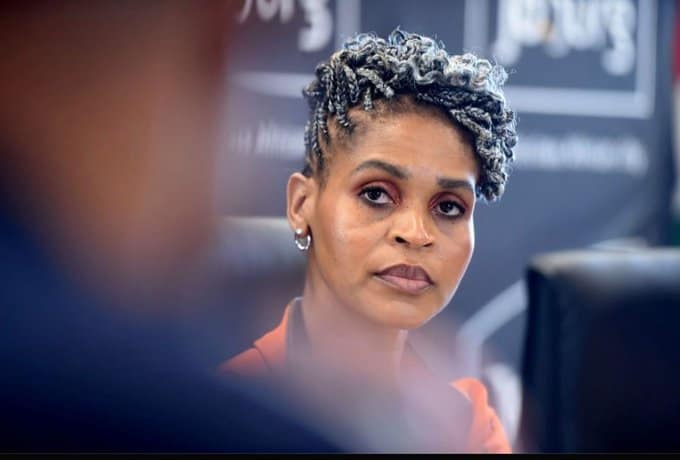
The uMkhonto weSizwe Party (MKP), the fledgling political movement that shook South Africa’s electoral landscape just two years ago, is bleeding members at an alarming rate. On Friday, February 20, 2026, Colleen Makhubele, a high-profile Member of Parliament and former Johannesburg City Council Speaker, announced her resignation from the party’s parliamentary caucus. She is the fourth MP to walk away since November 2025, and her departure has sent shockwaves through an organization already teetering on the edge of internal collapse.
Makhubele’s resignation, confirmed by parliamentary officials late on Friday, is a significant blow to the MKP’s credibility and its ability to maintain a coherent presence in the National Assembly. Her decision to leave comes amid swirling rumors of factional battles, leadership disputes, and growing disillusionment among public representatives who feel marginalized by the party’s top brass.
While Makhubele has not yet issued a detailed public statement explaining her reasons, sources close to the former MP suggest that she had become increasingly frustrated with the “chaotic” and “undemocratic” functioning of the party’s internal structures. She is expected to address the media in the coming days, and her words are likely to be damning.
The Fourth Domino
Makhubele’s departure is not an isolated incident. It is the latest in a series of high-profile exits that have gutted the MKP’s parliamentary contingent. Since November 2025, three other MPs have resigned, each citing varying degrees of dissatisfaction with the party’s direction, leadership style, and internal governance.
The MKP, formed as a vehicle for the legacy of former president Jacob Zuma and drawing on the historical resonance of the uMkhonto weSizwe liberation struggle, burst onto the scene with significant fanfare. It positioned itself as the true heir to the revolutionary tradition, appealing to voters disillusioned with the African National Congress (ANC) and the Economic Freedom Fighters (EFF). In the 2024 general elections, it performed remarkably well, securing a foothold in Parliament and establishing itself as a kingmaker in KwaZulu-Natal.
But the transition from a protest movement to a governing party has proven treacherous. Internal squabbles over leadership, policy, and the allocation of positions have plagued the party from the start. The departure of four MPs in just four months suggests that the rot is deep and that the party’s internal cohesion is fracturing.
Who is Colleen Makhubele?
Colleen Makhubele is not a political novice. Before joining the MKP, she was a prominent figure in the City of Johannesburg, serving as the Speaker of the Council. In that role, she was known for her firm hand and her attempts to navigate the complex coalition politics that have defined South Africa’s largest metropolis in recent years. She was also a key figure in the short-lived “Moonshot Pact” coalition talks, representing the interests of smaller parties seeking to unseat the ANC.
Her decision to join the MKP was seen as a major coup for the party. She brought with her a reputation for competence, a network of relationships across the political spectrum, and a profile that extended beyond the party’s core base in KwaZulu-Natal. Her presence in Parliament added weight and diversity to the MKP’s caucus.
Her departure, therefore, is more than just a loss of a number; it is a loss of a brand. It signals to potential voters and allies that the MKP may not be a stable or reliable vehicle for political ambition.
The Leadership Question
At the heart of the MKP’s troubles is the question of leadership. The party is closely associated with Jacob Zuma, whose personal legal battles and political vendettas often overshadow the party’s policy platform. While Zuma remains a powerful draw for a significant segment of the electorate, his influence within the party’s internal structures has created tension between those who want to build a lasting institution and those who see the party as a personal project.
Parliamentary leaders have reportedly chafed at what they perceive as micro-management from the party’s extra-parliamentary leadership. Decisions about voting, messaging, and strategy are often dictated from outside, leaving MPs feeling like rubber stamps rather than elected representatives with a mandate to think and act independently.
Makhubele, a seasoned politician accustomed to wielding authority, is unlikely to have tolerated such constraints quietly. Her resignation may well be a protest against a culture that stifles debate and punishes dissent.
The Zuma Factor
Jacob Zuma’s shadow looms large over every aspect of the MKP. His imprisonment for contempt of court in 2021, and the subsequent political fallout, was the catalyst for the party’s formation. His name and image are central to its brand. But his presence is also a source of constant controversy.
Zuma’s legal troubles are far from over. He continues to face court proceedings related to corruption charges stemming from the arms deal era. The party is forced to constantly defend him, diverting energy and resources away from building a policy platform and holding the government to account.
For MPs like Makhubele, who may have joined the party with hopes of focusing on service delivery, economic reform, and the practical work of opposition politics, the constant focus on Zuma’s personal battles can be exhausting and counterproductive. The party risks becoming a single-issue organization, defined entirely by its relationship to one man, rather than a broad-based movement with a vision for the country.
The Impact on Parliament
The MKP’s parliamentary caucus, already diminished by the four resignations, will now have to reorganize. The loss of Makhubele, a vocal and visible presence in debates and committee meetings, weakens the party’s ability to punch above its weight.
The departing MPs have not yet indicated whether they will join other parties or sit as independents. If they form a new bloc or align with another opposition force, it could further erode the MKP’s position. The party’s leadership will have to work hard to reassure remaining MPs and prevent a cascade of further departures.
For the ANC and the broader Government of National Unity, the MKP’s turmoil is a distraction. They are focused on governing. But for the opposition landscape, the MKP’s implosion creates a vacuum that other parties, particularly the EFF and perhaps a resurgent Inkatha Freedom Party (IFP), may seek to fill.
What Comes Next?
Colleen Makhubele’s next move will be closely watched. She has options. She could take a break from active politics, rejoin the private sector, or align herself with another political formation. Her experience and profile make her an attractive prospect for any party seeking to bolster its parliamentary presence.
For the MKP, the immediate priority is damage control. Party leaders will issue statements praising Makhubele’s contribution and wishing her well, while privately scrambling to contain the narrative of a party in crisis. They will also be watching nervously to see if any other MPs are preparing to follow her out the door.
The MKP was born out of anger and betrayal. It promised to shake up the system. But as the resignations mount, it risks becoming a cautionary tale: a party that could not manage itself, let alone the country. Colleen Makhubele’s departure is just the latest chapter in that story. It may not be the last.
About The Author


