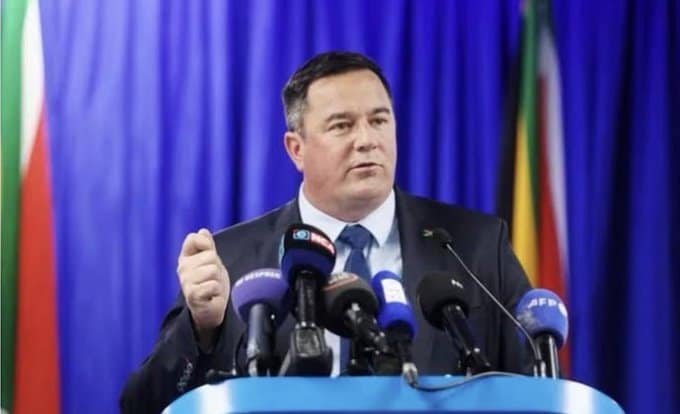
In a move that marks a significant turning point for South Africa’s political landscape, Democratic Alliance (DA) leader John Steenhuisen has confirmed he will not seek a third term at the helm of the country’s main opposition party. The announcement, made during a closed-door Federal Council meeting on Saturday, ends months of speculation about his future and sets the stage for a potentially transformative leadership contest within the organisation.
Steenhuisen, who has led the DA since 2019, will complete his current term in April 2025. His decision paves the way for a new generation of leadership as the party gears up for crucial local government elections in 2026 and the national parliamentary polls in 2029.
A Calculated Transition
In an exclusive interview following the announcement, Steenhuisen framed his departure not as a retreat, but as a strategic choice to renew the party at a critical juncture.
“After nearly six years at the helm, and with the party on a stable trajectory following our improved electoral performance, I believe the time is right for new leadership to take the DA forward,” Steenhuisen stated. “My goal has always been to leave the party stronger than I found it. With our structures solid, our finances in order, and a clear policy platform established, we are entering a phase where fresh energy and perspective will be invaluable.”
Political analysts suggest the move is strategically timed. The DA, having recently entered a Government of National Unity (GNU) at the national level and governing several key metropolitan municipalities, faces the complex challenge of being both a governing party and an effective opposition. A leadership transition now allows a new figure to shape the party’s approach to this dual role well ahead of the 2026 local elections.
Legacy of Stabilisation and Growth
Steenhuisen’s tenure has been defined by consolidation. He took over following a period of internal turbulence and declining electoral support, steering the party to a recovery in the 2021 local elections and strengthening its position as the dominant opposition force in the 2024 national elections, where it achieved its highest-ever share of the vote at just over 21%.
His leadership saw the DA formalise the Multi-Party Charter, an unprecedented pre-election coalition agreement with like-minded parties, and subsequently negotiate its entry into the historic GNU with the African National Congress (ANC) and others. This positioned the DA as a party of governance, with ministers and deputy ministers in the national executive for the first time in the democratic era.
Critics, however, argue that the party struggled to make significant inroads into the black African voter base under his watch, remaining largely reliant on its traditional support base. Internal debates about ideology, race, and coalition politics have also persisted.
The Succession Race Begins
With Steenhuisen’s announcement, the focus immediately shifts to potential successors. Names already circulating in party circles include:
- Ivan Meyer, the current Western Cape Premier and a seasoned administrator with strong support in the party’s heartland.
- Solly Malatsi, the DA’s national spokesperson and MP, seen as a sharp communicator from a younger generation.
- Emma Powell, the party’s Shadow Minister of Public Service and Administration, who has built a reputation for detailed policy work.
- Alan Winde, the highly popular Premier of the Western Cape, though he has previously indicated reluctance to take the federal leadership role.
- A potential “unity candidate” from the party’s black caucus, such as Mbali Ntuli or Refiloe Nt’sekhe, though their paths would depend on the outcome of upcoming internal nomination processes.
The succession contest is expected to be a defining moment for the party’s future direction—will it choose a leader who doubles down on its core liberal values, or one who prioritises expansion and demographic representativity?
The Road to 2026 and Beyond
The new leader will inherit immediate challenges: managing the DA’s sometimes-fraught relationship within the GNU, preparing a compelling manifesto for the 2026 local elections, and crafting a narrative that broadens the party’s appeal.
“John’s departure is the end of an important chapter,” said political analyst Professor Richard Calland. “The DA is no longer just the opposition; it is now a party of national government. The next leader must therefore be both a unifying internal figure and a credible national statesperson. They must navigate coalition politics while simultaneously building a distinct, voter-attractive brand. It is arguably the most complex leadership role in South African politics today.”
Steenhuisen has not disclosed his own future plans but indicated he will remain an active MP and “serve the party in whatever capacity is most helpful.” His decision to step aside voluntarily, a rarity in South African politics where leaders often cling to power, has been broadly praised within the party as an act of institutional loyalty.
As the DA prepares for its Federal Congress in mid-2025, all eyes will be on the contest to shape the next chapter of South Africa’s official opposition.
About The Author