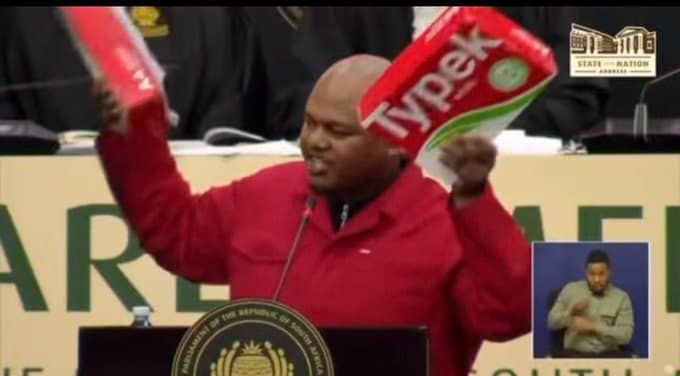
The night of Thursday, March 19, 2026, was always going to be a raucous one in the Cape Town City Hall. The annual State of the Nation Address (SONA) debate is the main political theatre of the South African calendar, a chance for parties to formally respond to the President’s address. But what began as a series of predictable partisan speeches was suddenly jolted into a moment of raw, visceral symbolism that cut through the political noise.
As the clock neared 8 p.m., Economic Freedom Fighters (EFF) Member of Parliament and convener of its powerful Youth Command, Sihle Lonzi, rose to speak. Dressed in the party’s signature red overalls and hard hat, he did not immediately launch into a policy critique. Instead, he reached down and hefted a thick stack of papers onto the podium. The thud echoed through the chamber.
“This,” Lonzi declared, his voice echoing in the suddenly hushed hall, “is not a prop. This is a cry for help.”
He held up the stack of documents. “These are Curriculum Vitaes. Real CVs. From young people in Mangaung, in Soweto, in Limpopo, in the Eastern Cape. Young people with qualifications, with dreams, with the will to work.”
With that, he stepped out from behind the podium and walked directly towards the central table where President Cyril Ramaphosa sat, listening to the debate. In a move both theatrical and deeply confrontational, Lonzi placed the thick bundle of CVs on the table in front of the President. For a moment, the weight of the gesture silenced even the usually boisterous parliamentary chamber.
“This is what the 4.6 million unemployed young people look like, President,” Lonzi said, looking directly at Ramaphosa. “They are not statistics. They are people. They are graduates, artisans, and matriculants who have been waiting years for you to act. Their future is literally in your hands.”
The moment was a deliberate and powerful counter-punch to comments made earlier in the debate by Mineral Resources Minister Gwede Mantashe. The veteran politician, known for his blunt speaking, had sparked fury by suggesting that the country’s sky-high youth unemployment was partly due to a “lazy” attitude among the young, who he claimed refused to take up available jobs in fields like mining and agriculture.
“You hear a senior minister call our young people lazy,” Lonzi thundered, turning back to the chamber. “But these CVs tell a different story. They tell of young people who have applied for hundreds of jobs, who walk kilometres to queue for positions that don’t exist, who are told they have ‘no experience’ but are given no chance to gain it. The only thing that is lazy is the government’s response to this crisis!”
The statistics he cited were devastating, painting a picture of a nation at a standstill for its youth. With 4.6 million young people between 15 and 34 not in employment, education, or training, and an unemployment rate of 57% for those aged 15-24, South Africa has one of the most dire youth unemployment crises in the world. Lonzi’s point was clear: this is not a character flaw in the youth, but a catastrophic failure of the state.
Lonzi did not stop at the parliamentary gesture. He vowed that the EFF would take this message beyond the halls of power. He announced a campaign of daily pickets outside key government departments—The Presidency, the Department of Employment and Labour, the Treasury—where EFF members would deliver bundles of CVs every single day until a meaningful response was given.
“And for the ministers who claim they don’t know where to find these young people,” Lonzi added, a wry smile playing on his lips as he looked towards the government benches, “we will be providing your real, workable email addresses to the youth so they can apply for jobs directly. Let’s see if the ‘lazy youth’ label sticks when your inbox is full every morning.”
The speech and the gesture were met with a chorus of approval from the EFF benches, who stamped their feet and chanted. On social media, the moment went viral instantly. #CVsForRamaphosa and #Lonzi trended for hours, with many praising the MP for capturing the desperation of millions in a single, tangible act.
“This is what opposition should look like,” one user tweeted. “Not just noise, but a mirror held up to power.”
However, the move was not without its critics. Some raised a practical and ethical concern: the handling of personal data. These were real CVs containing the names, addresses, ID numbers, and contact details of real, vulnerable young people. By using them as a political prop, had the EFF exposed them to potential privacy breaches? What would happen to the documents now that they had served their purpose? Others on the government side dismissed the act as a publicity stunt, arguing that real solutions required complex policy, not symbolic gestures.
President Ramaphosa, for his part, was seen leaning over to consult with a colleague after the CVs were placed before him. He did not address the gesture directly in his closing remarks, but the image of the stack of paper sitting on his table throughout the rest of the debate was an inescapable visual.
As the City Hall emptied for the night, the stack of CVs remained, a silent, powerful monument to the crisis outside. Whether it would be lost in the bureaucracy of the Union Buildings or serve as a catalyst for renewed, urgent action was the question hanging in the air. What was undeniable was that Sihle Lonzi had, for a few minutes, shifted the debate from abstract policy to human reality. He had taken the long, hopeless queues of the unemployed and placed them directly on the President’s desk, forcing the nation to confront the uncomfortable truth that for millions of its young people, the dream of a better life is a document that, so far, no one is willing to sign.
About The Author