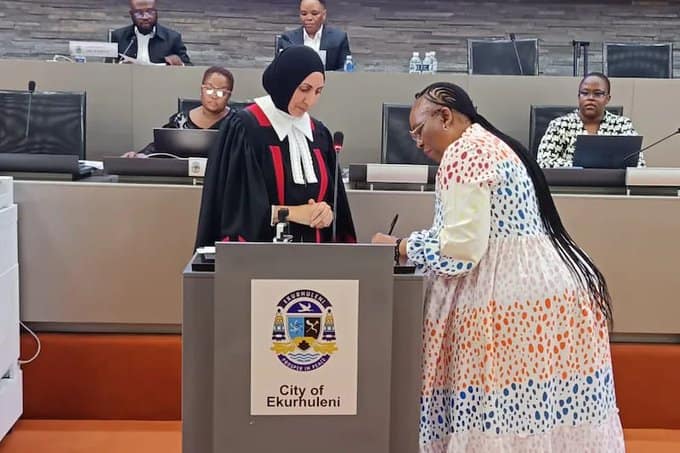
The council chamber in Ekurhuleni was a pressure cooker of tense whispers and simmering animosity. The air, thick with the scent of polished wood and political desperation, seemed to vibrate with the high-stakes vote about to be called. At the center of the storm sat Dora Mlambo, the ANC’s nominee for Council Speaker—a seasoned, formidable figure known more for her steely command of procedure than for fiery rhetoric. Her victory, when it came, was not a landslide of unity but a narrow, calculated triumph that echoed through the hall like a cracking whip, signaling not just a shift in power, but the deliberate shattering of a fragile political compact.
The backstory to this pivotal vote was a tapestry of secret meetings and broken promises. Following the last local elections, Ekurhuleni had become the quintessential hung metro—a prize fought over by a fractured political landscape. After months of turbulent negotiations, a shaky but workable coalition had been brokered. Its central pillar was an understanding between the ANC and the Economic Freedom Fighters: a power-sharing arrangement that would see key positions, including the critical Speaker’s role, distributed to maintain a precarious balance and keep the Democratic Alliance-led bloc from power.
The Accusation: A Pact in Pieces
As the councilors filed in for the vote, Julius Malema and the EFF’s leadership were already preparing their statement, their faces masks of cold fury. The agreement, they claimed, was specific. The Speaker’s gavel was to go to a candidate from a smaller party, a neutral arbiter to oversee the tense proceedings of a divided house. The ANC, according to furious EFF insiders, had agreed. Dora Mlambo’s nomination was therefore not just a surprise; it was a betrayal—a raw display of what the EFF termed “the ANC’s hereditary arrogance.”
“They have shown their true colours!” an EFF chief whip thundered to journalists in the hallway, his voice cutting through the pre-vote murmur. “They negotiated in bad faith. They used us to stabilize the metro, and now, believing they have regained their strength through these behind-the-door dealings with political mercenaries, they stab us in the back to reclaim total control. This is the ancient, corrupt ANC reflex—centralize power, sideline partners, rule alone.”
The “political mercenaries” he referred to were the smaller parties—the African Independent Congress (AIC), the Patriotic Alliance (PA), and others—whose handful of seats had become the currency of kingmaking. In the days leading up to the vote, a flurry of late-night negotiations, promises of committee chairpersonships, and whispers of future favors had seen these minority parties tilt decisively toward the ANC. Their consolidated votes provided the exact margin needed to elevate Mlambo, bypassing the EFF’s preferred candidate and, more importantly, the spirit of the coalition agreement.
The ANC’s Calculus: Stability or Supremacy?
From the ANC’s perspective, articulated by a calm but defiant regional secretary after the result, the move was one of necessary pragmatism, not treachery. “Our first duty is to the people of Ekurhuleni, not to any political agreement that paralyzes service delivery,” he stated. “The previous arrangement was untenable, a circus of obstruction. Comrade Mlambo is a woman of immense integrity and capability. She will bring order and ensure the council focuses on the work of rebuilding this city.”
The subtext was clear: the ANC, after a period of weakened authority, had successfully exploited the fractious opposition landscape. By peeling away a few small parties with targeted incentives, they had achieved two goals: first, they secured the strategic Speaker’s position, which controls the council agenda, recognizes speakers, and interprets rules—a powerful tool for governing. Second, and perhaps more devastatingly, they drove a wedge deep into the heart of the coalition that once threatened them, isolating the EFF and demonstrating that the ANC remained the ultimate center of gravity in South African politics.
The Fallout: A Metro on the Brink
The immediate aftermath was one of spectacular acrimony. The EFF, feeling publicly humiliated and strategically outmaneuvered, declared the coalition officially dead. They vowed to transition from a reluctant partner to the ANC’s most virulent opposition within the council, promising to challenge every item on the agenda, expose every perceived corruption, and turn the chamber into a theater of relentless disruption.
Dora Mlambo, holding the ceremonial gavel for the first time, now presides over a metro more divided than ever. Her victory, secured by the whispers and promises made to minority kingmakers, is a pyrrhic one. While it grants the ANC a procedural upper hand, it has unleashed a wave of political volatility. The prospect of stable, coalition-driven governance in Ekurhuleni has evaporated, replaced by the certainty of legislative trench warfare.
Analysts now watch with grim fascination. The ANC’s short-term tactical win in securing the Speaker may have come at the cost of long-term governability. They have proven they can still win the battle of the ballot in backrooms, but in doing so, they have guaranteed a council where every session will be a war. The people of Ekurhuleni, hoping for potholes to be filled and electricity stabilized, are now left with a new reality: a government where the most resonant sound is not the hum of restoring services, but the echoing thud of the Speaker’s gavel struggling to control a chamber in open revolt. The collapse was not an accident; it was a calculated play. And its repercussions will define the city’s future long after the vote was tallied.
About The Author