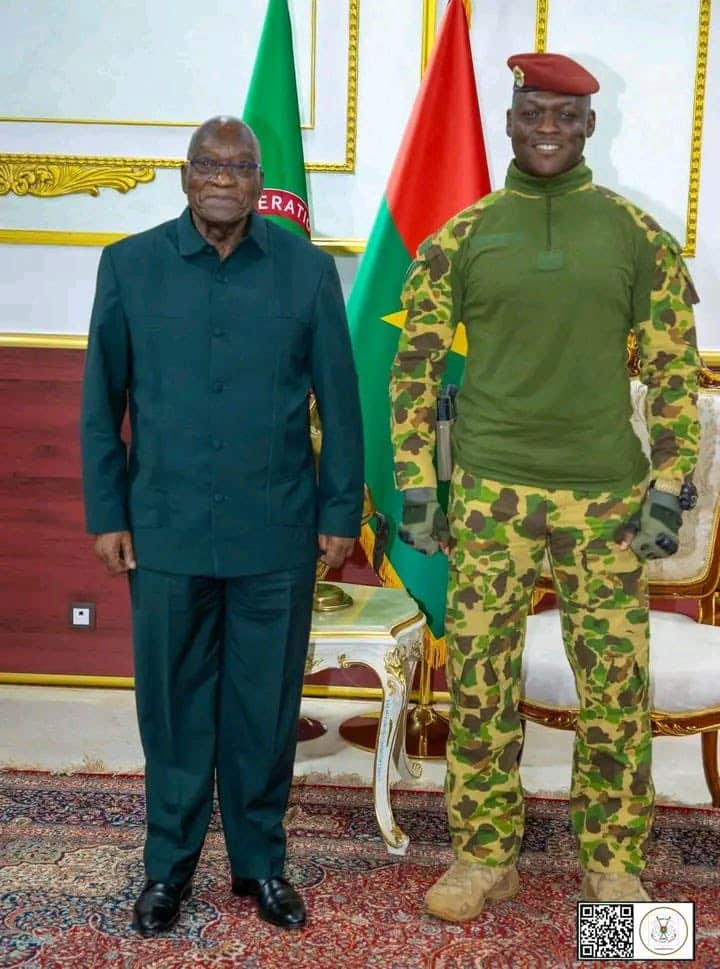
In a meeting that signals a potent alignment of political visions, former South African President Jacob Zuma was received by Burkina Faso’s transitional leader, Captain Ibrahim Traoré, for high-level bilateral talks at the Koulouba Palace in Ouagadougou on November 3, 2025. The encounter, rich with symbolism, was not merely a diplomatic formality but a strategic convergence aimed at championing a radical agenda of pan-African liberation, economic sovereignty, and resistance to foreign influence.
The meeting served as the capstone of Zuma’s high-profile visit to the West African nation, a trip designed to solidify his role as an elder statesman for a burgeoning movement that finds its contemporary epicenter in the Sahel.
Setting the Stage: The University as a Pulpit
Days before the palace meeting, Zuma laid the ideological groundwork at the University of Ouaga 1 Professor Joseph Ki-Zerbo. Before a packed auditorium of students and academics, he delivered a lecture on the history of African liberation movements, framing the continent’s current struggles as an unfinished project.
“The first phase was the fight for the flag and the anthem—our political independence,” Zuma declared, echoing themes from his own past in the anti-apartheid struggle. “But the second, and more crucial phase, is the battle for the mine, the bank, and the soil. We must ask ourselves: who owns the wealth that lies beneath our feet? Who profits from the sweat of our youth?”
This rhetoric, calling for a transfer of economic control from foreign corporations to African states, resonated deeply in a Burkina Faso still mourning the legacy of its revolutionary leader, Thomas Sankara, and now led by the populist, military-led government of Captain Traoré.
The Koulouba Palace Accord: Forging a Common Front
The subsequent meeting between Zuma and Traoré translated this ideology into a framework for cooperation. According to readouts from both delegations, the discussions were focused and substantive, centering on three key pillars:
- Economic Self-Reliance and Resource Nationalization: Both leaders vehemently criticized what they termed the “neo-colonial economic model” that sees African raw materials exported for processing and value-added abroad. They pledged to share expertise and strategies for renegotiating mining contracts and building domestic processing capacities to ensure that the continent’s mineral and agricultural wealth primarily benefits its own people.
- Regional Security and Sovereignty: In a clear reference to the growing influence of Russian paramilitary groups like Wagner (now part of the Africa Corps) and the withdrawal of French forces from the region, Zuma and Traoré commended each other’s “firm resistance to external exploitation and military imposition.” They discussed collaborative approaches to regional security that prioritize African-led solutions and reject what they perceive as conditional and self-interested foreign intervention.
- Youth Empowerment and Ideological Alignment: Recognizing that Captain Traoré’s rise was fueled by widespread youth disillusionment, the leaders agreed to launch joint programs focused on skills development and political education for the next generation. The aim is to cultivate a continent-wide youth vanguard committed to the principles of pan-Africanism and economic nationalism.
A Symbolic Handshake with Real-World Implications
The visual of the two leaders—Zuma in his signature traditional attire, representing the old guard of liberation movements, and Traoré in his military fatigues and red beret, symbolizing the new wave of “junta-preneurs”—was powerfully symbolic. Their mutual commendation for “resisting external exploitation” serves as a direct challenge to traditional Western partners and aligns with a broader geopolitical shift occurring across the Sahel and parts of Southern Africa.
For Zuma, the visit bolsters his stature as a key node in an anti-Western alliance, potentially strengthening his hand amidst his ongoing legal and political battles at home. For Traoré, the endorsement from a figure of Zuma’s continental profile lends legitimacy to his transitional government and reinforces his narrative of leading a pan-African vanguard.
The Ouagadougou meeting, therefore, transcends a simple bilateral engagement. It represents the crystallization of a political bloc defined by its defiance, its demand for resource control, and its ambition to write a new, self-determined chapter for Africa—one free from the perceived shackles of its former colonizers.
About The Author